
Reviewed · SANTA CROCE AND FLORENCE CHURCHES
Private Florence San Marco Museum Tour with Skip-the-Line Entry
The real prize here is not a grand parade of famous paintings. It is the chance to see Fra Angelico’s quiet frescoes in the monks’ cells, painted for the people who actually lived in this Dominican convent. San Marco feels personal and spare, a welcome change from Florence’s louder museums.
I like the private guide format, which lets you stop for questions instead of being swept along with a large group. I also like the early 9:00 am start, when the museum may be calmer and school groups have not yet filled the halls. The main drawback is the price: at $175.80 per person, this is a serious splurge for a two-hour visit.
Key points to know before booking
- Fra Angelico’s monks’ cells: The museum’s main attraction is a cycle of frescoes created for the Dominican friars who lived here.
- Savonarola’s former cell: Hear about the fiery monk who was executed in Florence in 1498.
- Private English tour: You get a guide for your own group, with time to ask questions and look around independently near the end.
- Skip-the-line entry: Your pre-booked ticket helps you bypass the main entrance line.
- Three Renaissance masters: The route includes works by Fra Angelico, Fra Bartolomeo, and Domenico Ghirlandaio.
- Practical timing: The tour begins at 9:00 am outside San Marco Museum and lasts about two hours.
Why San Marco feels different from Florence’s major museums
Florence has museums built around masterpieces meant to impress. San Marco works differently. You enter a former Dominican convent and see art in the spaces where monks prayed, ate, studied, and slept.
That setting matters. Fra Angelico’s paintings are not gathered in a bright gallery with long labels and crowded sightlines. Many were painted on the walls of small cells, where a friar could see them during prayer. The art feels tied to daily religious life rather than placed on display as an isolated object.
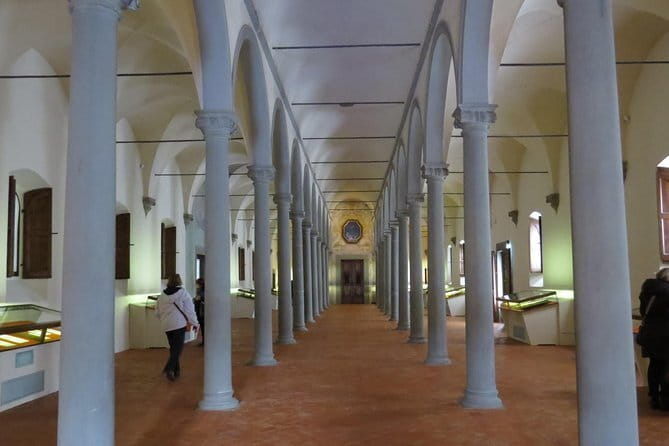
The convent was commissioned by Cosimo de’ Medici in the 1400s, and the architectural work was entrusted to Michelozzo. Dominican monks still use part of the complex, giving the museum a living connection to its original purpose.
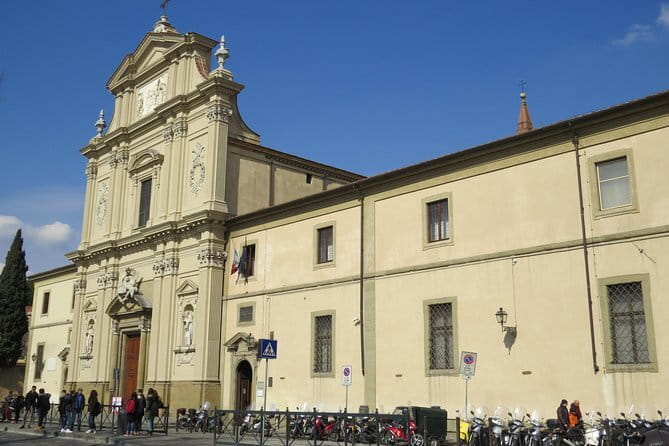
You begin outside at Piazza San Marco. This gives your guide a chance to explain the exterior, the convent’s place in Florence, and its continuing Dominican role before you enter. That short introduction helps you read the building as a working religious house, not simply another Renaissance attraction.
More churches and chapels in Florence:
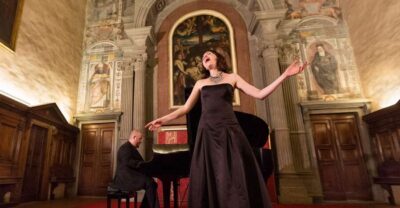
- Florence: Santa Monaca Church Italian Opera Concert Ticket
★ 4.7 · 2,692 reviews - Florence: Santa Maria Novella Entry Ticket & Audioguide
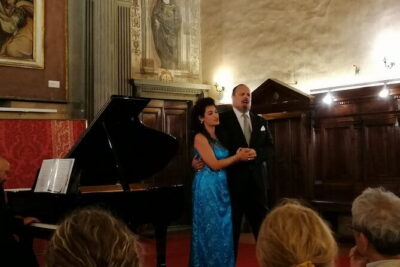
★ 4.3 · 717 reviews - Italian Opera Concert Ticket in Florence’s Santa Monaca Church
★ 4.5 · 602 reviews
Entering through the Cloister of St. Anthony
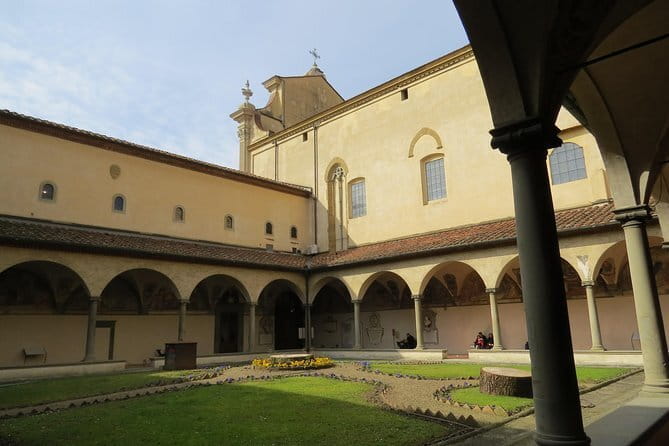
The tour starts in the Cloister of St. Anthony, an elegant open courtyard that sets the tone for the visit. From here, frescoed doors and lunettes lead toward the former convent rooms.
This is a good place to listen closely. The building’s layout tells you how the Dominican community functioned. Instead of rushing directly to the best-known paintings, you move through the structure in a way that connects architecture, worship, work, and community life.
The private format is especially useful here. A guide can explain what you are looking at without forcing the whole group to move on after a fixed number of seconds. If you care about Renaissance art, this is where you can ask how Fra Angelico’s work fits into the convent, or how the rooms were used by the friars.
Skip-the-line entry is helpful, but keep your expectations sensible. It lets you bypass the main entrance line. It does not turn the museum into a private building or guarantee that every room will be empty.
Fra Angelico’s frescoes in the monks’ cells
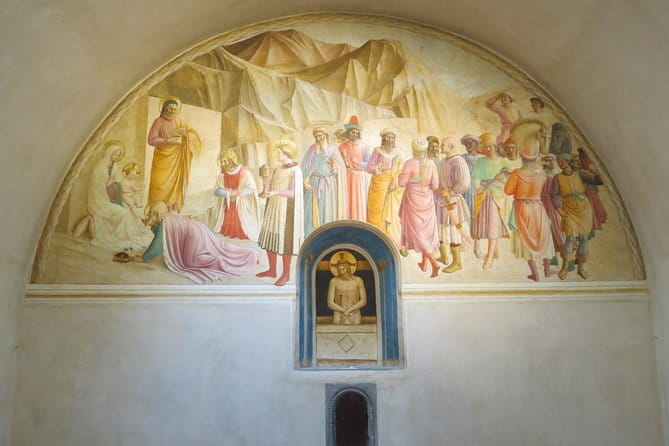
The upstairs cells are the emotional center of the visit. Fra Angelico, also called Beato Angelico, created a cycle of frescoes for his fellow Dominican monks. These are not giant altar paintings designed to dominate a cathedral. They are intimate works made for contemplation.
You will see the paintings in small rooms rather than one grand gallery. That scale changes how you look. The scenes ask for patience, and the simple surroundings keep your attention on the figures, gestures, and religious subjects.
A strong guide makes a clear difference here. The art can seem modest at first if you expect the theatrical impact of Florence’s largest masterpieces. Once you understand that each image served a spiritual purpose for a friar in his cell, the rooms make much more sense.
Hilaria has guided this experience and is particularly strong on Fra Angelico and the convent. If you are assigned a different guide, the tour is still designed around an explanation of the art and the building, with time for questions.
Morning is the smart choice if your schedule allows it. The 9:00 am departure has the advantage of getting you inside before the museum becomes busier with school groups. You should not count on total quiet, but the early start can make it easier to study the frescoes at close range.
The refectories, kitchen, and service rooms
The route continues to the Great Refectory, where you see works by Fra Bartolomeo, another Dominican painter from the early 1500s. A refectory was the dining room, so this stop brings you back to the practical side of convent life.
You also visit the kitchen and service areas. These rooms may not have the instant fame of the painted cells, but they help you picture the daily work behind the religious community. San Marco is strongest when it shows both the art and the ordinary spaces that supported it.
Next comes the Small Refectory, home to Domenico Ghirlandaio’s Last Supper. Ghirlandaio was a major Florentine artist, and this fresco gives you a useful comparison with Fra Angelico. The two artists worked within the religious world, but their approaches and periods were different.
The room also helps explain why a private guide is worth considering. Without context, you may simply see another Last Supper scene. With a guide, you can connect the painting to the refectory, the convent, and the broader tradition of decorating dining rooms in religious houses.
More skip-the-line tickets in Florence:
- Florence: Skip-The-Line Uffizi Gallery Timed Entry Ticket
★ 4.5 · 27,832 reviews - Florence: Michelangelo’s David Skip-the-Line Entry Ticket
★ 4.5 · 12,764 reviews - Florence: Skip-the-Line Uffizi Small Group Tour
★ 4.6 · 5,926 reviews - Skip the line: Uffizi and Accademia Small Group Walking Tour
★ 4.5 · 3,135 reviews
Savonarola’s cell and a fiery Florentine story
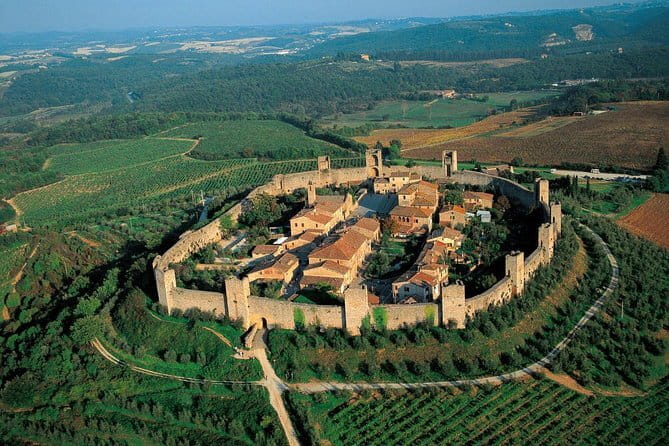
One cell is linked to Girolamo Savonarola, the Dominican friar who became one of Florence’s most controversial religious and political figures. He preached fiercely against what he saw as moral decay and excess, gained major influence, and was executed in Piazza della Signoria in 1498.
The cell itself is not a grand memorial. That is part of its interest. You are looking at a small, functional space associated with a man whose voice once shook the city.
Your guide can place Savonarola within the convent’s story rather than treating him as a separate historical character. The result is a sharper picture of San Marco: this was not only a place where artists painted beautiful religious scenes. It was also a home for men engaged in intense debates about faith, power, reform, and Florence’s future.
If you have already seen Piazza della Signoria, the connection adds another layer to the city. If you have not, you will still understand why Savonarola’s story belongs in this museum.
The Library and the Medici connection
The museum visit ends in the Library, a particularly atmospheric final stop. It contains valuable manuscripts once owned by the Medici family.
This is a quieter part of the tour, and it rewards visitors who enjoy books, preservation, and the practical side of Renaissance culture. The Medici connection also becomes clearer here. Their support helped shape San Marco, not only through money for the building but through the intellectual and artistic life associated with it.
The Library may not be the first thing that draws you to San Marco, but it rounds out the visit. You leave with more than a set of frescoes in mind. You have seen a convent shaped by religious devotion, Dominican scholarship, Medici patronage, and Florentine politics.
A short walk through two important squares
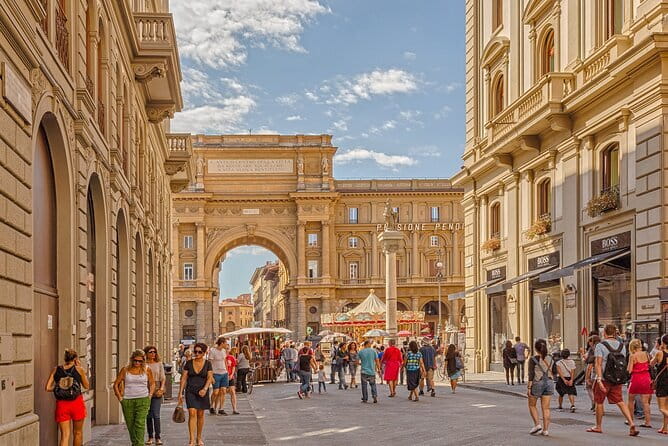
After the museum, the guide takes you outside for about 15 minutes around Piazza San Marco and Piazza della Santissima Annunziata. This exterior portion is brief, but it adds useful orientation.
Piazza San Marco is the convent’s immediate setting. The nearby Santissima Annunziata square includes the Santissima Annunziata church and the Spedale degli Innocenti, described as Europe’s oldest orphanage.
Do not book this experience mainly for the outdoor portion. The museum accounts for about an hour and 45 minutes, while the square walk lasts about 15 minutes. Think of the walk as a tidy extension that helps you place San Marco within central Florence.
It is also convenient for planning the rest of your day. After saying goodbye near the starting point, you are already close to other major sights in the historic center. The tour does not include hotel pickup or drop-off, so you make your own way to Piazza San Marco.
What the private format adds
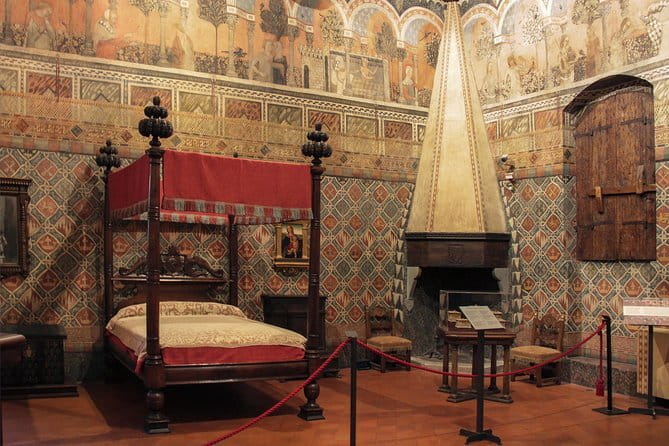
This is a private activity, so only your group participates. That makes the $175.80 price easier to justify for families or friends who want a more focused visit, especially if the cost can be shared across a group.
You are not paying only for entrance. The fee also covers the skip-the-line San Marco ticket and a professional local guide. For a first visit, that combination can prevent the museum from feeling like a series of disconnected rooms.
The private format also lets you ask questions suited to your interests. You may care most about Fra Angelico, Savonarola, Dominican life, Renaissance architecture, or the Medici family. A fixed group tour has less room to adjust.
There are limits. The tour lasts about two hours, so it is not an all-day art lesson. If you want a slow, scholarly reading of every fresco, you may wish you had more time. The structure does give you independent time near the end, allowing you to look around on your own after the guided explanation.
Earphones are supplied for groups larger than seven participants. Since the activity is private, this matters mainly if your own party is sizable.
Price, timing, and the booking details that matter
At $175.80 per person, this tour sits in the premium range for a short Florence museum visit. I would not recommend it to someone who simply wants to enter San Marco as cheaply as possible.
I would consider it good value if you care about understanding what you see. San Marco is not always self-explanatory, and the connection between the rooms, the artwork, the Dominican community, and Savonarola is a major part of its appeal. The guide turns a quiet convent museum into a readable story.
The 9:00 am start is another reason to book carefully. You meet outside Museo di San Marco at Piazza San Marco, 3, in Florence. The museum is near public transportation, but you still need to arrive at the meeting point on time.
Booking tends to happen well ahead, with this experience often reserved about 33 days in advance. That is useful planning information if your Florence dates are fixed. You also need to provide the full names of everyone in your group.
Each person must bring a valid passport or identity document matching the name given at booking. The ticket office may deny entry if the voucher does not show every traveler’s full name, so treat those details as essential, not paperwork to handle later.
The ticket is mobile, which is convenient. The experience is non-refundable and cannot be changed after purchase, so confirm your date, names, and meeting point before paying.
Who should book this San Marco visit
I would choose this tour for:
- Art lovers who want Fra Angelico explained in the place where he worked and lived.
- First-time Florence visitors who prefer a guide to connect architecture, art, and history.
- Families or small groups who want to ask questions without joining a large public tour.
- Visitors who like quieter museums and religious buildings more than crowded blockbuster galleries.
- Anyone curious about Savonarola and the less polished side of Renaissance Florence.
I would think twice if you want a broad survey of Florence’s major art. This visit concentrates on one convent and its artists. You will not see the Uffizi’s large collection or the Accademia’s David.
I would also reconsider it if your schedule cannot handle a firm morning appointment. Since the ticket cannot be refunded or changed, the booking requires care.
Should you book the Private Florence San Marco Museum Tour?
Book it if you want a focused, personal look at one of Florence’s most distinctive museum settings, especially if Fra Angelico’s frescoes are high on your list. The early start, skip-the-line entry, and private guide make the visit efficient without stripping away its quiet mood.
The strongest reason to go is the combination of art and place. You see the cells where Dominican friars lived, the refectories where they ate, the spaces linked to Savonarola, and the Library connected with the Medici family. That is far more revealing than viewing the paintings without their setting.
Skip it if $175.80 feels too steep for two hours, or if you mainly want famous standalone masterpieces. San Marco asks you to slow down and pay attention to rooms, context, and religious life. For the right visitor, that is exactly the point.
FAQ
Where does the tour begin?
You meet your guide outside Museo di San Marco at Piazza San Marco, 3, 50121 Florence, Italy.
What time does the tour start?
The tour starts at 9:00 am.
How long does the experience last?
The full experience lasts about two hours. Approximately one hour and 45 minutes is spent at the San Marco Museum, followed by about 15 minutes around Piazza San Marco and Piazza della Santissima Annunziata.
Is museum admission included?
Yes. Skip-the-line tickets for San Marco Museum are included.
Is this a private tour?
Yes. Only your own group participates in the activity.
What identification do I need to bring?
Every traveler must bring a valid passport or identity document matching the name provided at booking. You must also provide the full names of all travelers when reserving the tour.
More museums and galleries in Florence
- Florence: Leonardo Interactive Museum Entry Ticket
★ 4.5 · 11,763 reviews - Florence Accademia Gallery Tour with Entrance Ticket Included
★ 4.5 · 6,148 reviews - Uffizi Gallery Small Group Tour with Guide
★ 4.5 · 4,923 reviews - Florence: Accademia Gallery Guided Tour
★ 4.6 · 4,156 reviews
Recently added around Florence
- Accademia and Uffizi Small-group Guided Tour★ 4.5 · 8 reviews
- The David from Michelangelo.★ 5.0 · 3 reviews
- The Complete Wine Tour Brunello, Nobile, Chianti wine experience★ 4.0 · 7 reviews
- Combo: Accademia + walking + Uffizi Galleries Guided Tour★ 3.5 · 6 reviews
- The Best of Tuscany in 3 Days★ 4.5 · 13 reviews
- The Cooking Lab – Authentic Food Experience★ 5.0 · 113 reviews
- Florence Central Market Food Tour – Private Tour★ 4.0 · 7 reviews
- Family Friendly Florence Private City Tour★ 5.0 · 47 reviews
Santa Croce and Florence Churches, compared.
Santa Monaca Church Italian Opera Concert Ticket
Read our review →
Italian Opera Concert Ticket in Florence’s Santa Monaca Church
Read our review →
Browse the lists this tour appears in