
Reviewed · SANTA CROCE AND FLORENCE CHURCHES
Florence: Access to the Brancacci Chapel
The Brancacci Chapel packs a major turning point in Renaissance art into one small, richly painted room. In 50 minutes, you see the Stories of Saint Peter close up and learn how Masaccio changed painting with stronger space, weight, and human feeling.
I like the special access through the cloister and the focus on three artists rather than a quick look at one famous wall. I also like the short format, which fits neatly into a busy Florence day. The main drawback is that the English explanation can feel dense, and one recent visitor found the guide difficult to hear without an audio guide.
Key points to know before you book
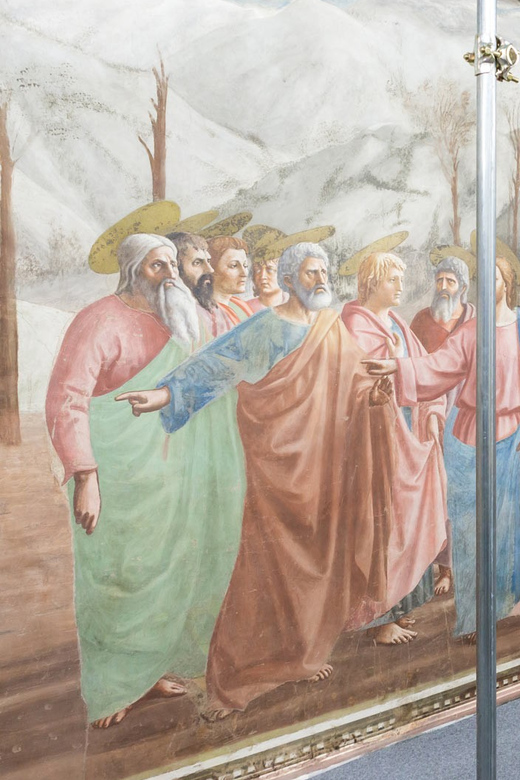
- Masaccio is the main reason to come: Follow the young artist’s bold changes to space, figures, and storytelling.
- Three masters share the chapel: Masolino da Panicale began the work, Masaccio transformed it, and Filippino Lippi later completed it.
- The entrance is easy to miss: Go to Piazza del Carmine 14 and use the entrance leading to the cloister of Santa Maria del Carmine.
- The tour lasts 50 minutes: That is enough for a focused introduction, but not a leisurely art-history lecture.
- The guide speaks English: The cultural mediator explains the frescoes live, though clear hearing may depend on where you stand.
- Leave your backpack behind: Comfortable shoes are allowed and sensible, but backpacks are not permitted.
Why the Brancacci Chapel matters in Florence
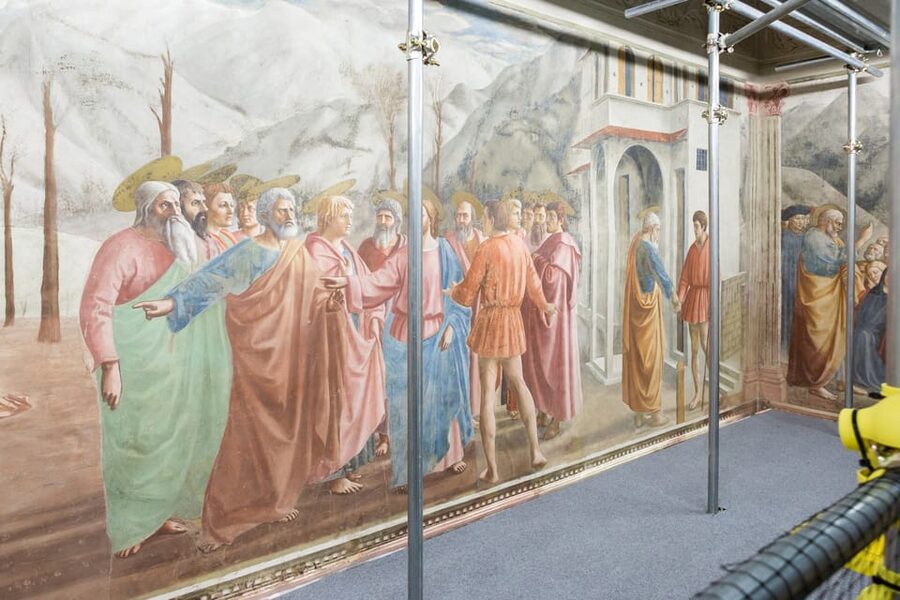
Florence has no shortage of famous paintings. The Brancacci Chapel earns its place on your list because it shows a new way of telling a sacred story.
The subject is the life of Saint Peter, one of Christianity’s key apostles. The scenes were commissioned by Felice Brancacci and painted over time by Masolino da Panicale, Masaccio, and later Filippino Lippi. That change of hands gives the chapel unusual value. You are not looking at one artist’s single style. You are watching Renaissance painting develop across the walls.
Masaccio, whose real name was Tommaso, worked at the start of the 15th century and died young. His nickname was linked by Giorgio Vasari to his careless nature, but his art was anything but careless. He brought a new sense of structure to figures and scenes. Bodies feel planted. Spaces feel built. Events seem to happen in a believable world rather than on a flat decorative surface.
I find that context useful because it changes the way you look. Instead of simply asking which fresco is prettiest, you can ask what Masaccio did differently. How does he make a figure occupy space? How does light help explain a scene? How does a group of people react to one event?
More churches and chapels in Florence:
- Florence: Santa Monaca Church Italian Opera Concert Ticket
★ 4.7 · 2,692 reviews - Florence: Santa Maria Novella Entry Ticket & Audioguide
★ 4.3 · 717 reviews - Italian Opera Concert Ticket in Florence’s Santa Monaca Church
★ 4.5 · 602 reviews
Entering through Santa Maria del Carmine’s cloister
Your meeting point is Piazza del Carmine 14. The important detail is that you do not enter through just any church door. Access to the chapel is through the entrance leading to the cloister of the Church of Santa Maria del Carmine.
That instruction matters in a busy city where several entrances may appear to serve the same complex. Give yourself enough time to find the correct doorway. The supplied meeting information does not describe a transfer or a separate meeting location, so you should plan to arrive directly at the piazza.
The cloister sets a quieter tone before the chapel itself. It also reminds you that this is not a stand-alone gallery attraction. The frescoes belong to a religious complex, and the route through the convent helps explain their original setting.
Wear comfortable shoes. The visit is short, but you will spend much of it standing while looking upward and shifting your attention from one scene to another. Backpacks are not allowed, so carry only what you need in a permitted smaller bag.
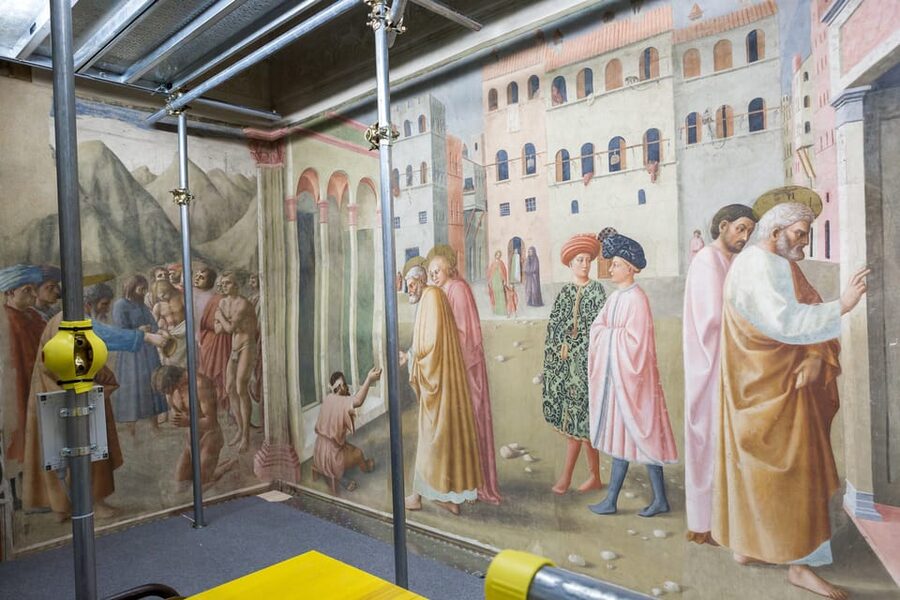
Seeing the Stories of Saint Peter up close
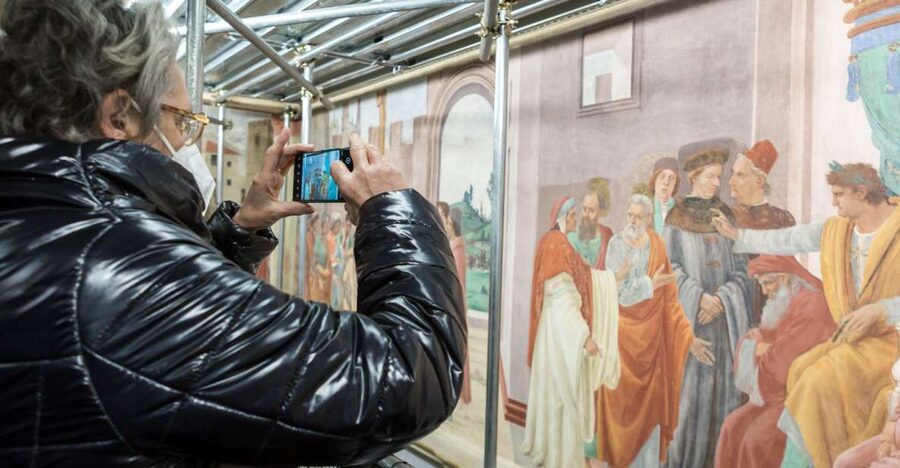
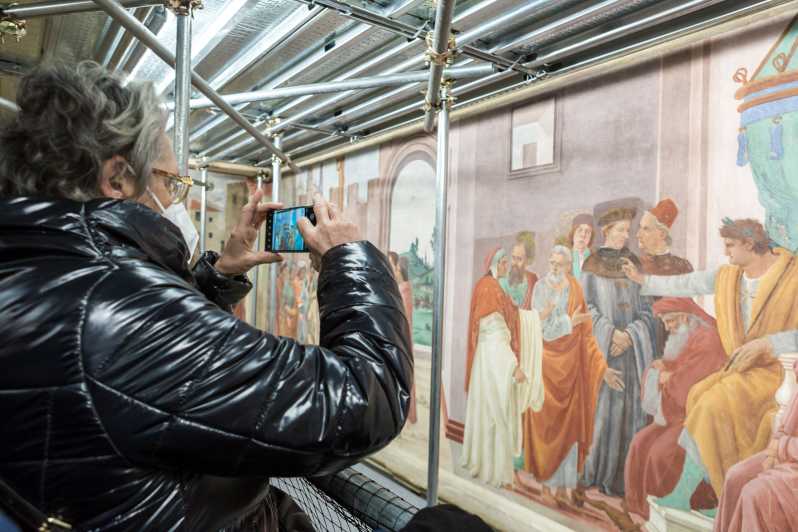
The tour centers on the fresco cycle known as the Stories of Saint Peter. Your cultural mediator guides your attention through the scenes and points out the artistic choices that can be hard to spot on your own.
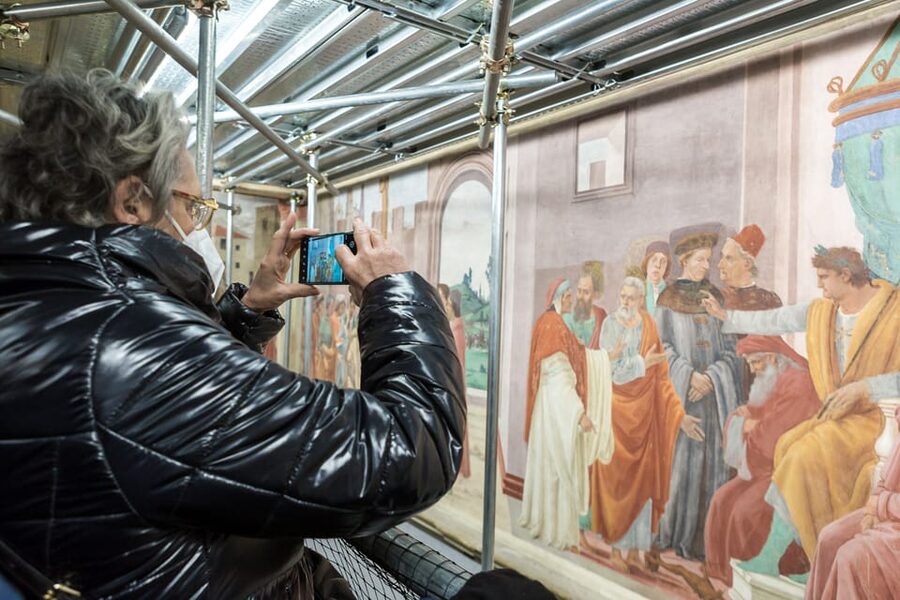
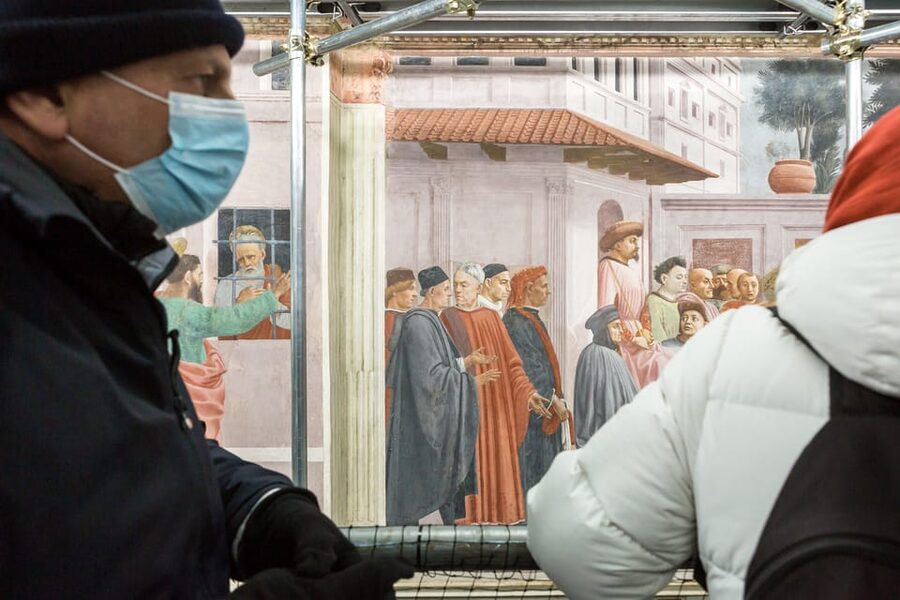
At close range, you can inspect details that disappear in a quick pass. Look at the faces, the gestures, the way figures overlap, and the way architecture frames the action. The goal is not simply to identify Saint Peter. It is to understand how the artists organize a crowded story so your eye knows where to go.
Masaccio’s contribution is especially important. His figures have a solid presence, and his scenes show a growing interest in believable space. The explanation focuses on his stylistic and structural innovations, so expect discussion of how the paintings work, not only what they depict.
That makes this visit a better choice for you if you like learning how art is made. If you prefer to wander silently and take photographs without commentary, the guided format may feel more directed than you want.
The close viewing distance is a real advantage. Frescoes can look simple from across a large church, but small decisions become clearer when you are near the surface. A hand, a turn of the head, or a line of architecture may carry part of the story.
Three artists, one evolving project
Masolino da Panicale began the chapel’s decoration. His work helps establish the earlier phase of the project and gives you a point of comparison for Masaccio’s approach.
Masaccio then introduced the changes that made the cycle famous. The young Tommaso is the artist to watch if you want to understand why the chapel matters to Renaissance art. The explanation highlights his new handling of form, space, and narrative structure.
Filippino Lippi completed parts of the work later. His presence means the chapel is also a record of changing artistic taste. You can compare the different hands rather than treating every section as if it came from the same moment.
I like this three-artist structure because it gives your visit a clear thread. You begin with the commission and the early work, move toward Masaccio’s breakthrough, and finish with Filippino Lippi’s contribution. The chapel becomes a lesson in artistic change without needing a full day of lectures.
The names may sound familiar from other Florence museums and churches, but this setting gives them a direct connection. You see how major artists worked within the same sacred space and responded to an ongoing project.
A completely different way to spend an afternoon in Florence:
- Florence: Skip-The-Line Uffizi Gallery Timed Entry Ticket
★ 4.5 · 27,832 reviews - Tuscany Day Trip from Florence: Siena, San Gimignano, Pisa and Lunch at a Winery
★ 5.0 · 21,634 reviews - Florence: Timed Entrance Ticket to Michelangelo’s David
★ 4.6 · 16,983 reviews - Florence: Michelangelo’s David Skip-the-Line Entry Ticket
★ 4.5 · 12,764 reviews
What the 50-minute format does well
Fifty minutes is a practical length. It is long enough for a focused explanation of the fresco cycle, yet short enough to pair with other sights in Florence.
You can fit the visit between larger plans without surrendering half a day. That matters in Florence, where the Uffizi, Accademia, churches, markets, and walks along the Arno can quickly fill your schedule.
The limit is also clear. A 50-minute tour cannot cover every scene, artist, and technical detail in equal depth. The guide needs to choose what matters most. One recent booking described the guide as charming and competent but too long-winded for the time available. That is useful advice: expect a concentrated talk, and do not assume every question can receive a long answer.
Hearing is another practical concern. The same account noted that the guide was hard to hear without an audio guide. No audio guide is listed as included, so stand as close to the guide as appropriate and avoid drifting toward the back of the group. If you have difficulty hearing spoken explanations, the visual experience may be stronger than the commentary.
The English-only format is also worth noting. The activity is offered in English, and another recent booking expressed interest in a Japanese-language option. If Japanese interpretation is important to you, this is not the right match based on the information available.
Is $36 a fair price?
At $36 per person, this is not a casual add-on for a quick look inside a church. You are paying for special access to the Brancacci Chapel and a live English explanation centered on some of Florence’s most important Renaissance frescoes.
The value depends on how much guidance you want. If you already know Masaccio’s work and feel comfortable reading art independently, the price may seem high for a 50-minute visit. You could prefer a simple admission option if one suits your plans, but that alternative is not described here.
For you, the price makes more sense if the chapel is a priority and you want help reading the scenes. A cultural mediator can direct your eyes to structural choices that are easy to miss. That can turn a short visit into a much clearer art lesson.
The price also buys time efficiency. You do not need to prepare a long explanation for yourself before arriving. The guide supplies a route through the chapel and connects the three artists.
I would view it as good value for a visitor with a serious interest in Renaissance painting, and fair value for anyone who wants a focused cultural stop. It is less attractive if you want a relaxed, unstructured visit or if $36 feels too steep for less than an hour.
Who will enjoy this chapel visit most?
I would recommend it to art-minded visitors, first-time Florence visitors who want context, and anyone who prefers a small specialist sight over another large museum.
It suits you especially well if you:
- Want to understand why Masaccio is important, not just see his name on a label.
- Like guided explanations of composition, space, and artistic technique.
- Have a limited schedule and want a short cultural stop.
- Appreciate seeing several artists in one connected project.
- Are comfortable standing and listening for most of the visit.
You may want to skip it if you dislike guided commentary, need interpretation in a language other than English, or cannot leave a backpack behind. The chapel’s fame comes from close looking, so it rewards patience more than rapid sightseeing.
Practical planning for your visit
Plan to meet at Piazza del Carmine 14 and look for the entrance leading to the cloister of Santa Maria del Carmine. Do not assume the first church entrance you see is the correct one.
Wear comfortable shoes, since you may be standing while listening and looking upward. Leave your backpack behind because backpacks are not allowed.
The activity offers free cancellation up to 24 hours before the start time, with a full refund. You can also reserve now and pay later, which helps if your Florence schedule is still changing.
Starting times depend on availability. Check the available slot before you plan other attractions around it. Since the duration is only 50 minutes, it can work well as a morning or afternoon appointment, but you should leave enough time to find the cloister entrance.
The live tour is in English. The provider is Associazione MUS.E, Palazzo Vecchio, and the explanation is delivered by a cultural mediator rather than through a listed self-guided audio program.
Should you book the Brancacci Chapel access?
Book it if you want a close look at Masaccio’s art with a guide who can explain how the frescoes changed Renaissance painting. The chapel’s combination of Masolino, Masaccio, and Filippino Lippi gives you more to compare than a single-artist stop.
Think twice if you want total freedom, need a non-English tour, or find a 50-minute guided explanation too compressed. Hearing may also be difficult if you are not near the guide, so stay attentive to your position in the group.
For most art lovers, the special access and focused subject justify the $36 price. I would place it high on a Florence list for anyone who wants a small, serious art experience instead of another crowded major museum.
FAQ
Where does the Brancacci Chapel experience meet?
The meeting point is Piazza del Carmine 14 in Florence. Access is through the entrance leading to the cloister of the Church of Santa Maria del Carmine.
How long does the activity last?
The visit lasts 50 minutes.
What language is the tour in?
The live tour is conducted in English.
Who provides the experience?
The experience is provided by Associazione MUS.E, Palazzo Vecchio.
Which artists are connected with the chapel frescoes?
The frescoes are connected with Masolino da Panicale, Masaccio, and Filippino Lippi.
What subject do the frescoes show?
The frescoes depict the Stories of Saint Peter.
Can I bring a backpack?
No. Backpacks are not allowed.
What should I wear?
Comfortable shoes are recommended.
Can I cancel for a refund?
Yes. You can cancel up to 24 hours in advance for a full refund.
Recently added around Florence
- Accademia and Uffizi Small-group Guided Tour★ 4.5 · 8 reviews
- The David from Michelangelo.★ 5.0 · 3 reviews
- Combo: Accademia + walking + Uffizi Galleries Guided Tour★ 3.5 · 6 reviews
- The Complete Wine Tour Brunello, Nobile, Chianti wine experience★ 4.0 · 7 reviews
- The Best of Tuscany in 3 Days★ 4.5 · 13 reviews
- The Cooking Lab – Authentic Food Experience★ 5.0 · 113 reviews
- Florence Central Market Food Tour – Private Tour★ 4.0 · 7 reviews
- Family Friendly Florence Private City Tour★ 5.0 · 47 reviews
Santa Croce and Florence Churches, compared.
Santa Monaca Church Italian Opera Concert Ticket
Read our review →
Italian Opera Concert Ticket in Florence’s Santa Monaca Church
Read our review →
Basilica Santa Croce: Walking Among the Masters of Florence
Read our review →Browse the lists this tour appears in