
Reviewed · SANTA CROCE AND FLORENCE CHURCHES
Florence: Santa Croce Church Tour with Entry Ticket
Santa Croce is Florence’s church of famous names, but the real pleasure is seeing how those names fit into the building around them. You’ll pass Michelangelo, Machiavelli, Galileo, Dante’s monument, Giotto’s frescoes, Donatello’s sculpture, and Brunelleschi’s chapel in one carefully guided visit.
I like the art-to-history connection here: a good guide explains not only what you’re looking at, but why it mattered. I also like the focused length, about an hour inside the church, which gives you useful context without taking half a day from Florence.
The main consideration is dress. Your shoulders and knees must be covered, and visitors refused for unsuitable clothing receive no rescheduled tour or refund. The guide quality is a major part of the experience, and names praised for clear, lively tours include Lara, Marcello, Viviana, Guido, Ilaria, Marie, Helena, and Leonardo.
Key points at a glance
- Michelangelo, Galileo, and Machiavelli: See the burial places of three major figures from Italian art, science, and political thought.
- Giotto’s Bardi and Peruzzi Chapels: Look closely at frescoes showing scenes from the lives of Saint Francis and Saint John the Evangelist.
- Brunelleschi’s Chapel of Fools: Notice the calm proportions and clean architectural design of this important Renaissance space.
- The 1966 flood: Learn how floodwater damaged the church’s art and how restoration work brought much of it back.
- Calcio Storico setting: Begin in the square where Florence’s rough medieval-style football match takes place each June.
- Optional wine tasting: Add Tuscan wines and a platter of local appetizers after the church visit.
Why Santa Croce deserves an hour of your Florence time
Santa Croce is the principal Franciscan church in Florence, and it is often called the temple of the Italian Glories because so many important Italians are commemorated here. That nickname can sound grand, but once you are inside, the reason becomes clear.
This is not just a church with a few famous tombs placed along the walls. It is a record of Florence’s artistic and intellectual life. Religion, painting, sculpture, architecture, literature, science, and politics all meet under one roof.
I find that Santa Croce rewards a guided visit more than a quick walk-through. The building contains plenty of visual information, and it is easy to glance at a fresco or monument without understanding its place in the larger story. A guide gives you a route through the church and helps you decide what deserves your attention.
The price is about $54.66 per person. That is not a bargain for simple entry, since the ticket alone would not provide the same level of explanation. The value comes from the reserved admission, live guide, radio system, and the chance to ask questions while standing in front of the art.
If you already have a strong background in Renaissance art and prefer to move at your own speed, you may find the tour more structured than necessary. For most visitors, though, Santa Croce is a better use of time with a guide, particularly if this is your first visit to Florence.
More churches and chapels in Florence:
- Florence: Santa Monaca Church Italian Opera Concert Ticket
★ 4.7 · 2,692 reviews - Florence: Santa Maria Novella Entry Ticket & Audioguide
★ 4.3 · 717 reviews - Italian Opera Concert Ticket in Florence’s Santa Monaca Church
★ 4.5 · 602 reviews
Starting in the square beside Santa Croce
The tour begins at Largo Piero Bargellini, near the Monument to Dante Alighieri, although the exact meeting point can vary with the option you book. Pay attention to the meeting instructions, because the tour returns to the same general meeting point at the end.
The opening setting adds a useful piece of local flavor. The square is associated with the annual Calcio Storico Florentino, Florence’s famous football match played in medieval costume each June. This is not modern football. The tradition is rough, physical, and tied to the city’s old neighborhoods and civic identity.
Your guide uses the square to set up the visit before you enter. That matters because Santa Croce is not an isolated monument. It belongs to a part of Florence where religious life, public ceremony, local pride, and major artistic commissions have overlapped for centuries.
The radio system is a practical benefit. Churches can be large and echoing, and groups often spread out around a chapel or monument. With the radio, you can look at the artwork instead of keeping your eyes fixed on the guide.
Entering the basilica and its major works
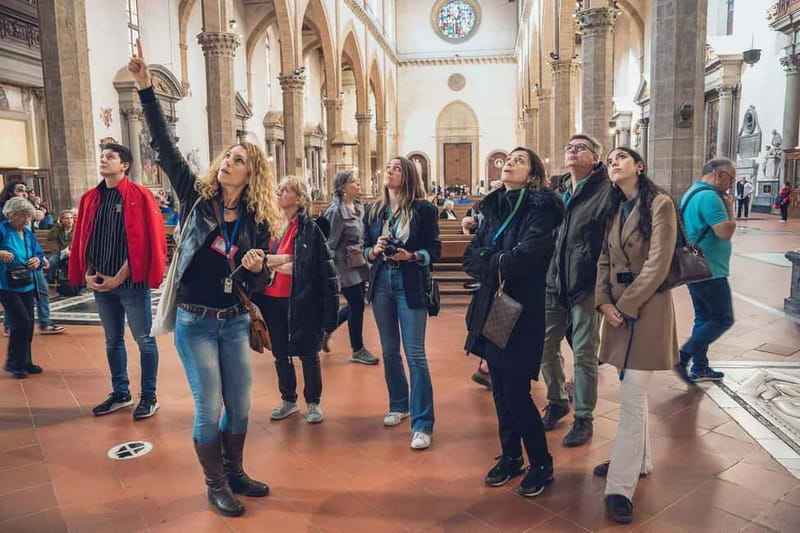
Once inside, expect a guided walk through the church’s central spaces, chapels, monuments, cemetery area, crypt, and bell tower area. The supplied tour description lists the 16 chapels, but the amount of time available for each will depend on the pace and the day’s conditions.
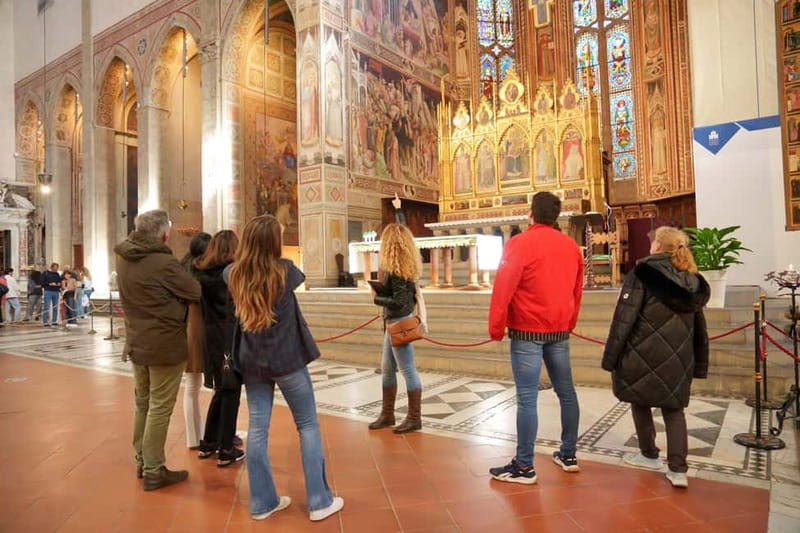
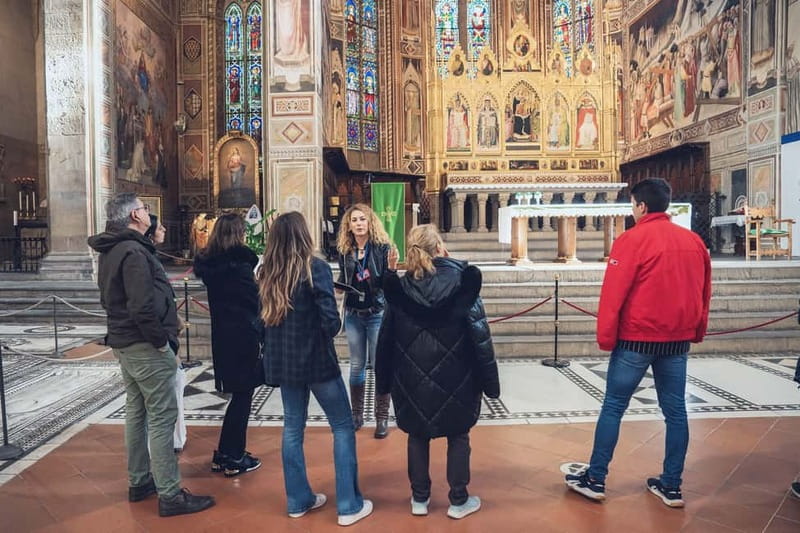
The Cappella Maggiore is one of the first major artistic stops. Its frescoes by Gaddi, dated to 1380, tell the story of Santa Croce. You get a sense here of how medieval and early Renaissance churches used painted walls to communicate religious stories to people who could not read easily.
The guide can point out how the scenes are organized and how the chapel functions as both a place of worship and a large-scale picture cycle. If you only glance upward, you may miss the sequence and the details that make the decoration meaningful.
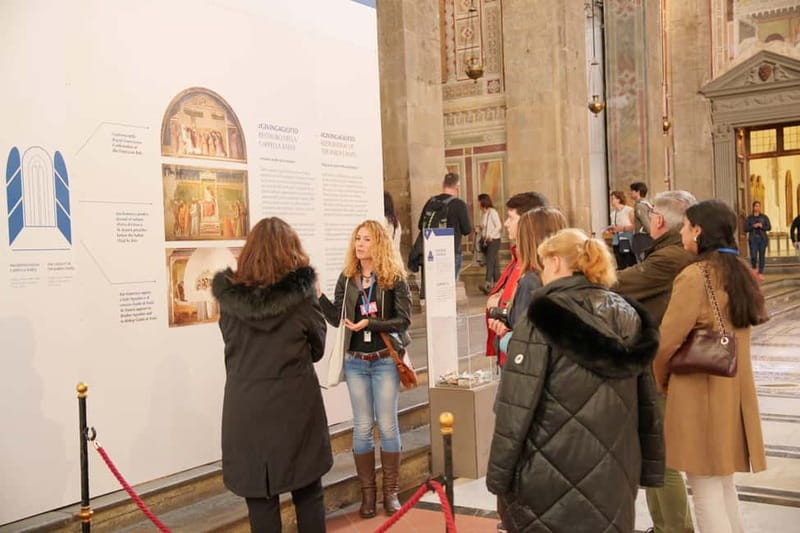
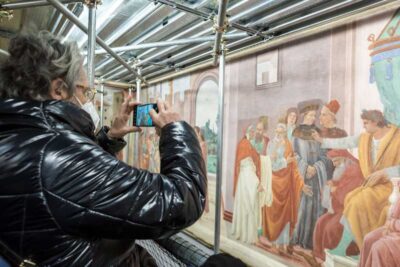
The Bardi and Peruzzi Chapels contain frescoes by Giotto. They show episodes from the lives of Saint Francis and Saint John the Evangelist. Giotto’s work is especially useful for understanding the shift toward more human, readable figures in Italian painting.
Your guide may compare the scenes, explain the figures, and give you enough background to read the action. This is where the radio is handy again. You can stand back to see the full wall, then move closer when the guide directs your attention to a particular detail.
Giotto’s chapels and the art of looking slowly
Giotto’s frescoes deserve time, but a guided tour cannot linger forever. I suggest looking first at the overall arrangement, then at faces, gestures, and the way the figures occupy the painted space.
The church’s art can feel dense at first. There are tombs, altars, paintings, chapels, carved details, and memorials competing for your eye. The guide’s job is to reduce that visual noise and identify the few works that explain the building best.
The strong point of this tour is the interpretive layer. The guides praised for this experience, including Lara, Marcello, Viviana, Guido, Ilaria, and Leonardo, are described as clear, personable, and able to connect individual pieces with the wider story of Florence. That kind of explanation is more useful than a list of dates.
A small group, when available, also helps. You can ask a question, share an observation, and hear the answer without interrupting a large crowd. Group size is not promised, so do not book on the assumption that you will receive a private tour.
More tickets and passes in Florence:
- Florence: Skip-The-Line Uffizi Gallery Timed Entry Ticket
★ 4.5 · 27,832 reviews - Florence: Timed Entrance Ticket to Michelangelo’s David
★ 4.6 · 16,983 reviews - Florence: Michelangelo’s David Skip-the-Line Entry Ticket
★ 4.5 · 12,764 reviews - Florence: Leonardo Interactive Museum Entry Ticket
★ 4.5 · 11,763 reviews
Michelangelo, Machiavelli, Galileo, and Dante
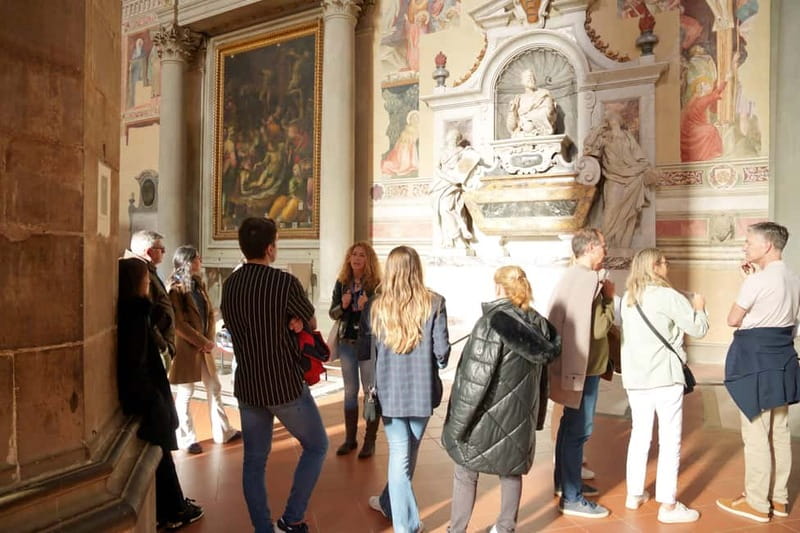
Santa Croce is famous for its tombs and memorials, and the guide spends time explaining the people behind them.
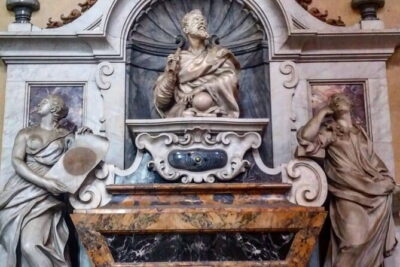
Michelangelo’s burial place connects the church to one of Italy’s most recognizable artists. Even if you have already seen his work elsewhere in Florence, the memorial gives you a chance to consider the public reputation built around his life and art.
Machiavelli represents a different side of the Italian story. He is linked with political thought rather than sculpture or painting. Galileo brings science into the church’s collection of celebrated names. Together, these memorials make Santa Croce feel less like a single-theme religious site and more like a national pantheon.
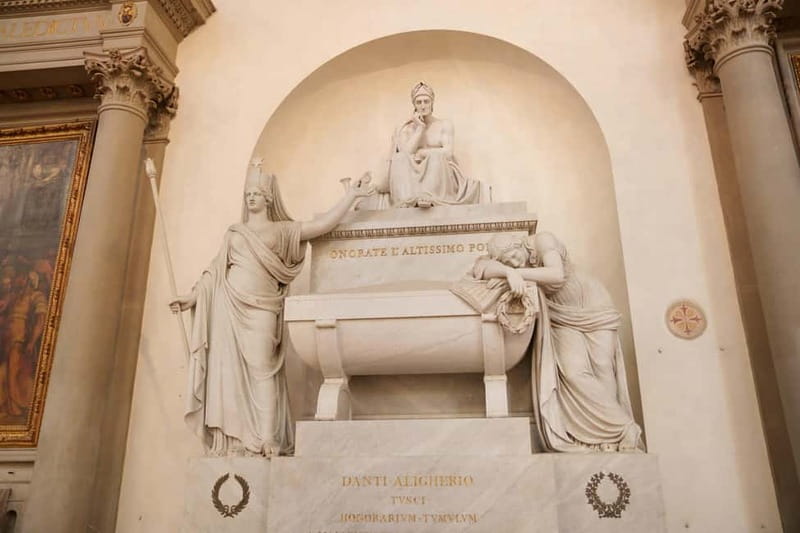
The church also contains a monument dedicated to Dante. Dante’s relationship with Florence was complicated, and the monument offers an opportunity to discuss his importance to Italian literature and identity. The tour’s strength is that these people are not presented as disconnected celebrities. You learn why each one matters and how the church became a place where their memory could be honored.
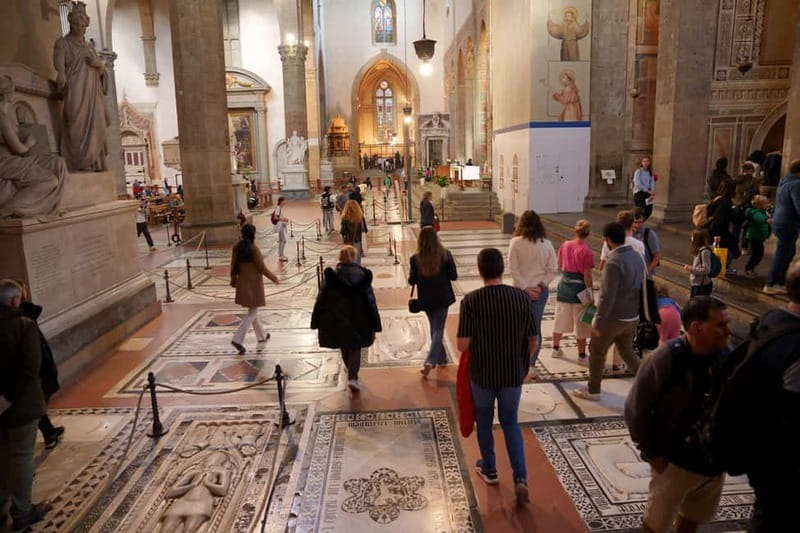
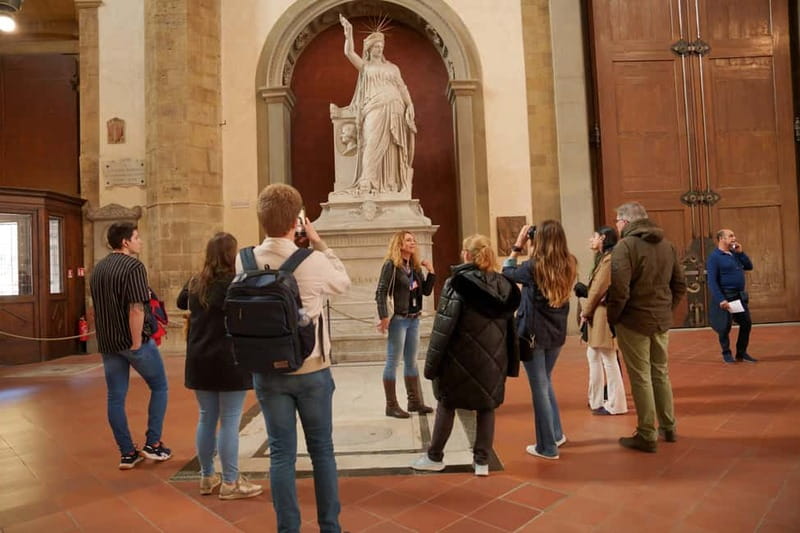
Near the entrance, you will also see the memorial to the 19th-century playwright Giovanni Battista Niccolini. Its design served as an inspiration for the Statue of Liberty. That is a surprising detail, and it gives the opening part of the church a broader connection to modern public sculpture.
Donatello’s crucifix and Brunelleschi’s chapel
Donatello’s crucifix is one of the key Renaissance works on the route. A guide can help you look beyond the basic subject and notice the treatment of the human body, emotion, and form.
The work is useful in a church setting because it is not art for decoration alone. It was made to support religious reflection, and the emotional force of the image matters as much as its place in art history.
The tour also includes the chapel associated with Brunelleschi, described here as the Chapel of Fools. Its appeal is different from the frescoes and tombs. Instead of asking you to follow a painted story, the chapel asks you to notice proportion, balance, and the relationship between architectural parts.
I especially like this change of pace. After looking at crowded walls and detailed scenes, a more orderly architectural space lets you appreciate how Renaissance designers created beauty through restraint. Your guide can point out the harmony that might otherwise pass unnoticed.
The flood of 1966 and the church’s damaged art
One of the most important parts of the visit is the discussion of the 1966 flood. Florence suffered catastrophic flooding, and Santa Croce’s art was damaged. Some paintings were destroyed or badly affected, and restoration followed.
The restored work is not simply a happy ending. Restoration can preserve an image, but it cannot always erase the signs of damage. The marks of the flood remain part of the church’s story.
This section gives you a more honest view of historic preservation. You see that famous art is not protected from weather, water, neglect, or human error. Keeping it in place requires years of work, careful choices, and continued care.
For me, this is one of the most valuable parts of the tour because it moves the visit beyond Renaissance glory. You see a living monument that has survived disaster and continues to require attention.
The monumental cemetery, crypt, chapels, and bell tower
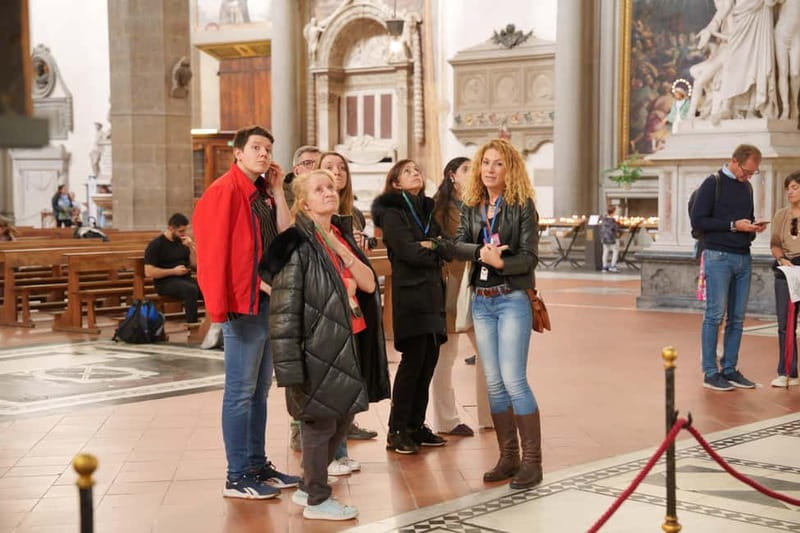
The route includes Santa Croce’s monumental cemetery area, along with the crypt, bell tower, and 16 chapels. The exact depth of the visit can depend on the tour schedule and access on the day.
The cemetery area adds another layer to the church. Santa Croce is not only a place where famous people are remembered through grand monuments. It is also a place shaped by burial, mourning, family memory, and religious practice.
The crypt gives you a change of atmosphere. It is below the main church and feels more direct and functional than the decorated chapels above. If you prefer art to architecture, this may not be your favorite stop, but it helps you understand the building as a working religious complex.
The bell tower and exterior portions round out the visit. The tour is not limited to the best-known tombs inside. You also learn how the church fits together and how its different parts served different purposes.
The marble facade and a final look outside
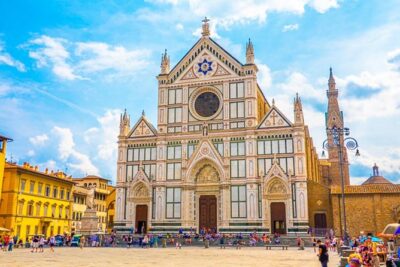
After the interior, the guide discusses Santa Croce’s exterior, covered in a polychrome marble facade. The colored marble creates a very different impression from the interior’s frescoes and stonework.
This is a good reason not to rush away after leaving the church. From outside, you can consider how the facade presents the building to the city. Inside, the focus is on chapels, monuments, and painted stories. Outside, the facade acts as a public face.
The tour ends back at the meeting point, and you have the chance to return to something you want to study again. That final freedom is useful. A guide-led route can move quickly, especially when there is a lot to cover. A few extra minutes for your favorite chapel or tomb helps you leave with a clearer memory of the place.
The optional Tuscan wine tasting
You can upgrade the church visit with a wine-tasting option. A wine expert leads a tasting of different Tuscan wines, served with a platter of Tuscan appetizers.
This add-on changes the shape of the experience. The church portion is focused on art, religion, and Florence’s cultural history. The tasting gives you a more relaxed food-and-drink finish.
I would choose it if you want one booking that combines a cultural visit with a casual introduction to Tuscan wine. I would skip it if you already have a winery visit or several food tastings planned, since the church tour itself is the main reason to book.
Food and drinks are not included unless you select that option. The basic tour includes the guide, reserved entry, and radio system, but not hotel pickup, transportation, or refreshments.
Timing, clothing, and access
The advertised duration ranges from one to 2.5 hours, with starting times shown when you check availability. The guided church visit itself takes about an hour, while the longer options may include the wine tasting or additional time connected with the selected arrangement.
There is no hotel pickup or drop-off, so you need to make your own way to the meeting point. Comfortable shoes are a sensible choice, especially if Santa Croce is one stop in a full day of walking around Florence.
Dress rules are strict. Shorts and sleeveless tops are forbidden, and both men and women must have their knees and shoulders covered. Bring a passport or identity card, since identification is listed among the things to bring.
The activity operates in all weather conditions. Wheelchair and stroller access are listed as available, although you should still check the exact meeting point and chosen option if mobility access is central to your plans.
Free cancellation is available up to 24 hours before the activity for a full refund, and you can reserve now and pay later. Those policies are useful if your Florence schedule is still shifting, but the clothing rule is not flexible.
Who will get the most from this tour
I would recommend this visit to first-time Florence visitors who want a clear introduction to Santa Croce’s art and memorials. It is especially useful if Michelangelo, Giotto, Donatello, Brunelleschi, Galileo, or Machiavelli are on your must-see list.
Families can also benefit from the guided format because the stories give children something specific to follow. The church contains a lot of visual material, and a guide can turn it into a sequence of people, events, and surprising details.
Art students, history fans, and visitors interested in Florence’s famous citizens will find plenty to hold their attention. The tour also works well for anyone who prefers a short, focused activity instead of a long museum visit.
I would be less likely to choose it if you want complete solitude, unlimited photography time, or a self-guided pace. You will be moving with the group, and the church’s religious setting requires respectful behavior and suitable clothing.
Should you book Santa Croce with a guide?
Yes, if you want the famous names to become real people and the artwork to make sense in context. At $54.66, the experience is worth the price when you value reserved entry, a live guide, clear audio, and the ability to ask questions.
Choose the basic version if Santa Croce is your main goal. Add the wine tasting if you want a pleasant Tuscan food-and-drink stop afterward and have the extra time.
Book this tour if you can cover your shoulders and knees, walk comfortably, and prefer explanation over wandering. Skip it only if you strongly favor exploring alone or already have a detailed art-focused plan for Santa Croce.
FAQ
Where does the Santa Croce tour start?
The meeting point is near Largo Piero Bargellini, 1, by the Monument to Dante Alighieri. The exact meeting point may vary depending on the option booked.
How long does the tour last?
The activity lasts between one and 2.5 hours, depending on the selected option and starting time. The guided church visit takes about one hour.
What is included in the tour?
The basic experience includes a certified guide, a radio system to hear the guide clearly, and reserved entrance tickets. Wine tasting and Tuscan appetizers are included only if you select that option.
Can I see Michelangelo’s tomb?
Yes. The tour includes the burial place of Michelangelo, along with memorials or burial places connected with Machiavelli, Galileo Galilei, and other important Italian figures.
What clothing is required?
Your knees and shoulders must be completely covered. Shorts and sleeveless tops are not allowed for either men or women. Entry can be refused for unsuitable clothing, without a rescheduled tour or refund.
Is the tour offered in English?
Yes. Live guides are available in English, Spanish, French, German, and Italian.
Is the activity accessible for wheelchairs and strollers?
Wheelchair and stroller access are listed as available. Check the meeting point and selected option in advance if you need specific access arrangements.
Can I cancel the booking?
You can cancel up to 24 hours in advance for a full refund. The activity also offers a reserve-now, pay-later option.
Recently added around Florence
- Accademia and Uffizi Small-group Guided Tour★ 4.5 · 8 reviews
- The David from Michelangelo.★ 5.0 · 3 reviews
- Combo: Accademia + walking + Uffizi Galleries Guided Tour★ 3.5 · 6 reviews
- The Complete Wine Tour Brunello, Nobile, Chianti wine experience★ 4.0 · 7 reviews
- The Best of Tuscany in 3 Days★ 4.5 · 13 reviews
- The Cooking Lab – Authentic Food Experience★ 5.0 · 113 reviews
- Florence Central Market Food Tour – Private Tour★ 4.0 · 7 reviews
- Family Friendly Florence Private City Tour★ 5.0 · 47 reviews
Santa Croce and Florence Churches, compared.
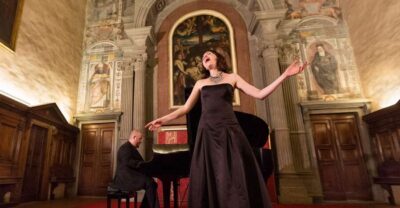
Santa Monaca Church Italian Opera Concert Ticket
Read our review →
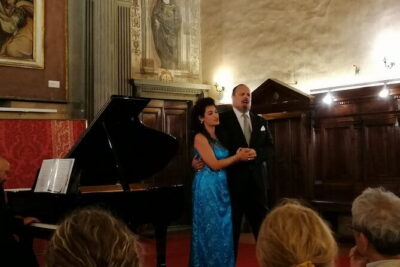
Italian Opera Concert Ticket in Florence’s Santa Monaca Church
Read our review →
Basilica Santa Croce: Walking Among the Masters of Florence
Read our review →Browse the lists this tour appears in