
Reviewed · SANTA CROCE AND FLORENCE CHURCHES
Basilica Santa Croce: Walking Among the Masters of Florence
Santa Croce is both a church and a roll call of Florence’s great names. Inside, you move from Giotto frescoes and Donatello sculpture to the tombs of Michelangelo, Galileo, Machiavelli, and Rossini, with the 1966 flood adding a sobering modern chapter. I especially like the compact one-hour format and the way a guide points out details that are easy to miss on your own.
I also like the chance to begin in Santa Croce Square, where the June Calcio Storico Florentino matches take place, before entering the basilica. The main caution is price: at $58.05 per person, this is not a cheap admission add-on, and one hour can feel tight if you want to linger over every chapel.
Key points at a glance
- Famous tombs in one powerful setting: See memorials connected with Michelangelo, Galileo, Machiavelli, and Rossini.
- Giotto and Gaddi frescoes: Study scenes in the Bardi, Peruzzi, and Cappella Maggiore chapels.
- A guide makes the difference: Matteo, Chiara Conti, Elena, Jenny, Sarah, Raphael, and others have been praised for clear storytelling and patience.
- The 1966 flood is part of the story: See damaged artwork and learn how restoration changed the basilica.
- More than the main nave: The visit includes Santa Croce Square, the church interior, crypt, cemetery, bell tower area, and 16 chapels.
- Plan for strict entry rules: Knees and shoulders must be covered, and late arrivals cannot join or receive a refund.
Why Santa Croce deserves a place on your Florence list
Florence has no shortage of famous churches. Santa Croce earns its place through the sheer mix of art, architecture, public memory, and burial monuments packed into one complex.
The basilica is often called the burial place of great Italians, and that description is useful but incomplete. The tombs draw your eye first, yet the frescoes and chapels are what give the building its character. You are not simply looking at famous names on marble. You are seeing how Florence chose to remember its artists, writers, scientists, and political figures.
I find Santa Croce especially rewarding if you like places where art and civic life overlap. The square outside still has a strong public role, while the church interior carries centuries of religious and artistic work. A guide helps connect those pieces instead of leaving you with a long list of names.
More churches and chapels in Florence:
- Florence: Santa Monaca Church Italian Opera Concert Ticket
★ 4.7 · 2,692 reviews - Florence: Santa Maria Novella Entry Ticket & Audioguide
★ 4.3 · 717 reviews - Italian Opera Concert Ticket in Florence’s Santa Monaca Church
★ 4.5 · 602 reviews
Meeting Dante in Santa Croce Square
The tour begins at the Monument to Dante Alighieri in Piazza di Santa Croce. This is a useful meeting point because the square is one of Florence’s recognizable open spaces, but you still need to arrive early enough to identify your guide.
The square itself deserves a few minutes before the tour starts. Every June, it hosts Calcio Storico Florentino, Florence’s rough-and-ready historic football match played in medieval costume. The event is not part of the one-hour visit, of course, but knowing the square’s role gives you a better sense of Santa Croce as a living civic space rather than only a museum setting.
The meeting instructions matter. Guides do not always carry the flags or pennants you might expect, so look carefully for the group around the Dante monument and keep your phone available. The activity ends back at the starting point, making it easy to continue through the Santa Croce neighborhood afterward.
Inside the basilica: frescoes before famous names
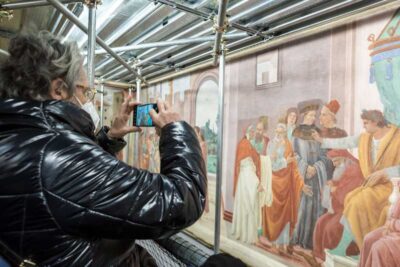
Once inside, your guide lays out the artistic story of Santa Croce. The Cappella Maggiore contains frescoes by Gaddi, dating to 1380, with scenes connected to Santa Croce. These works help you understand how the chapels functioned as visual storytelling spaces at a time when painted walls carried much of a church’s teaching.
The Bardi and Peruzzi Chapels bring Giotto into the picture. Here, scenes from the lives of Saint Francis and Saint John the Evangelist show why Giotto matters so much to Florence’s art story. You may recognize the name, but the guide’s explanation helps you see the work as part of a change in how figures, gestures, and sacred stories were presented.
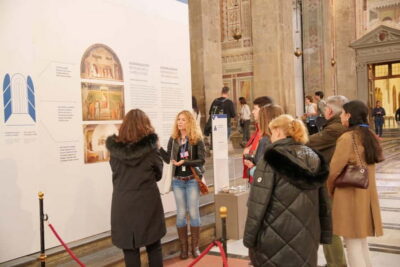
This is one of the strongest reasons to take the tour rather than simply walk in with a ticket. Santa Croce can feel visually busy at first. With someone directing your attention, a painted scene or architectural detail becomes easier to read, and you spend less time wondering which parts deserve your attention.
The pacing is usually brisk. That is helpful if you have a full day of Florence sightseeing, but it means you should not expect long quiet periods in front of every artwork. If you already know Giotto, Donatello, and Renaissance architecture well, you may want extra time after the tour to revisit your favorite areas.
Donatello, Brunelleschi, and the Chapel of Fools
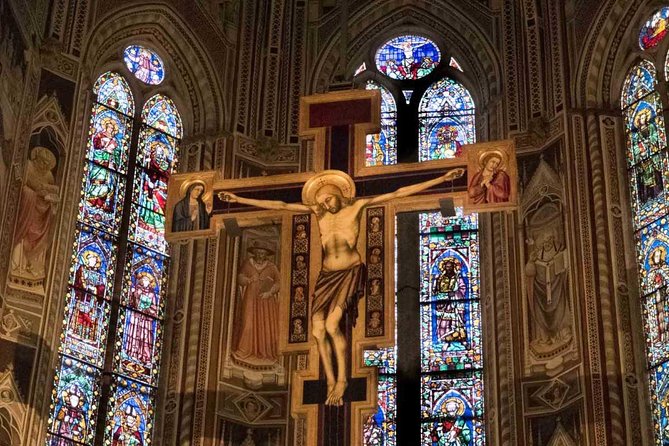
Donatello’s crucifix is one of the visit’s key artistic stops. The guide explains why it matters within the Renaissance, rather than treating it as another object in a crowded church. This kind of context is particularly useful if you are seeing several Florentine churches in a short period and need help distinguishing one artist’s work from another’s.
Brunelleschi is also part of the tour, especially through the Chapel of Fools and its balanced architectural design. The emphasis here is not only on decoration. You get a chance to see how proportion and structure shape the feel of a sacred space.
On the left side near the entrance, the memorial to nineteenth-century playwright Giovanni Battista Niccolini brings a more surprising connection. It was built as an inspiration for the Statue of Liberty. That is the sort of small detail easy to miss when sightseeing alone, and it gives the entrance area an unexpected link to a much larger story of public monuments.
The guide’s delivery matters greatly at this point. Several guides have been singled out for warmth, humor, and clear explanations, including Matteo, Chiara Conti, Elena, Jenny, and Marcello. A few guides have also been praised for answering questions patiently, which can make a small group feel more like a private lesson than a standard walk-through.
More walking tours in Florence:
- Florence: Guided Walking Tour
★ 4.5 · 3,334 reviews - Skip the line: Uffizi and Accademia Small Group Walking Tour
★ 4.5 · 3,135 reviews - Florence: Guided Walking Tour
★ 4.6 · 1,602 reviews - Florence: Renaissance and Medici Tales Guided Walking Tour
★ 4.8 · 1,549 reviews
Famous tombs and the people behind them
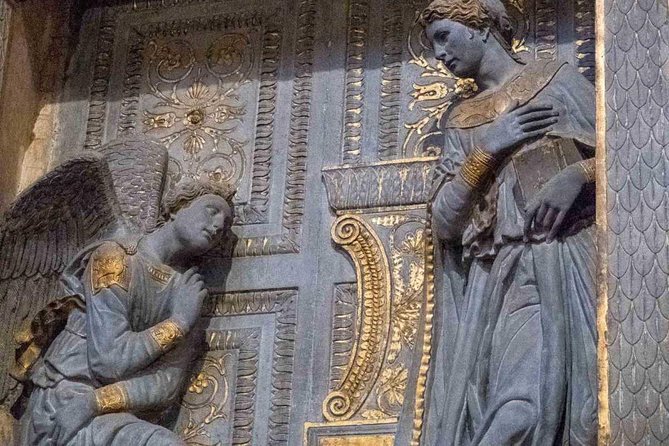
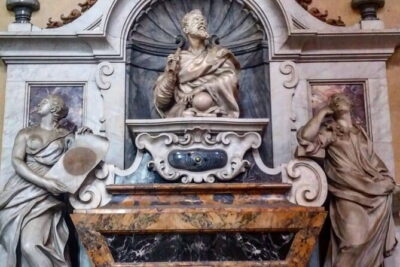
Santa Croce’s tombs are among its most memorable features. Michelangelo, Galileo, Machiavelli, and Rossini are all connected with burial monuments here, turning the church into a place where art, science, literature, music, and politics meet.
The value of the guide is strongest when these names are given human and historical context. Without explanation, you might see a grand tomb, take a photograph, and move on. With a good guide, you learn why the person mattered to Florence and why the monument looks the way it does.
This section may be the emotional high point for you if you enjoy biography. It also works well for families and mixed-interest groups because the stories extend beyond religious art. Someone interested in music can focus on Rossini, while another person may care more about Galileo or Machiavelli.
Do not expect a full biography of every person buried or memorialized at Santa Croce. The tour lasts about an hour, so the guide must choose highlights. If one tomb captures your attention, note its location and return to it once the formal tour ends.
The 1966 flood and damaged works
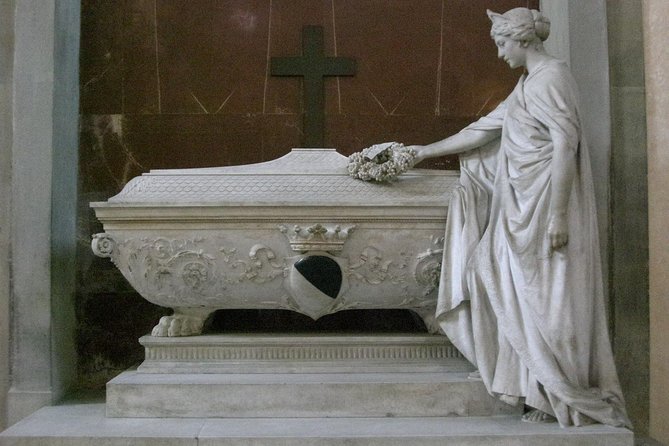
The visit also covers the devastating Florence flood of 1966. Water and mud damaged artworks and parts of the basilica, and the restoration work remains part of Santa Croce’s modern story.
This is more than a side note about conservation. It shows that historic art is not frozen in time. The church you see today reflects years of repair, careful cleaning, and difficult decisions about what could be restored. Seeing damaged and restored paintings gives you a clearer sense of the effort required to protect Florence’s art.
I appreciate this part because it adds balance to the usual Renaissance focus. You are not only hearing about celebrated artists from centuries ago. You are also seeing how the city dealt with a disaster in living memory.
The flood section may be particularly meaningful if you have visited other Florence sites affected by the same event. The guide can place Santa Croce within that wider city story, though the amount of time spent here will depend on the guide and the group’s questions.
Cemetery, crypt, bell tower, and chapels
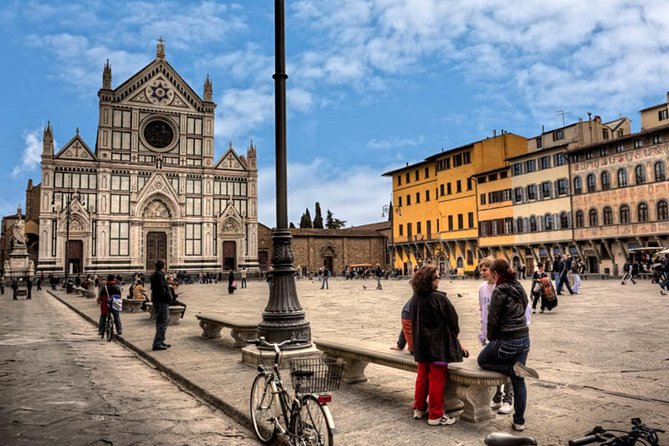
The itinerary goes beyond the principal church interior. You are also taken around the monumental cemetery, crypt, bell tower area, and 16 chapels.
These spaces give the visit a broader feel, but they also explain why the one-hour estimate should be treated as approximate. One guide may move quickly through several areas, while another may spend longer on an especially interesting artwork or answer more questions. One recent experience ran longer than expected, with the final section turning out to be particularly worthwhile.
That variation is not necessarily a problem, but it is worth knowing if you have a train, museum reservation, or dinner booking immediately afterward. I would leave a little breathing room rather than schedule the next activity to begin exactly one hour after the start.
The cemetery and crypt add a quieter, more solemn side to the visit. The grand church receives most of the attention, yet these areas help explain Santa Croce as a working religious complex and a place of memory. The 16 chapels also make clear how much more there is here than the central nave.
After the guided portion, you have the chance to return to anything you want to see again. Use that time well. The best strategy is to listen for the names and locations that interest you most, then make a short mental list for a second look.
The marble facade and the church from outside
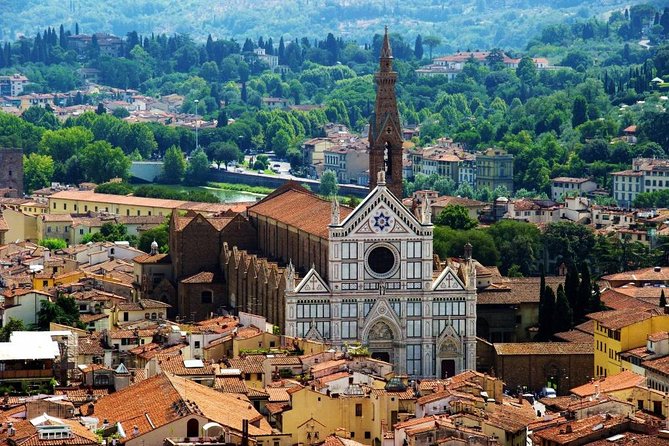
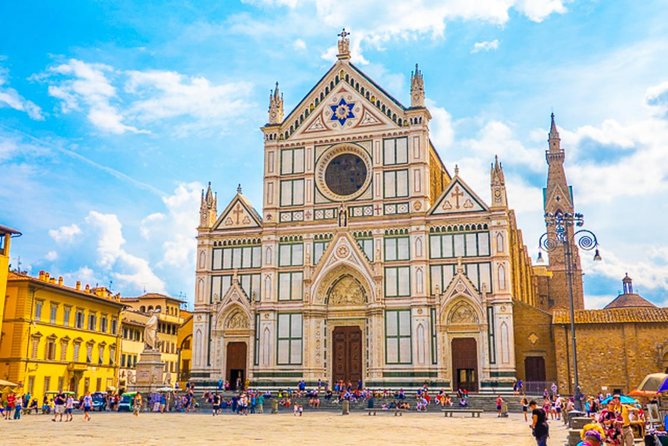
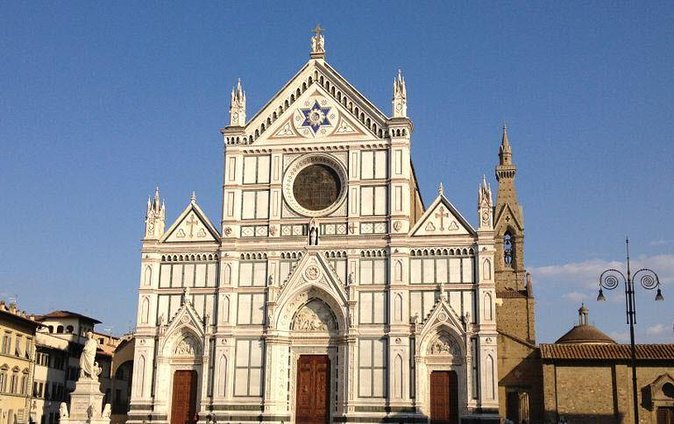
The exterior is covered with a polychrome marble facade, a striking contrast to the frescoed and sculptural interior. The guide discusses the outside after taking you through the church, which gives you a chance to compare the public face of Santa Croce with the layers of art inside.
The facade is also a good reminder that Santa Croce is not visually simple. From the square, it reads as a grand Florentine church. Inside, you find chapels, memorials, paintings, and restoration traces competing for attention. A guided sequence helps you make sense of that change from outside to inside.
Because the tour starts in the square, you do not need to save the exterior for later. Still, you may want to look back at the facade after the tour, when you can take it in without trying to keep up with the group.
Is $58.05 a fair price?
At $58.05 per person, this tour costs more than simply entering a church on your own. You are paying for reserved admission, an official certified guide, and a radio system that lets you hear the explanation in a group of up to 20 people.
The price makes the most sense if you want interpretation. Santa Croce has enough art, tombs, chapels, and architectural details to overwhelm a first-time visitor. A strong guide can turn an hour of looking into an organized story.
The value is less convincing if you prefer slow, independent sightseeing or already know the basilica well. One critical experience found the guiding expensive for the amount of information provided, and that is a fair concern at this price. The quality depends heavily on the individual guide, even though most named guides received strong praise for their command of Florence and their friendly manner.
The radio system is a practical plus. In a large interior, it is easy to lose a guide’s voice, especially with a group of 20. You can listen while looking at the artwork instead of standing shoulder to shoulder around the guide.
Who should book this Santa Croce tour?
I would recommend it to first-time visitors who want a clear introduction to Santa Croce without giving half a day to one building. It also suits anyone who likes art, biographies, religious history, or the stories behind famous Florentine figures.
Families can benefit from the short format, especially if different people want different things from the visit. The tombs and flood story offer accessible talking points, while the frescoes and architecture reward closer attention.
You should think twice if you need complete quiet, dislike group tours, or want to study every artwork at length. The maximum group size is 20, and the pace may feel fast for serious art students. You may still find the tour useful as an orientation, followed by independent time inside.
Guide quality is an important factor. Matteo has been praised for turning the visit into an engaging history lesson, while Chiara Conti has been appreciated for patience and kindness. Elena, Jenny, Sarah, Raphael, Hillary, Guido, Marcello, and others have also received warm comments for clear explanations and an easy pace. One guide was criticized for difficult English, so I would treat the strong overall rating as a good sign, not an absolute promise about your assigned guide.
Practical details before you book
The experience is offered in English and generally runs for about one hour. It requires at least two participants, and the maximum group size is 20.
You must cover your knees and shoulders to enter the place of worship. This applies to men and women, and inappropriate clothing can lead to refused entry without a refund or rescheduling. I would carry a light layer even in warm weather so you are not caught short.
The tour operates in all weather conditions. Since the starting point is in Piazza di Santa Croce and there is an outdoor portion around the square and exterior, dress for the forecast and wear comfortable shoes.
Arrive early. If you show up after the start time, you cannot join the tour, and you will not receive a refund or a new appointment. The meeting point is the Dante Alighieri monument, and the activity ends there.
You can cancel for a full refund up to 24 hours before the start time. Changes or cancellations made inside that window are not accepted, and the operator may cancel if too few people book. In that case, you will be offered another option or a full refund.
Should you book it?
Book this tour if you want Santa Croce to make sense quickly. The best parts are the mix of Giotto, Gaddi, Donatello, Brunelleschi, major tombs, and the 1966 flood, all tied together by a guide who can explain why each piece matters.
At $58.05, it is a paid interpretation rather than a bargain entry ticket. I think it is good value for a first visit, especially if you are short on time and want the famous names placed in context. If you prefer to wander slowly and read on your own, save the money and plan a longer independent visit instead.
FAQ
How long does the Santa Croce tour last?
The tour takes approximately one hour. It may run a little longer depending on the guide, the group, and the questions asked.
What is the price?
The listed price is $58.05 per person.
Is admission included?
Yes. Reserved entrance tickets are included in the tour price.
Is the tour offered in English?
Yes. The experience is offered in English.
Where does the tour meet?
The meeting point is the Monument to Dante Alighieri in Piazza di Santa Croce, Florence.
Where does the tour end?
The activity ends back at the meeting point.
What places are included during the visit?
The visit includes Santa Croce Square, the basilica interior, the crypt, the monumental cemetery, the bell tower area, and 16 chapels.
What should I wear?
You must cover your knees and shoulders to enter the church. Shorts and sleeveless tops are not allowed for men or women.
Can I cancel for a refund?
You can cancel at least 24 hours before the start time for a full refund. Cancellations or changes made less than 24 hours before the start time are not refunded or accepted.
Recently added around Florence
- Accademia and Uffizi Small-group Guided Tour★ 4.5 · 8 reviews
- The David from Michelangelo.★ 5.0 · 3 reviews
- Combo: Accademia + walking + Uffizi Galleries Guided Tour★ 3.5 · 6 reviews
- The Complete Wine Tour Brunello, Nobile, Chianti wine experience★ 4.0 · 7 reviews
- The Best of Tuscany in 3 Days★ 4.5 · 13 reviews
- The Cooking Lab – Authentic Food Experience★ 5.0 · 113 reviews
- Florence Central Market Food Tour – Private Tour★ 4.0 · 7 reviews
- Family Friendly Florence Private City Tour★ 5.0 · 47 reviews
Santa Croce and Florence Churches, compared.
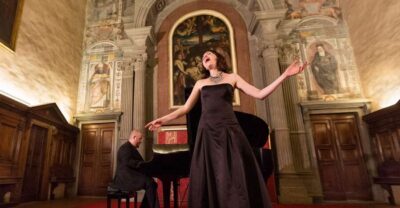
Santa Monaca Church Italian Opera Concert Ticket
Read our review →
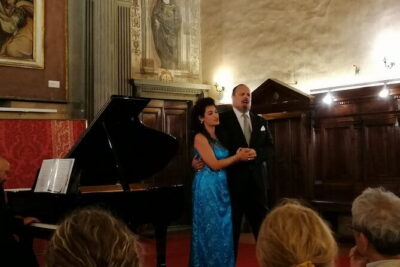
Italian Opera Concert Ticket in Florence’s Santa Monaca Church
Read our review →
Browse the lists this tour appears in