
Reviewed · SANTA CROCE AND FLORENCE CHURCHES
Private Guided Visit of Florence Santa Maria Novella Basilica and its Officina Profumo Farmaceutica
Santa Maria Novella gives you two very different Florentine sights in one compact visit: a grand Dominican church filled with masterpieces, followed by an old pharmacy where monks once prepared rose water, balms, and herbal remedies. I like the excellent concentration of art, including Masaccio’s Trinity, Giotto’s Crucifix, and frescoes by Ghirlandaio and Filippino Lippi. I also like the quiet Green Cloister, with its unusual green-earth frescoes by Paolo Uccello.
The private format lets you ask questions and set the pace within the 90-minute visit. Guides such as Andrea and Laura have earned praise for their care and clear explanations. The main drawback is the pharmacy stop: some guides give it only a quick introduction, and the modern space functions partly as a perfume and cosmetics shop. Basilica admission, €7.50 for adults, is paid separately.
Key points to know before booking
- See major Florentine art in one church: Masaccio, Giotto, Ghirlandaio, and Filippino Lippi all have important works here.
- Step into the Green Cloister: Paolo Uccello’s green-toned frescoes give this courtyard a calmer, more unusual feel than the main church.
- Learn the Dominican connection: Your guide explains how a mendicant order shaped the church and its work.
- Visit the 1612 pharmacy: The Officina Profumo Farmaceutica occupies the old monastery building, with vaulted ceilings and wall frescoes.
- Expect a private English tour: Only your own group takes part, with earphones provided for groups larger than seven.
- Allow extra money for admission: The guide is included, but the basilica ticket is not.
Why Santa Maria Novella is worth your morning
Many first-time visitors hurry across Piazza di Santa Maria Novella toward Florence’s central sights. That is a mistake. The church facing this square is one of the city’s best introductions to how religion, art, science, and trade once worked together.
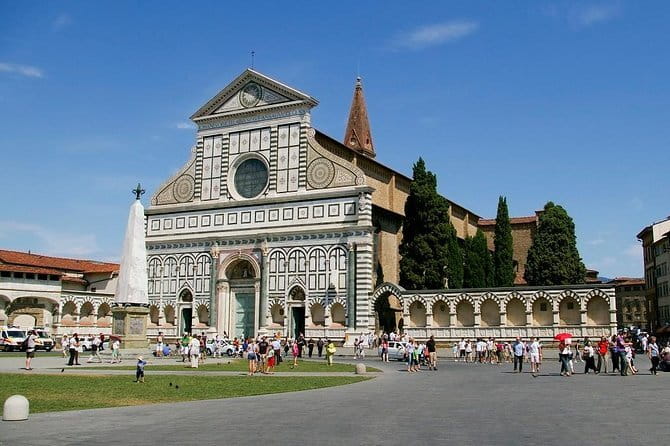
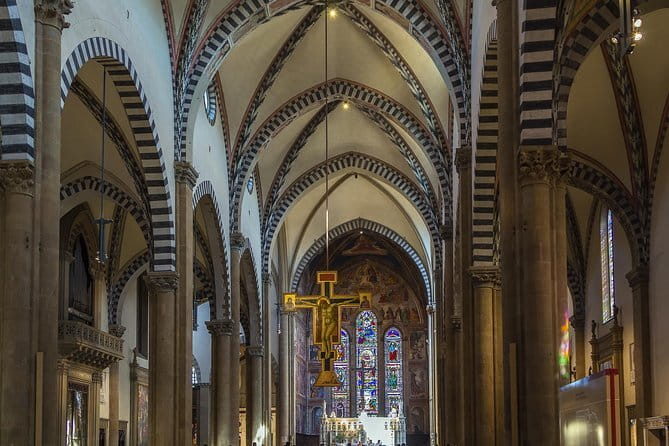
Your visit begins outside the basilica, where the striped marble facade gives you an immediate lesson in Florentine taste. The building’s pale and dark marble patterns are orderly and bold, and the broad piazza gives you room to appreciate the facade before going inside.
The church was founded by Dominican friars at the beginning of the 13th century. Your guide connects the building to the mendicant order, whose members lived among ordinary people and preached rather than remaining apart in remote monasteries. That background matters. Santa Maria Novella was not simply a place for private prayer. It was a major public church, built to teach through sermons, architecture, and pictures.
The private format is useful here. A large group can turn a church visit into a contest for the best listening position. With your own guide, you can ask why a painting matters, pause when a detail catches your eye, and request help with photographs. Andrea, Laura, and Marcello are among the guides associated with this activity, and their styles appear to vary. Andrea has been praised for punctuality, care, and strong answers to questions. Laura helped one visitor locate Plautilla Nelli’s restored Last Supper, an important detail if you are interested in women artists.
More churches and chapels in Florence:
- Florence: Santa Monaca Church Italian Opera Concert Ticket
★ 4.7 · 2,692 reviews - Florence: Santa Maria Novella Entry Ticket & Audioguide
★ 4.3 · 717 reviews - Italian Opera Concert Ticket in Florence’s Santa Monaca Church
★ 4.5 · 602 reviews
The church’s major works, from Giotto to Ghirlandaio
The basilica is the main event, so do not treat it as a quick passage to the pharmacy. Plan to spend most of your attention here.
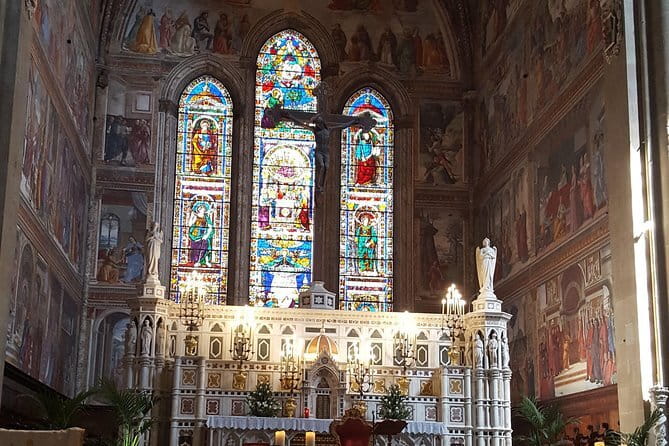
Giotto’s Crucifix is one of the works your guide points out. It offers a chance to see an early move away from the stiff, highly symbolic style of medieval art toward figures with more physical presence and emotion. You do not need a background in art history to appreciate the change. A good guide makes the comparison plain.
Masaccio’s Trinity is another essential stop. The painting is famous for its convincing architectural illusion, which makes the wall appear to open into a chapel. The work also reflects a new interest in perspective and human space. This is exactly the sort of painting that benefits from explanation. Without guidance, you might admire the surface and move on. With context, you understand why it altered Florentine painting.
The Tornabuoni Chapel brings the Renaissance into full view. Ghirlandaio’s frescoes cover the chapel with carefully observed figures, settings, and scenes from the lives of the Virgin Mary and Saint John the Baptist. The chapel also carries clear connections to wealthy Florentine patrons and to the social world of the city. One visitor singled it out as especially impressive, and it is easy to see why.
Filippino Lippi’s frescoes add another layer. His work is more decorative and imaginative, with lively detail that rewards a closer look. Your guide can help you compare his approach with Ghirlandaio’s more orderly storytelling.
If you want to see Plautilla Nelli’s Last Supper, mention it early. The work has been restored, and Laura helped one visitor find it during the visit. The supplied details do not promise that every guide will make it a formal stop, so ask at the start rather than waiting until the final minutes.
The Green Cloister and Paolo Uccello’s strange color
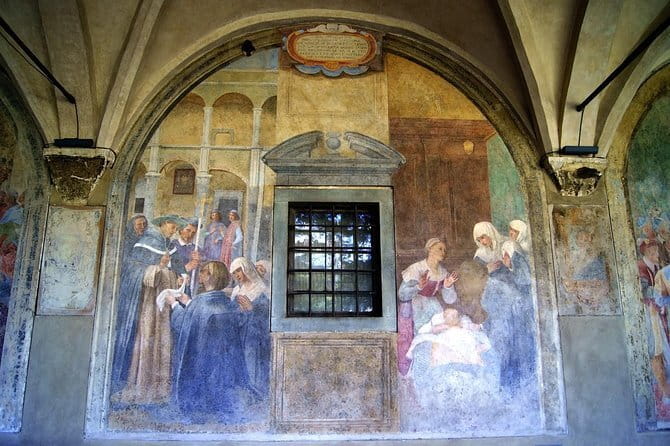
The visit ends inside the Green Cloister, a peaceful courtyard named for the dominant green-earth pigment used in its murals. Paolo Uccello’s frescoes are the focus here.
This stop changes the mood. The basilica presents grand chapels and famous masterpieces. The cloister feels quieter and more open, with painted walls that show the working world of a religious community. The green pigment has aged in a way that gives the scenes a distinctive, slightly muted appearance.
Uccello is often remembered for his interest in perspective, and his frescoes reward a careful look at space, figures, and movement. The cloister is not as instantly dramatic as the church interior, but it may be the part you remember most clearly because it feels less expected.
The visit to the basilica and cloister is scheduled for about one hour. That is enough for a focused introduction, not enough for every chapel and detail. If you are an art specialist or want a slow look at every fresco, you may find the pace brisk. One person described the full visit as quick despite the stated time, so tell your guide what matters most to you before the tour begins.
From monastery garden to Florence’s famous pharmacy
After the church, you continue to the Officina Profumo Farmaceutica di Santa Maria Novella. The name sounds like a modern boutique, but the setting is much older. The pharmacy occupies parts of the original Dominican monastery, with vaulted ceilings and frescoed walls.
The story begins with the monks’ gardens behind the cloisters. By the 14th century, they were selling rose water, including for use as a disinfectant during outbreaks of disease. In the 16th century, the influence of Cosimo I de’ Medici and later rulers encouraged greater interest in natural science. The monks cultivated medicinal plants, distilled flowers and herbs, and prepared essences, ointments, and balms.
The present workshop dates to 1612. That date gives the pharmacy its special appeal. You are not simply entering a shop with an old name. You are seeing a business that grew from monastic medicine and later developed into a maker of perfumes, soaps, and other products based on old recipes.
The room itself is a major part of the visit. Look up at the vaulted ceilings and around the frescoed walls. The scent of herbs and perfumes adds something that paintings alone cannot provide. It is a pleasant sensory change after the solemn church.
Still, keep your expectations in check. The pharmacy is also a retail shop. You will see perfumes, soaps, and cosmetics for sale, and the visit may feel more like a historical introduction followed by browsing than a museum tour. One guide, Marcello, was praised for his basilica commentary but gave too little explanation at the pharmacy. Another person found the pharmacy less worthwhile than expected because it felt mainly like a sales space.
That difference may depend on how your guide divides the time. The listed schedule allows about 30 minutes here, but the guide may spend more time in the basilica because of its importance and the amount of art inside. If the pharmacy is your main reason for booking, say so at the beginning. Ask for its monastic origins, the role of the medicinal gardens, and how the old recipes relate to today’s products.
More private tours in Florence:
- Cinque Terre and Pisa Tower Tour from Florence Semi Private
★ 5.0 · 1,406 reviews - From Florence: Private Chianti Hills Tour with Tasting
★ 4.3 · 809 reviews - Private Self-Guided E-Bike Ride in Tuscany with Vineyard Visit
★ 5.0 · 775 reviews - Florence Private Transportation in Rickshaw
★ 5.0 · 730 reviews
Is $124.96 a fair price?
The listed price is $124.96 per person, with group discounts available. It covers a private English-speaking guide and the guided visit, but not the basilica admission. Add €7.50 per adult, €5 for ages 11 to 17, and nothing for children 10 and under.
That is a serious price for a 90-minute activity. Its value depends on your group size and your priorities. If you are traveling as a small family or group and want a guide devoted only to you, the cost can make sense. You are paying for explanation, questions, and a simpler visit rather than for entry alone.
If you are a solo visitor or a couple focused mainly on the pharmacy shop, the price is harder to justify. The pharmacy itself is free to enter as a retail space, and the guided portion there may be short. The stronger value comes from the basilica, where a guide can point out works that are easy to miss and explain why they matter.
The activity is booked, on average, about 40 days ahead. That suggests you should reserve early if your Florence dates are fixed, especially if you want a particular morning or afternoon. Confirmation arrives at booking, and the mobile ticket makes the arrangement easy to carry on your phone.
Timing, meeting point, and practical details
Meet your guide outside the entrance to the Basilica of Santa Maria Novella at Piazza di Santa Maria Novella 18. The tour ends at the same meeting point, so you do not need to arrange a separate ride back to your hotel.
The church is near public transportation, and most people can take part. Hotel pickup and drop-off are not included. The activity is offered in English, and it is private, so only your group participates. For groups larger than seven, earphones are supplied.
Build in a little flexibility. The stated duration is about one hour and 30 minutes, with roughly one hour for the basilica and Green Cloister and 30 minutes for the pharmacy. A private visit can sometimes run differently depending on questions, crowd conditions, and the guide’s choices.
You can cancel for a full refund up to 24 hours before the start time. Changes or cancellations made less than 24 hours ahead are not accepted for a refund, and the cut-off uses Florence local time.
Who should book this private visit?
I would choose this tour if you want Florence’s art explained in plain language and you prefer a private guide to a large scheduled group. It works especially well for families, first-time visitors, and anyone curious about how a religious complex later connected to medicine, perfume, and commerce.
Art lovers should tell the guide about specific priorities, such as Masaccio’s Trinity, the Tornabuoni Chapel, or Plautilla Nelli’s Last Supper. That simple request can keep the visit from feeling rushed.
I would hesitate if your main goal is a long, detailed pharmacy tour. The Officina is beautiful and historically unusual, but it is also a functioning shop, and the amount of explanation can vary. Book it for the combination of basilica, cloister, and pharmacy, not for the pharmacy alone.
Should you book it?
Book this experience if you want a well-focused introduction to Santa Maria Novella and appreciate the ease of having a private English-speaking guide. The basilica contains enough important art to justify the visit by itself, while the Green Cloister and old pharmacy add variety.
Before the tour begins, tell your guide which works matter most and ask for a full explanation of the pharmacy. With that small bit of planning, the 90-minute visit can give you a clear picture of one of Florence’s most interesting religious complexes.
FAQ
Where does the tour meet?
Meet your guide outside the entrance of the Basilica of Santa Maria Novella at Piazza di Santa Maria Novella 18, Florence.
Where does the tour end?
The activity ends back at the meeting point outside the basilica.
How long does the visit last?
The visit lasts approximately one hour and 30 minutes. About one hour is planned for the basilica and Green Cloister, followed by about 30 minutes at the pharmacy.
Is the tour private?
Yes. Only your own group participates in the activity.
Is the tour offered in English?
Yes. The tour is offered in English.
Is admission to the basilica included?
No. The basilica ticket is paid separately on the day. The listed prices are €7.50 for adults, €5 for ages 11 to 17, and free for children age 10 and under.
Are earphones provided?
Earphones are provided for groups of more than seven participants.
Can I cancel for a full refund?
Yes, if you cancel at least 24 hours before the experience start time. Cancellations or changes made less than 24 hours ahead are not refunded or accepted.
Recently added around Florence
- Accademia and Uffizi Small-group Guided Tour★ 4.5 · 8 reviews
- The David from Michelangelo.★ 5.0 · 3 reviews
- Combo: Accademia + walking + Uffizi Galleries Guided Tour★ 3.5 · 6 reviews
- The Complete Wine Tour Brunello, Nobile, Chianti wine experience★ 4.0 · 7 reviews
- The Best of Tuscany in 3 Days★ 4.5 · 13 reviews
- The Cooking Lab – Authentic Food Experience★ 5.0 · 113 reviews
- Florence Central Market Food Tour – Private Tour★ 4.0 · 7 reviews
- Family Friendly Florence Private City Tour★ 5.0 · 47 reviews
Santa Croce and Florence Churches, compared.
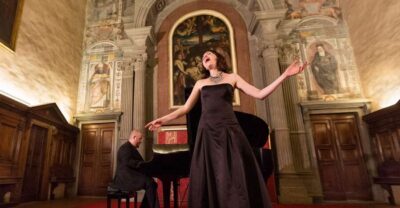
Santa Monaca Church Italian Opera Concert Ticket
Read our review →
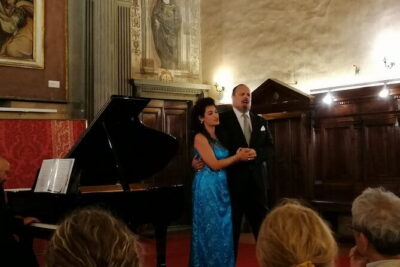
Italian Opera Concert Ticket in Florence’s Santa Monaca Church
Read our review →
Browse the lists this tour appears in