
Reviewed · FLORENCE
Florence Unveiled: The Rivalry of Leonardo and Michelangelo
Florence’s most gripping art story is not a single masterpiece, but the fierce rivalry between Leonardo da Vinci and Michelangelo. This three-hour walk follows that tension through the city, from the political heart of Piazza della Signoria to the quiet Basilica di Santo Spirito, where you can see Michelangelo’s early wooden crucifix.
I like the way the tour links famous sights to the people who shaped them, rather than treating Florence as a string of photo stops. I also like the practical local advice from guide Antonio, including his personal list of places for food, wine, music, gardens, and museums. The main drawback is that this is a walking tour with no transport, and three hours can feel brisk if you want long visits inside the major museums.
Key points at a glance
- Leonardo versus Michelangelo: Learn how their competing Palazzo Vecchio commissions pushed Renaissance art forward.
- Michelangelo’s wooden crucifix: See the quiet Santo Spirito work carved when Michelangelo was only 17.
- Antonio’s local advice: Receive a photo of his secret diary with suggestions for food, drinks, museums, gardens, music, and wine tasting.
- A practical Florence route: Walk from Piazza della Signoria through the Duomo area, across Ponte Vecchio, and into Santo Spirito.
- Small-group feel: Antonio’s relaxed approach is designed to avoid the feel of a large flag-waving city procession.
- Optional add-ons: Add the Medici Chapel for €19 or Leonardo’s interactive museum for €9 through online booking.
Why the Leonardo and Michelangelo rivalry matters
Florence can overwhelm you with names, dates, churches, and marble. This tour gives the city a clear storyline: two towering artists, two powerful patrons, and a competition that reflected the ambition of Renaissance Florence.
Leonardo and Michelangelo were very different men. Leonardo worked across painting, science, engineering, anatomy, and observation. Michelangelo focused with intense force on sculpture, painting, architecture, and religious subjects. Their rivalry was not simply personal. It was also a contest between artistic methods and ideas about what a great artist should be.
The key episode came when both men received commissions for large frescoes in the Palazzo Vecchio. Their paintings were meant to celebrate Florentine military victories, but neither work was completed. Even unfinished, the contest encouraged new approaches to movement, anatomy, composition, and human emotion.
Antonio builds the walk around this story while pointing out the city’s broader political forces. The Medici family used banking wealth and patronage to shape Florence into a center for art, scholarship, science, and humanist thought. That context helps you understand why so many major works appeared in one compact city.
I especially like this approach for a first visit. You do not need to arrive with a detailed knowledge of Renaissance art. The rivalry gives you something to follow, and the streets provide the setting.
Other Florence days worth putting in the same trip:
- Florence: Skip-The-Line Uffizi Gallery Timed Entry Ticket
★ 4.5 · 27,832 reviews - Tuscany Day Trip from Florence: Siena, San Gimignano, Pisa and Lunch at a Winery
★ 5.0 · 21,634 reviews - Florence: Timed Entrance Ticket to Michelangelo’s David
★ 4.6 · 16,983 reviews
Starting beside Neptune in Piazza della Signoria
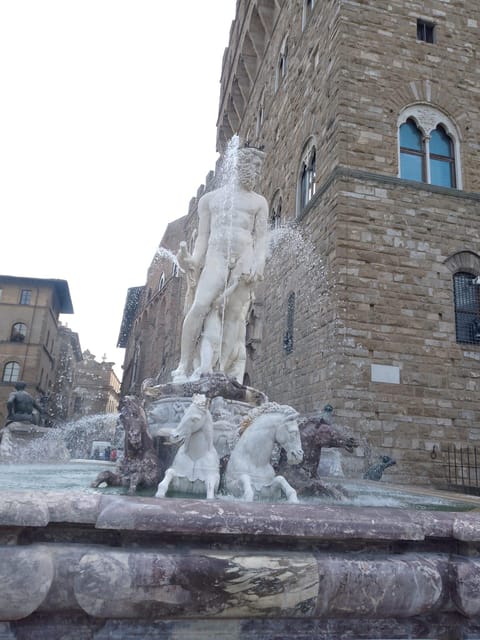
The meeting point is the Fountain of Neptune beside Palazzo Vecchio in Piazza della Signoria. This is one of the easiest places in Florence to recognize, but it is also one of the busiest. Give yourself extra time to reach it, especially if you are coming from the train station or crossing the historic center.
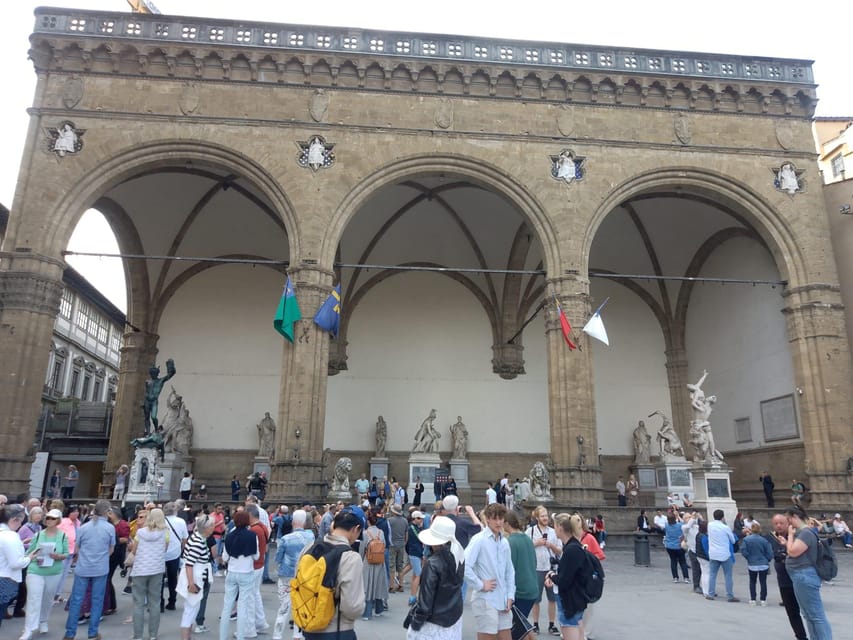
The square was Florence’s political stage for centuries. Palazzo Vecchio served as the seat of government and later became closely tied to Medici power. Around it, you will see an outdoor collection of sculpture, including a replica of Michelangelo’s David.
The replica is worth seeing even if you plan to visit the original at the Galleria dell’Accademia. It shows how public sculpture was used to express civic identity. David was not just a biblical hero. For Florence, he became a symbol of courage and resistance.
This first stop also sets up the tour’s main contrast. The square is open, theatrical, and public. Later, at Santo Spirito, the mood becomes quieter and more personal.
The listed visit here lasts about 40 minutes, making it one of the longer stops. That matters because it gives Antonio time to explain the square, the Medici connection, and the artists’ rivalry without reducing everything to a quick photograph.
Ponte Vecchio and the Medici route
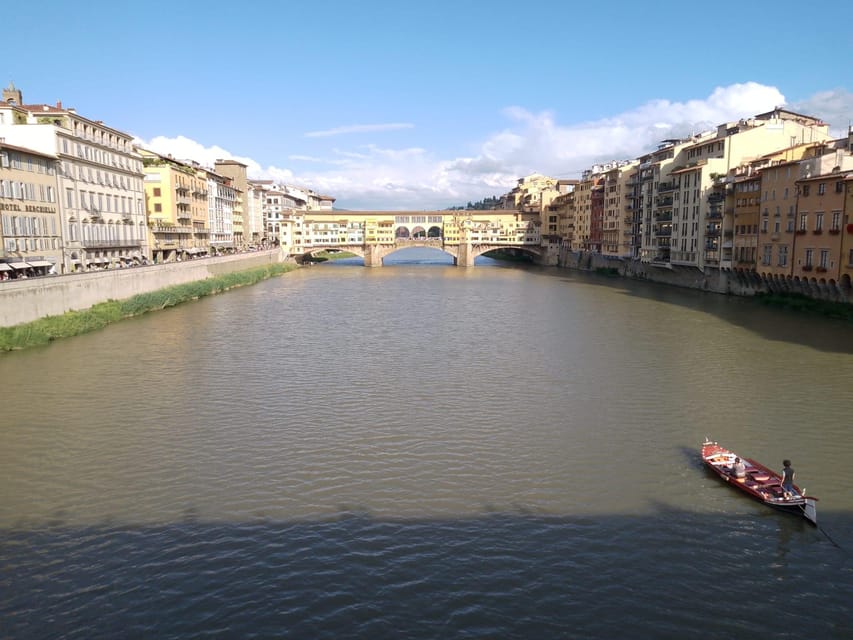
From Piazza della Signoria, the walk continues to Ponte Vecchio, Florence’s oldest bridge. It crosses the Arno and is lined with jewelry shops, a tradition linked to the Medici era.
The bridge is one of Florence’s most photographed sights, so expect people and limited space. You will have time for photographs and a guided explanation, but this is not a slow shopping visit. Keep your group close and watch your footing around the bridge approaches.
Ponte Vecchio is more than a pretty crossing. It shows how Florence’s commercial life and political life were joined together. The bridge carried people and goods across the river while also forming part of the city’s Medici story.
The route then reaches the Oltrarno district, where Pitti Palace recalls the scale and wealth of Florence’s ruling families. The palace itself is not listed as an extended interior visit on this tour, so think of this section as an orientation walk rather than a palace tour.
That distinction is useful. If you want detailed time inside Pitti Palace, you will need a separate ticket and a separate visit. Here, the value is in connecting the palace, the bridge, the Medici family, and the neighborhoods on either side of the Arno.
Republic Square and Florence’s changing city center
Piazza della Repubblica is another brief stop, listed for about 10 minutes. The square presents a different side of Florence from the medieval lanes and Renaissance palaces.
It is broad and open, with an urban feel shaped by later changes to the city. Antonio uses stops like this to add anecdotes about Florence beyond the standard art-history script. That can make the city easier to read as a living place rather than a museum set.
Do not expect a long historical lecture here. The stop is short, and the main purpose is to orient you as the walk moves toward the cathedral district.
A completely different way to spend an afternoon in Florence:
- Florence: Michelangelo’s David Skip-the-Line Entry Ticket
★ 4.5 · 12,764 reviews - The Best tour in Florence: Renaissance & Medici Tales – guided by a STORYTELLER
★ 5.0 · 12,316 reviews - Florence: Leonardo Interactive Museum Entry Ticket
★ 4.5 · 11,763 reviews - The Best Tour in Florence: Renaissance and Medici Tales
★ 5.0 · 10,810 reviews
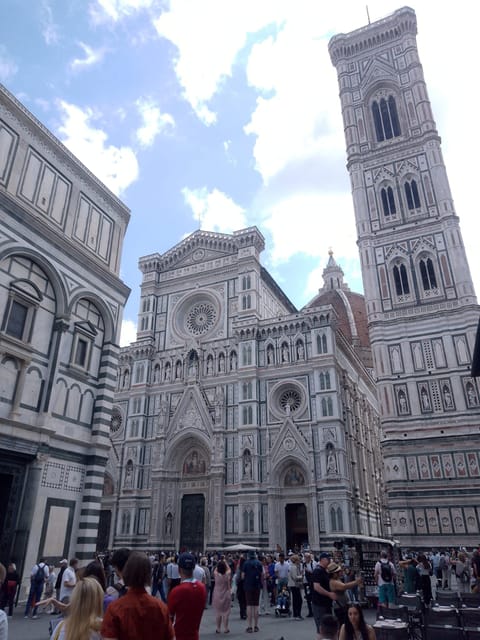
The Duomo, Brunelleschi’s dome, and Giotto’s bell tower
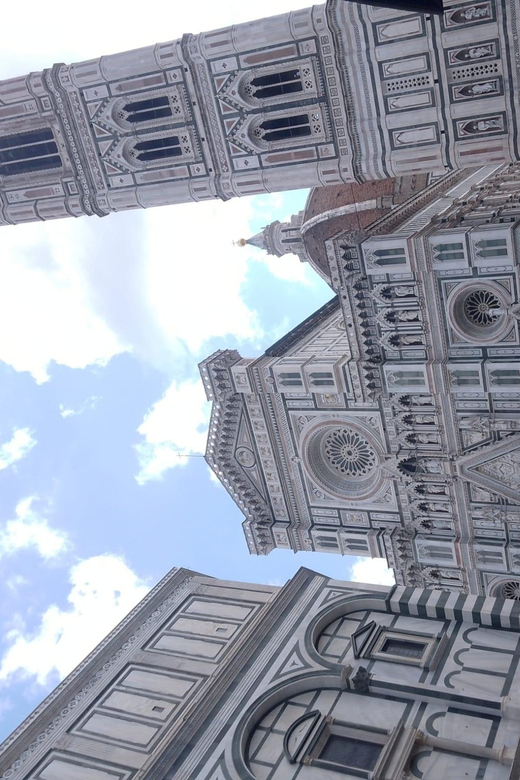
The Cathedral of Santa Maria del Fiore is one of Florence’s defining sights. Its enormous dome, designed by Filippo Brunelleschi, transformed architectural history and remains the visual center of the city.
The tour includes photo stops and guided explanations at the cathedral, Brunelleschi’s Dome, and Giotto’s Bell Tower. These are listed as separate points, but they form one connected cathedral complex. The total time is roughly 35 minutes, so the focus is on viewing, interpretation, and photographs rather than climbing the dome or bell tower.
That is an important practical point. The activity does not list entry to the dome, bell tower, or cathedral as an included interior visit. If you want to climb Brunelleschi’s Dome, you will need to arrange that separately.
The external view still gives you plenty to appreciate. The cathedral’s scale is hard to grasp from one angle, and the nearby bell tower adds another layer of colored marble, sculpture, and vertical ambition. Antonio can help you connect the buildings to Florence’s competition for civic prestige.
I like having these stops in the middle of the walk. After the political drama of Piazza della Signoria and the commercial story of Ponte Vecchio, the cathedral shows Florence competing through architecture.
Santo Trinita and the quieter road to Santo Spirito
Piazza Santa Trinita is a smaller, more relaxed stop on the route. It gives you a chance to slow down and hear more about the city’s churches, streets, and local traditions.
This part of the tour is useful because it moves away from Florence’s most obvious landmarks. The walk is still central, but the emphasis shifts from famous façades to details and anecdotes that you might miss when exploring alone.
The tour description places strong emphasis on avoiding tourist traps and sharing local places for food, drinks, music, museums, gardens, and wine tasting. Antonio’s secret diary is provided as a photograph, so you can save the recommendations and use them later during your stay.
The diary is one of the more practical features of the experience. You are not just collecting facts about the past. You are also getting a starting point for choosing where to eat or what to visit after the tour. Since the exact businesses and current opening hours can change, use the list as guidance and check details before setting out.
Michelangelo’s 17-year-old crucifix at Santo Spirito
The final major stop is Basilica di Santo Spirito, and this is where the tour gains its most personal art-history moment.
Michelangelo lived at the monastery here around 1492, after the death of his patron Lorenzo de’ Medici. The monks allowed him to study corpses from the monastery hospital. That unusual access helped him examine the human body closely, strengthening the anatomical understanding seen in his later sculpture.
Inside the church, you can see a wooden crucifix attributed to Michelangelo and carved when he was just 17. It is far less famous than David or the ceiling of the Sistine Chapel, but that is part of its appeal. The work offers a glimpse of the young artist before his public fame became enormous.
Look for the early signs of his interest in proportion, anatomy, and the physical reality of the human body. The crucifix also carries a quieter spiritual quality. It is not simply a study of form. Its small scale and devotional purpose make it feel more intimate than Michelangelo’s grand public commissions.
This is a fitting ending because the tour has moved from public rivalry to private study. In Piazza della Signoria, Michelangelo appears as a civic champion. At Santo Spirito, you see the young artist learning through close observation, discipline, and access to a place most people could not enter.
The church visit is listed for about 30 minutes. That allows time to appreciate the setting, hear the story, and consider the crucifix without rushing straight back into Florence’s busy streets.
Antonio’s storytelling and the small-group approach
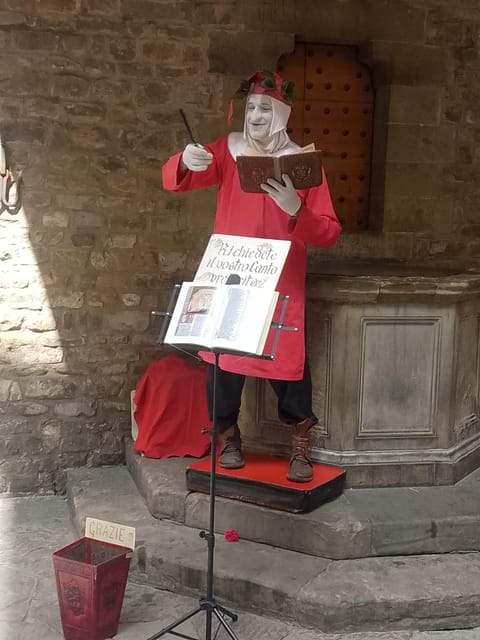
Antonio is the named guide for this experience, and his style is central to its appeal. The strongest praise focuses on his enthusiasm, storytelling, and ability to connect Renaissance figures with more recent Florence, architecture, and Tuscan food traditions.
The tour is described as relaxed and personal rather than a large procession. That matters in Florence, where narrow streets and crowded squares can make it hard to hear a guide. A smaller group usually makes it easier to ask questions and stay engaged, though the exact group size is not specified.
Antonio’s approach also seems suited to people who want more than dates. He brings in anecdotes about the city and points out places you might not notice alone. You should still expect a history-led walk, not a food tour or a full museum tour.
The language is English, and the guide is live rather than audio-based. Bring your questions. The rivalry between Leonardo and Michelangelo gives you plenty to discuss, especially if you are interested in how artists worked, competed, and depended on wealthy patrons.
What the €53 price gives you
At €53 per person, this is not the cheapest way to see Florence’s streets. The value depends on how much you want from a guide.
You are paying for three hours of live explanation, a focused story, guided access to the listed landmarks, photo breaks, and Antonio’s recommendations for later meals and visits. The route also includes Santo Spirito and Michelangelo’s wooden crucifix, which many first-time visitors could easily miss.
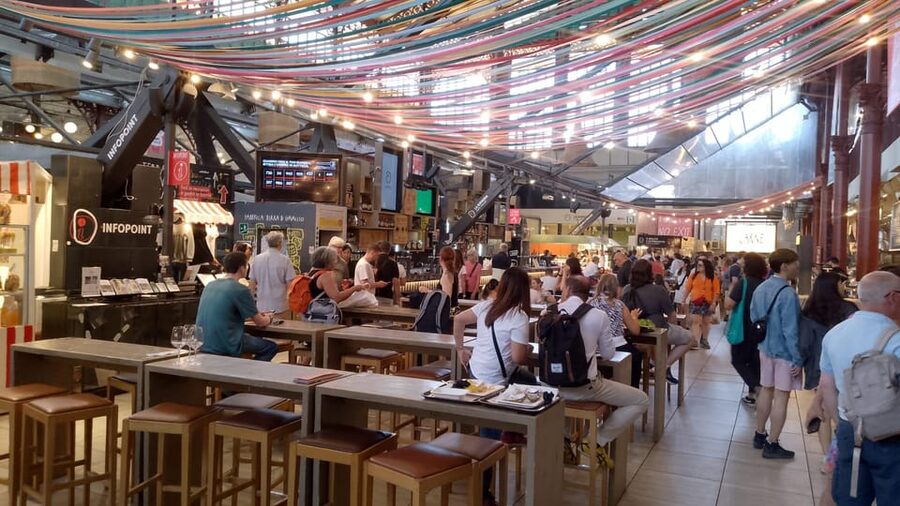
The price does not cover transport or hotel pickup and drop-off. The walk begins at the Neptune statue and ends at Mercato Centrale, so plan to make your own way to the meeting point and onward from the market.
Food and drinks are listed among the inclusions, but the exact form is not specified. I would confirm what is covered before booking if this affects your budget. Do not assume it means a full meal or a set tasting.
The optional add-ons are clear: the Medici Chapel can be added for €19, and Leonardo’s interactive museum for €9 with online booking. These extras may suit you if you want more indoor content, but they are not essential to the main walking route.
Free cancellation up to 24 hours before the start and reserve-now, pay-later terms add useful flexibility. That is helpful when your Florence schedule depends on train times, weather, or museum reservations.
Timing, footwear, and summer heat
Three hours is a sensible length for a first orientation to Florence. It is long enough to connect several districts but short enough to fit around a museum visit or dinner.
You will be on your feet for the full route. Wear comfortable shoes and comfortable clothes. The route includes city streets, bridges, squares, and church interiors, so practical footwear matters more than looking polished.
Florence can become very hot in summer. Bring at least 500 milliliters of water and wear a hat. The tour includes breaks for photographs, but do not count on those pauses to replace regular hydration.
The walk is not suitable for children under two or babies under one. Older children may enjoy the dramatic rivalry and the open-air sculpture, but the three-hour pace and art-history focus may be a better match for older children and adults.
Who should book this Florence walk
I would choose this tour if you want a strong introduction to Florence before exploring museums on your own. It is especially useful if you enjoy art but prefer stories and city streets to a long lecture inside a gallery.
It also suits you if you have already seen the Duomo and Ponte Vecchio but want a more connected explanation of what they mean. The Leonardo and Michelangelo theme keeps the experience focused, while the Medici and food recommendations give it a wider local frame.
You may want something else if your main goal is extended museum time. The Uffizi appears in the wider story, but this is not an Uffizi tour with a dedicated interior visit. The cathedral, dome, bell tower, and Pitti Palace are also approached as landmarks rather than full admissions.
The best timing is early in your Florence stay. Use Antonio’s recommendations afterward, then return to the museums or churches that caught your attention. Ending at Mercato Centrale also makes it convenient to continue with food and market exploration.
Should you book Florence Unveiled?
Book it if you want Florence explained through people, power, and artistic competition rather than a checklist of monuments. The most distinctive part is the final visit to Santo Spirito and Michelangelo’s early wooden crucifix, supported by Antonio’s lively storytelling and local advice.
Skip it if you want a quiet, self-guided walk or a tour built around long museum visits. The route is active, the main sights are mostly viewed from outside, and the exact food-and-drink inclusion should be clarified before you pay.
For €53, the tour offers good value when you want a personal introduction, practical Florence suggestions, and a clear story to carry through the rest of your visit. The combination of famous landmarks and less obvious Michelangelo material gives the walk a reason to exist beyond the usual city highlights.
FAQ
Where does the tour meet?
The meeting point is the Fountain of Neptune beside Palazzo Vecchio in Piazza della Signoria.
Where does the tour finish?
The walk finishes at Mercato Centrale.
How long does the tour last?
The tour lasts three hours.
What language is the tour conducted in?
The live tour guide speaks English.
Is transport included?
No. Transport, pickup, and drop-off are not included.
Can I cancel the booking?
Yes. You can cancel up to 24 hours in advance for a full refund. The reserve-now, pay-later option lets you hold your place without paying immediately.
Recently added around Florence
- Accademia and Uffizi Small-group Guided Tour★ 4.5 · 8 reviews
- The David from Michelangelo.★ 5.0 · 3 reviews
- Combo: Accademia + walking + Uffizi Galleries Guided Tour★ 3.5 · 6 reviews
- The Complete Wine Tour Brunello, Nobile, Chianti wine experience★ 4.0 · 7 reviews
- The Best of Tuscany in 3 Days★ 4.5 · 13 reviews
- The Cooking Lab – Authentic Food Experience★ 5.0 · 113 reviews
- Florence Central Market Food Tour – Private Tour★ 4.0 · 7 reviews
- Family Friendly Florence Private City Tour★ 5.0 · 47 reviews