
Reviewed · GALILEO AND LEONARDO MUSEUM TOURS
Florence: Museo Galileo Entry Ticket
Florence is famous for paintings and marble saints, but Museo Galileo offers a different view of the city: the Renaissance as a scientific workshop. You’ll see original instruments linked to Galileo, huge armillary spheres, early microscopes, clocks, maps, and devices that made astronomy and engineering possible.
I like the flexible one-day admission, since you can visit at your own pace instead of being tied to a strict tour schedule. I also like the calm atmosphere. This museum is often much quieter than the Uffizi, making it a smart change of pace between major sights. The main drawback is that the displays can feel text-heavy, and the optional app guide is not always easy to follow.
Key points
- Galileo’s original instruments: See telescopes, thermometers, microscopes, and meteorological tools connected to Galileo’s work.
- Medici scientific collections: Examine quadrants, astrolabes, compasses, armillary spheres, sundials, and other carefully made instruments.
- A broader story than Galileo alone: The museum follows science, mathematics, medicine, mechanics, and technology across several centuries.
- Flexible admission: Your voucher provides entry for one day, and visitors have used it at different times during opening hours.
- Good rainy-day and family stop: The displays suit science fans, curious children, and anyone wanting a break from Florence’s churches and paintings.
- Plan at least two hours: You can pass through in about an hour, but the collection rewards a slower visit.
Why Museo Galileo changes your view of Florence
Museo Galileo is not simply a room about one famous astronomer. It explains how Florence’s ruling families supported scientific work alongside painting, sculpture, architecture, and music.
The Medici collected scientific instruments as carefully as they collected art. Their early collection was displayed in the Stanzino delle Matematiche, or Mathematics Room, in the Uffizi Gallery. At Museo Galileo, you can see the tools that helped scholars measure the sky, study motion, calculate distance, track time, and test new ideas.
That connection matters. You begin to see the Renaissance not only as a period of beautiful art, but also as a period of practical experiment. An ornate armillary sphere may look like decoration at first glance, yet it was also a working model of the heavens. A compass or quadrant could guide navigation, surveying, and military planning.
I especially like the way the museum links one advance to the next. The collection shows how earlier work by Greek and Roman thinkers, including Ptolemy, helped create the conditions for later discoveries. Galileo’s work then becomes part of a longer chain rather than an isolated miracle.
More Galileo and Leonardo museum visits:
- Florence: Leonardo Interactive Museum Entry Ticket
★ 4.5 · 11,763 reviews - Leonardo Da Vinci Museum Entrance Ticket
★ 4.5 · 1,458 reviews - Leonardo Interactive Museum® Entrance Ticket
★ 4.5 · 583 reviews
The Medici rooms and the science of looking upward
The Medici collection occupies the first part of the visit. Across the rooms, you’ll find instruments for astronomy, geometry, navigation, and measurement.
Look for quadrants and astrolabes, which helped users calculate positions and angles. These objects are not always easy to understand from a quick glance, so take time to read the labels or use the museum’s audio material. Their value becomes clearer when you imagine using them without digital displays, satellites, or electronic calculators.
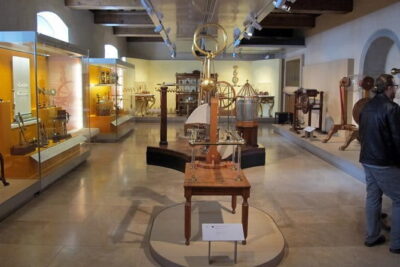
The armillary spheres are among the most visually striking objects. Their interlocking rings represent the movements of celestial bodies and the structure of the heavens as early scholars understood it. Some are large enough to dominate a room, while others show the fine workmanship expected from a court collection.
You’ll also see dials, compasses, meridians, and sundials. Many are beautifully made, with engraved markings and decorative details. This is one of the museum’s strengths: the objects are scientific equipment, but they are also works of craft.
The collection can feel dense. There are many similar-looking instruments, and the differences between them may not be obvious at first. I suggest choosing a few objects and asking what problem each one solved. That simple question makes the displays easier to follow.
Galileo’s instruments and the turning point in astronomy
The Galileo section gives the museum its name and its strongest draw. You’ll see original instruments associated with Galileo, along with devices tied to the scientific work that followed.
The displays include telescopic equipment, thermometers, microscopes, and meteorological instruments. The important point is not only that these objects are old. It is that they represent a new habit of investigation: observe, measure, test, and revise.
Galileo’s instruments help you picture the limits and possibilities of early scientific work. These were delicate tools, often made by skilled craftsmen, and they demanded patience from the person using them. There was no quick digital reading. A small error in alignment or measurement could change the result.
One memorable display concerns Galileo’s missing finger. It is an odd and slightly macabre detail, but it gives the museum a human edge. The collection is full of grand ideas, yet it also contains the strange physical remains and personal traces that make historical figures feel less remote.
You may also find copies of Galileo-related instruments that visitors can use or test. These models help explain ideas about motion and mass better than a label alone. Still, the museum is not an interactive science center. Many objects are intended for careful viewing, and some visitors would like more chances to handle working models.
The Lorraine collection and later mechanical inventions
The second-floor rooms shift the focus toward the Lorraine family and later scientific development. Here, the subjects include mechanical, electrostatic, and pneumatic applications.
This section helps you see how science moved from observing the heavens to controlling forces and building machines. Mechanical devices show the importance of gears, movement, balance, and precision. Electrostatic and pneumatic instruments reveal attempts to understand electricity and air pressure long before modern laboratory equipment.
You’ll also find mechanical clocks, sextants, octants, pharmaceutical and chemical apparatus, weights, and measures. These objects broaden the museum beyond astronomy. If your interest is engineering, medicine, navigation, or the history of technology, this is where the visit becomes especially useful.
The displays can feel like a long sequence of specialized equipment. I recommend taking a short break between sections and thinking about the basic purpose of each group. The clock collection is about reliable time. The navigational instruments are about position and direction. Weights and measures are about making trade and science more consistent.
That approach keeps the visit from becoming a parade of unfamiliar names. You do not need to understand every technical detail to appreciate the larger story.
More tickets and passes in Florence:
- Florence: Skip-The-Line Uffizi Gallery Timed Entry Ticket
★ 4.5 · 27,832 reviews - Florence: Timed Entrance Ticket to Michelangelo’s David
★ 4.6 · 16,983 reviews - Florence: Michelangelo’s David Skip-the-Line Entry Ticket
★ 4.5 · 12,764 reviews - Florence: Uffizi Priority Ticket & Masterpieces Audio App
★ 4.2 · 6,402 reviews
How long to spend inside the museum
The museum can work as a one-hour stop, especially if you want a quick look at Galileo and the most unusual instruments. I would allow at least two hours for a proper visit.
Science fans may want three hours, particularly if they read the labels and use the audio material. One visitor found that even two hours did not feel sufficient, and that is easy to understand. There are many objects, and the museum covers several fields rather than presenting one narrow subject.
The flexible admission makes this easier. You can enter during the day without rushing through every room in a fixed tour group. If you are combining the museum with the Uffizi, it is a convenient stop nearby. You can visit before or after the art museum and adjust your time according to your energy.
Do not plan this as a five-minute photo stop. The objects are small in detail, and the labels carry much of the explanation. A hurried walk through the galleries gives you impressive shapes and shiny brass, but not much sense of why the instruments mattered.
The self-guided format and audio option
This ticket does not include a guided tour. You explore independently, which suits visitors who want to set their own pace.
An app-based audio guide may be available, and you should bring your own earbuds or headphones if you want to use it. Some visitors found the app less intuitive than older audio systems, while others found it helpful once they got it working. Information at the front desk and clearer labeling would make the experience easier for some people.
I would not depend entirely on the app. Read the room introductions, pause at objects that catch your eye, and ask museum staff if you need help finding your way. The visit is manageable without a guide, but the scientific vocabulary can be demanding.
A guided tour could add useful context, especially if you are not comfortable with astronomy or the history of science. Since a guide is not part of this admission, decide in advance if independent exploration is enough for you.
Is the $20 ticket good value?
At $20 per person, this is not the cheapest museum ticket in Florence. Its value depends on how much time and interest you bring to the visit.
For someone curious about Galileo, astronomy, mathematics, or engineering, the price is reasonable. You are paying to see original scientific instruments and a large collection that cannot be reduced to a single famous object. The museum also offers a quieter experience than Florence’s biggest art sights, which adds value on a crowded sightseeing day.
For a visitor focused only on Renaissance painting, the ticket may feel less essential. Some displays require patience, and the museum does not offer the constant visual drama of the Uffizi or a sculpture gallery.
The booking fee is included in the listed price. The flexible one-day admission is useful if your schedule changes, and cancellation is allowed up to 24 hours before the visit for a full refund. A reserve-now, pay-later option is also available when offered at booking.
Visiting with children and family members
This is a good choice for families with children who like space, machines, inventions, or hands-on learning. The collection gives young visitors plenty of questions to ask: How did people measure the stars? How did a clock keep time? How could a lens change what someone saw?
The museum is not packed with interactive stations, so children who need constant activity may lose interest. A child who enjoys STEM subjects, however, may find the instruments fascinating. Copies of historic devices and the unusual story of Galileo’s finger can provide memorable entry points.
I would keep the visit flexible. Let children choose a few objects to study instead of insisting on every label. The museum’s size is manageable, but the amount of information is substantial.
Practical details before you go
Show your confirmation voucher at the museum on the day of your visit. The ticket is valid for one day, and the admission process has been straightforward for many ticket holders.
Check the hours carefully, especially on Tuesdays. The museum closes at 1:00 PM on that day, which can catch you out if you leave it until afternoon.
The museum is wheelchair accessible, and an elevator is available for visitors with mobility needs. Seating inside may be limited, so anyone who needs frequent rest should plan a slower pace and ask staff for help.
Bring earbuds if you want to connect to the audio material on your phone. You may be able to buy them at the front desk, but bringing your own is simpler.
The museum is near the Uffizi, making it easy to pair with a day of central Florence sightseeing. I would avoid stacking it immediately after several hours of intense gallery viewing unless science is a major interest. A fresh morning visit may be more comfortable, especially on Tuesday.
Who should book Museo Galileo?
I would book this ticket if you enjoy science, astronomy, mathematics, engineering, medicine, or the story of how inventions develop. It is also a good pick if you want a thoughtful break from Florence’s churches and art museums.
You should allow two hours, use the displays at your own speed, and accept that some instruments need explanation. The museum is most rewarding when you ask what each object made possible.
I would skip it only if your Florence schedule is extremely tight or you strongly prefer paintings and sculpture. For everyone else, $20 buys a calm, unusual, and intellectually rewarding museum visit. It gives you a better sense of how measurement, observation, and technical skill helped shape the Florence you came to see.
FAQ
How much does the Museo Galileo entry ticket cost?
The listed price is $20 per person, including the booking fee.
How long is the ticket valid?
The ticket is valid for one day.
Does the ticket include a guided tour?
No. The ticket includes entry to Museo Galileo, but not a guided tour.
Can I cancel the booking?
Yes. You can cancel up to 24 hours in advance for a full refund.
Can I reserve now and pay later?
Yes. A reserve-now, pay-later option is available to keep your plans flexible.
What can I see at Museo Galileo?
You can see Galileo’s original instruments, astronomical devices, thermometers, microscopes, meteorological instruments, clocks, sextants, octants, pharmaceutical and chemical apparatus, weights, and measures.
How many rooms does the museum have?
The experience describes 18 thematic rooms covering the museum’s scientific collections.
Is Museo Galileo open all day on Tuesdays?
No. On Tuesdays, the museum is open only until 1:00 PM.
Is the museum wheelchair accessible?
Yes. Museo Galileo is wheelchair accessible, and an elevator is available.
Should I bring headphones?
Bring earbuds or headphones if you want to use the audio material through the museum’s app. Headphones may also be available for purchase at the front desk.
Recently added around Florence
- Accademia and Uffizi Small-group Guided Tour★ 4.5 · 8 reviews
- The David from Michelangelo.★ 5.0 · 3 reviews
- Combo: Accademia + walking + Uffizi Galleries Guided Tour★ 3.5 · 6 reviews
- The Complete Wine Tour Brunello, Nobile, Chianti wine experience★ 4.0 · 7 reviews
- The Best of Tuscany in 3 Days★ 4.5 · 13 reviews
- The Cooking Lab – Authentic Food Experience★ 5.0 · 113 reviews
- Florence Central Market Food Tour – Private Tour★ 4.0 · 7 reviews
- Family Friendly Florence Private City Tour★ 5.0 · 47 reviews
Galileo and Leonardo Museum Tours, compared.


Skip the Line: Galileo Museum Ticket in Florence
Read our review →
Express Uffizi Gallery and Leonardo da Vinci Museum
Read our review →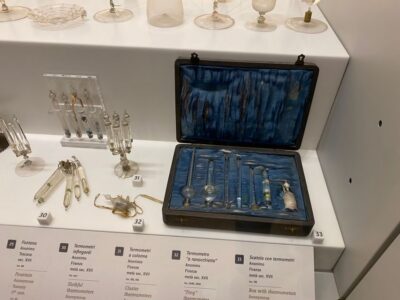
Browse the lists this tour appears in