
Reviewed · SANTA CROCE AND FLORENCE CHURCHES
Private Guided Visit Florence’s Santa Croce Basilica and Ancient Leather School
Santa Croce gives you two very different sides of Florence in one compact visit: a grand Franciscan church filled with Renaissance art and tombs, followed by a working leather workshop where craftspeople still make bags, belts, and purses by hand. I especially like the private guide, since guides such as Lisa, Ilaria, Marta, Tiziana, and Andrea have been praised for making complex art and city history easy to follow. I also like the chance to see the Pazzi Chapel and cloisters, not just the main church.
The main thing to watch is the tour’s timing. It is sold as about 90 minutes, with roughly an hour at the basilica and 30 minutes at the Leather School, but one detailed account found the church and convent portion lasted closer to two hours. The €8 basilica admission is extra, and the Leather School is closed Saturday and Sunday.
Key Points at a Glance
- See the tombs of Michelangelo, Galileo, Machiavelli, and Ghiberti inside Florence’s great Franciscan church.
- Study Renaissance art by Giotto, Agnolo Gaddi, and Donatello with a private English-speaking guide.
- Walk through the Brunelleschi Cloister and Pazzi Chapel, two calmer spaces away from the main nave.
- Watch leatherworkers make Florentine goods by hand at the adjacent Scuola del Cuoio.
- Choose a morning or afternoon departure and tour only with your own group.
- Plan for the €8 entrance fee, which is not included in the tour price.
Why Santa Croce Is More Than a Church Visit
Santa Croce is one of Florence’s great places for connecting art with actual people. The church is not only a Gothic building with painted chapels. It is also a memorial hall for figures who shaped Italian art, science, politics, and literature.
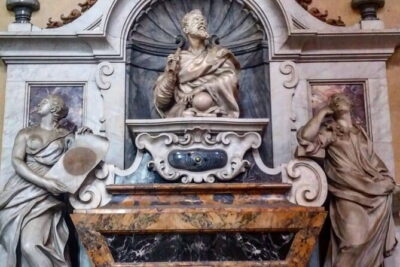
Inside, you can see the tombs of Michelangelo and Galileo, along with monuments to Machiavelli and Ghiberti. These memorials give the visit a human focus. Instead of looking at anonymous decoration, you are looking at the final resting places of people whose work still shapes the way you understand Italy.
I find a private visit especially useful here because Santa Croce can feel visually crowded with details. A guide can point out a fresco, tomb, or architectural feature, then explain why it matters. Guides named in past bookings include Lisa, Ilaria, Marta, Tiziana, Andrea, and Andreus. The assigned guide can vary, but the experience is designed around one guide for your own group.
The tour is offered in English. The guides have been praised for clear English, patience, and the ability to answer questions about both the basilica and Florence beyond its walls. That makes this a good choice if you want more than a quick walk through the church but do not have a background in art history.
More churches and chapels in Florence:
- Florence: Santa Monaca Church Italian Opera Concert Ticket
★ 4.7 · 2,692 reviews - Florence: Santa Maria Novella Entry Ticket & Audioguide
★ 4.3 · 717 reviews - Italian Opera Concert Ticket in Florence’s Santa Monaca Church
★ 4.5 · 602 reviews
Meeting the Guide in Piazza Santa Croce
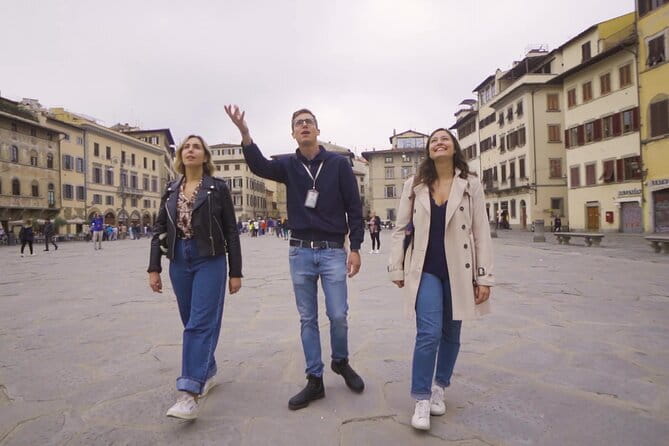
You meet near the entrance to Santa Croce Basilica at Piazza Santa Croce, 16. This is a central location, and the area is served by public transportation, but the tour does not include hotel pickup or drop-off.
I would arrive a little early. The meeting point is in a busy public square, and finding the exact entrance is easier when you are not rushing. Confirmation is provided at booking, so keep the meeting details available on your phone.
The tour has morning and afternoon departure choices. Morning can work well if you want to visit Santa Croce before filling the rest of your day with Florence’s major sights. An afternoon visit may fit better after a morning at another museum, though you should check the Leather School schedule carefully if that part matters to you.
Because this is a private activity, only your group participates. That changes the pace in a useful way. You can stop to ask about a tomb or painting instead of waiting for a large group to move along. For a couple, family, or small group with mixed interests, that personal pace is a major part of the value.
The Marble Façade and the Franciscan Interior
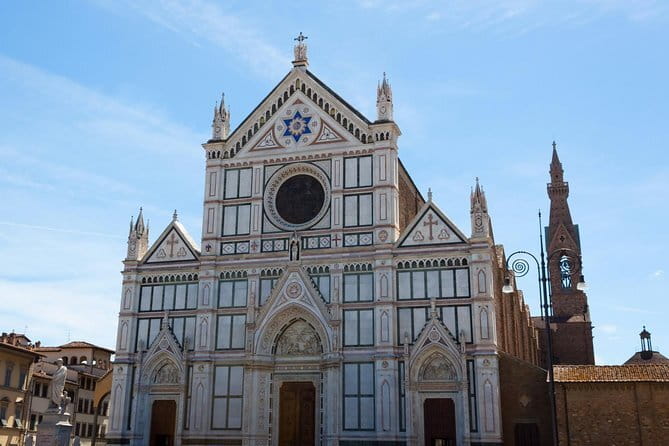
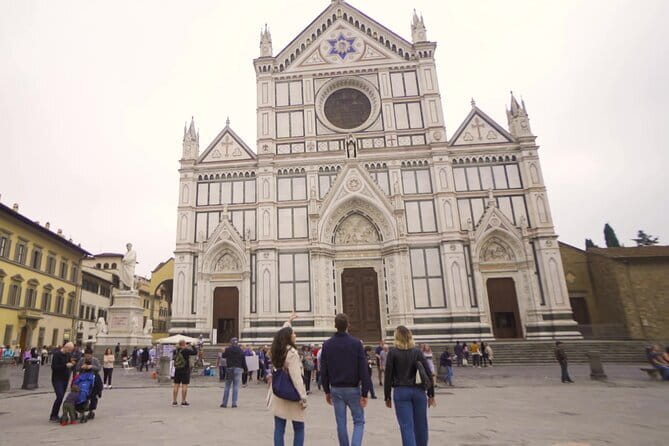
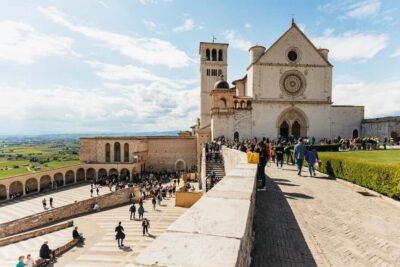
Your visit begins outside, where the church’s neo-Gothic façade is covered in polychrome marble. The patterned exterior immediately signals that this is not a modest neighborhood church, even though Santa Croce began as a Franciscan foundation outside Florence’s old city walls.
Once inside, your guide introduces the church’s nearly 700-year story. The Franciscan setting matters. Santa Croce developed as a place of worship, teaching, burial, and artistic patronage, and those roles overlap throughout the building.
The church is often described as the world’s largest Franciscan church. Its scale can be impressive, but the most useful part of the visit is learning how to read the smaller sections within it. Chapels, fresco cycles, sculpture, and memorials each tell a different part of Florence’s story.
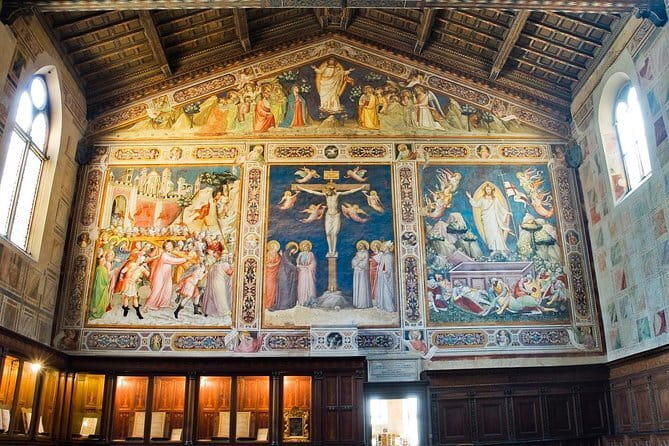
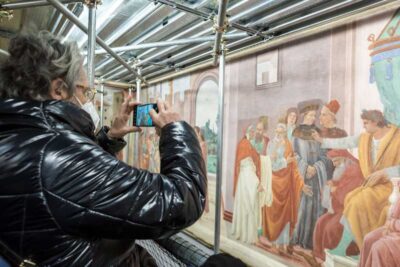
You will see frescoes connected with artists such as Giotto and Agnolo Gaddi. You will also encounter Donatello works, including a Crucifix and Annunciation. These are not just names to tick off. With a guide, you can ask about the difference between painted and sculpted religious images, how the works fit into the church, and what details you might otherwise miss.
The tour is particularly helpful for visitors who enjoy art but do not speak the language of specialists. One guide, Marta, was praised for explaining the works in an approachable way and for encouraging questions. That is the right approach for Santa Croce, where a long list of famous names can otherwise turn into a blur.
The Tombs of Florence’s Famous Sons
The funerary monuments are one of Santa Croce’s strongest reasons to visit. Michelangelo, Galileo, Machiavelli, and Ghiberti are among the figures commemorated here.
These monuments vary in style and purpose. Some celebrate artistic achievement, others scientific work or political thought. Together, they create a portrait of Florence as a place where creative, intellectual, and civic life have long overlapped.
I like this section because it gives you a clear thread through the church. You are not simply admiring marble and frescoes. You are seeing how later generations chose to remember major figures, and how those memories became part of the church itself.
A private guide also helps you spend time where your own interest lies. If you care most about Galileo, you can ask more about his place in Florentine history. If sculpture interests you, you can focus on the tomb designs and Donatello’s work. The experience is not built around a fixed large-group script.
More artisan workshops in Florence:
- Florence: Perfume Masterclass and Sensory Experience
★ 4.7 · 463 reviews - Perfume Masterclass in Florence: Make your Own Personal Fragrance
★ 4.5 · 253 reviews - Handmade Tuscan Ceramics Masterclass in Montelupo
★ 5.0 · 205 reviews - Private jewelry class in Florence, Tuscany, Italy (4 hours)
★ 5.0 · 90 reviews
Brunelleschi’s Cloisters and the Pazzi Chapel
After the main church, the route continues into the cloisters. The Brunelleschi Cloister is bordered by columns carved from stone, giving it a more measured and peaceful feel than the decorated interior.
This is a good point in the visit to slow down. The cloister spaces show how Santa Croce functioned as a religious complex, not just a single church. The open layout, columns, and quiet atmosphere offer a welcome change after the visual density of the nave and chapels.
The route then reaches the fourteenth-century Ancient Cloister and the Pazzi Chapel. The chapel is associated with Brunelleschi and is valued for its balanced Renaissance design. Its appeal is not based on size. It is the sense of proportion and calm that makes it memorable.
If you are short on time in Florence, this part adds real value. You get architecture, religious history, and a quieter setting without traveling to another part of the city. It also makes the visit feel more complete than a simple look at the famous tombs.
The exact time spent in the basilica and convent areas can vary. The advertised tour lasts about an hour and a half overall, but a detailed account described nearly two hours for the basilica and convent before the Leather School visit. If you have a timed reservation elsewhere, leave a cushion.
The Ancient Leather School and Florentine Craft
The Scuola del Cuoio sits beside the basilica and connects the Franciscan complex with Florence’s long leatherworking tradition. Franciscan monks began working with hides and leather in this area as early as the thirteenth century.
The location near the Arno River was practical. Leather processing required large amounts of water, so the river helped support the early work. Over time, the methods were preserved through generations of craftspeople working in the school’s workshops.
During the visit, you can watch artisans make leather goods by hand. Purses, bags, and belts are produced using traditional methods, and you may see the care that goes into cutting, shaping, finishing, and decorating the pieces.
The Leather School is a useful contrast to Santa Croce. The basilica presents Florence through monumental art and famous names. The workshop presents Florence through skilled manual work that continues in the present. You are seeing a living craft rather than only an old building.
Keep your expectations measured. The Leather School portion is listed at about 30 minutes, and the main focus of the experience is Santa Croce. It is not a long technical workshop class or an extended craft lesson. You receive an introduction to the school and see artisans at work.
If you want to spend more time examining products or discussing custom work, you may need to continue on your own after the guided portion. Staff at the school can provide more help, and one detailed account described spending an additional hour making selections and watching items being customized and packaged.
The school is closed on Saturday and Sunday. If the workshop is important to you, book a weekday visit. The basilica portion remains the main attraction, but missing the school would change the balance of the experience.
What the $124.82 Price Really Buys
At $124.82 per person, this is not a budget walk-in visit. The €8 Santa Croce admission is also extra, so you should add that to your planning. The price pays mainly for the private guide and the ability to shape the visit around your group.
That value makes the most sense for people who want explanations. If you are happy to read labels and wander independently, entering the basilica on your own will cost less. If you want someone to connect Giotto, Donatello, Brunelleschi, Michelangelo, Galileo, and the Franciscan story, the private format can justify the higher cost.
Group discounts are available, though the exact saving depends on the booking. The tour includes earphones for groups of more than seven participants. Since the activity is private, that detail will matter most to larger family or friend groups.
I would also consider the cost in relation to time. Florence has no shortage of famous museums, but Santa Croce and the Leather School combine major art, memorials, architecture, and craft in one visit. You avoid arranging separate explanations or finding the workshop yourself.
Who Will Get the Most From This Visit
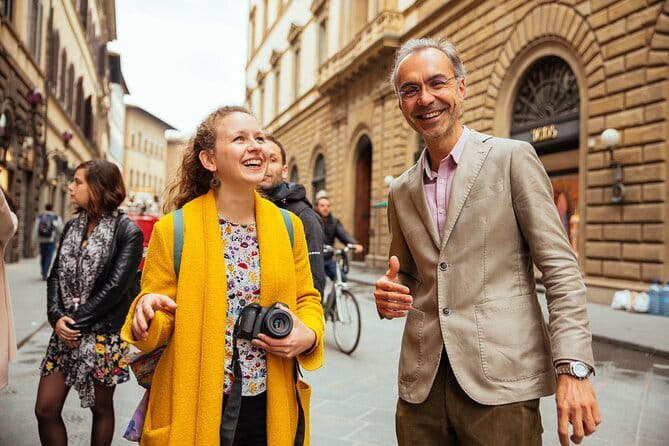
I would choose this tour if you are visiting Florence for the first time and want a clear introduction to Santa Croce. It also suits returning visitors who want to focus on art, tombs, or Franciscan architecture rather than simply checking off another church.
Families can benefit from the private setting because children can ask questions without holding up a large group. The same applies to anyone who prefers a slower pace or wants explanations in plain English.
Art lovers will find plenty to discuss, but you do not need formal art training. The guides have been praised for making the material accessible to beginners and for answering detailed questions when interest runs deeper.
I would be more cautious if you want a long, specialized tour of leatherworking. The school visit is brief, and the church receives most of the attention. I would also avoid booking on a weekend if the Leather School is one of your main reasons for going.
Practical Details Before You Book
The tour is offered in English and has morning or afternoon departures. Confirmation arrives at booking, and most people can participate. The activity begins and ends at the basilica meeting point.
Admission to Santa Croce costs €8 per person and is not included. The Leather School admission is free. Hotel transportation is not included, so you arrange your own way to Piazza Santa Croce.
Free cancellation is available when you cancel at least 24 hours before the start time. Cancellations made less than 24 hours ahead are not refunded, and changes inside that window are not accepted.
I would book ahead rather than wait until the last day. The experience is booked an average of 43 days in advance, which suggests that private time slots can fill early, especially for popular travel dates.
Should You Book the Santa Croce and Leather School Tour?
Book it if you want Santa Croce to make sense, not just look beautiful. The private format, strong English-language guiding, famous tombs, cloisters, and Renaissance art give you a clear and personal visit. The Leather School adds a practical Florentine craft tradition that many church tours leave out.
Skip it if you only want a quick look inside Santa Croce, or if your main goal is an extended leather demonstration. For everyone else, especially first-time visitors and small groups, the combination offers a thoughtful use of about 90 minutes, with the understanding that the church portion may run longer.
FAQ
How long does the tour last?
The experience is scheduled for approximately 1 hour and 30 minutes. The basilica portion is listed at about one hour, and the Leather School visit at about 30 minutes. The church and convent portion can sometimes take closer to two hours.
What is the price per person?
The listed price is $124.82 per person. The €8 Santa Croce admission fee is not included.
Is the Santa Croce entrance ticket included?
No. You must pay the €8 admission fee per person for the Basilica of Santa Croce.
Is admission to the Leather School included?
Yes. The Leather School visit is listed as free admission.
Where does the tour meet?
You meet near the entrance to the Basilica of Santa Croce at Piazza Santa Croce, 16, in Florence.
Where does the tour end?
The activity ends back at the meeting point at Santa Croce.
Is the tour private?
Yes. Only your own group participates in the private tour.
Is the tour offered in English?
Yes. English is the listed tour language.
Is the Leather School open every day?
No. The Leather School is closed on Saturday and Sunday.
Can I cancel for a full refund?
Yes, if you cancel at least 24 hours before the experience start time. Cancellations made less than 24 hours before the start time are not refunded.
Recently added around Florence
- Accademia and Uffizi Small-group Guided Tour★ 4.5 · 8 reviews
- The David from Michelangelo.★ 5.0 · 3 reviews
- Combo: Accademia + walking + Uffizi Galleries Guided Tour★ 3.5 · 6 reviews
- The Complete Wine Tour Brunello, Nobile, Chianti wine experience★ 4.0 · 7 reviews
- The Best of Tuscany in 3 Days★ 4.5 · 13 reviews
- The Cooking Lab – Authentic Food Experience★ 5.0 · 113 reviews
- Florence Central Market Food Tour – Private Tour★ 4.0 · 7 reviews
- Family Friendly Florence Private City Tour★ 5.0 · 47 reviews
Santa Croce and Florence Churches, compared.
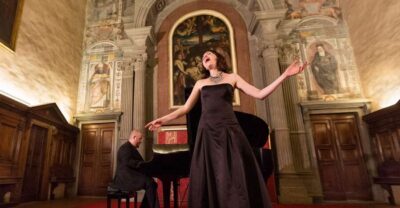
Santa Monaca Church Italian Opera Concert Ticket
Read our review →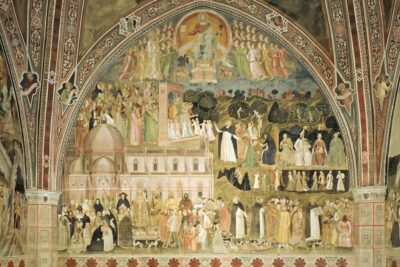
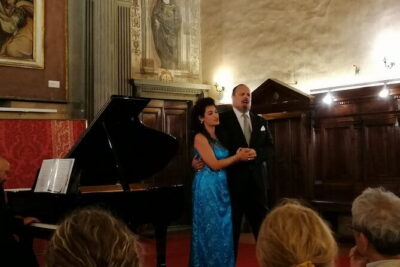
Italian Opera Concert Ticket in Florence’s Santa Monaca Church
Read our review →
Browse the lists this tour appears in