
Reviewed · ACCADEMIA GALLERY AND DAVID TOURS
Florence: Michelangelo’s David and Accademia Gallery Tour
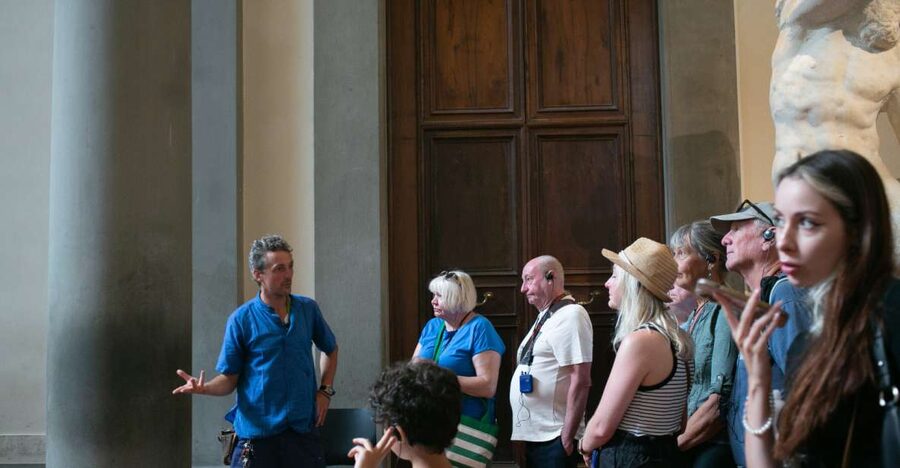
Michelangelo’s David is easy to admire and surprisingly hard to understand. This tour takes the familiar marble giant as its starting point, then follows a thread through the Prisoners and toward the Sistine Chapel. Guide Mario Gesu, a Florentine researcher and performer of Dante’s Divine Comedy, presents Michelangelo’s work as part art lesson, part philosophical conversation.
I like two things here. First, the tour asks you to think instead of simply listening to dates and labels. Second, it makes the Prisoners important rather than treating them as a quick stop on the way to David. The main consideration is that Mario’s approach can become abstract, so if you want only basic facts and a fast photo stop, this may not be your best match.
Key points at a glance
- A 75-minute visit focused on ideas: The tour centers on David, the Prisoners, and the meaning behind Michelangelo’s creative process.
- A native Florentine guide: Mario Gesu brings local knowledge, research, theatrical delivery, and a background performing Dante.
- A link to the Sistine Chapel: You explore the suggested connection between David and Michelangelo’s later work in Rome.
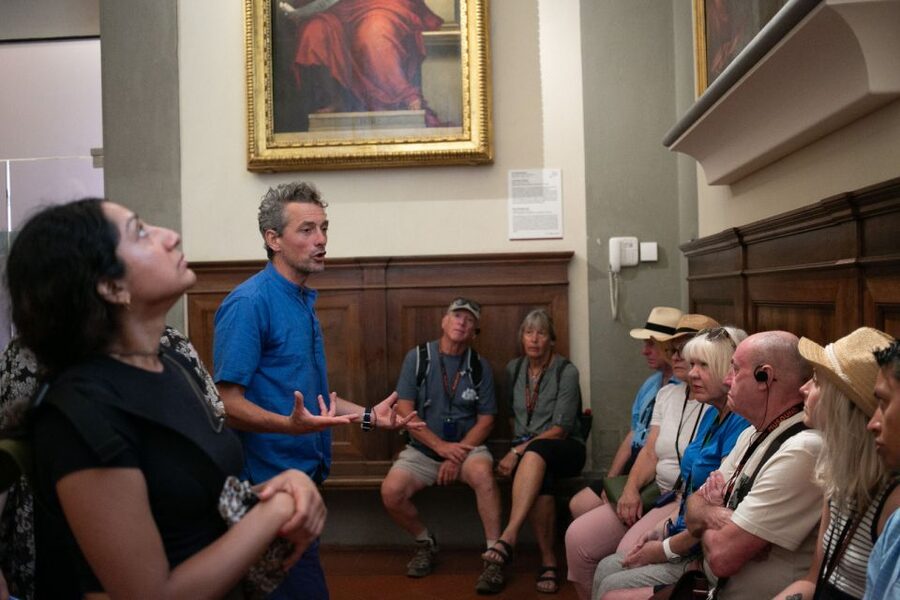
- An interactive format: Mario uses questions, images, metaphors, and discussion instead of delivering a fixed speech.
- Skip-the-ticket-line entry: You meet outside the Accademia and join the time-controlled entry process with your guide.
- Independent time afterward: Once the guided portion ends, you can continue through the museum on your own.
Why this is not a standard David tour
Many Accademia visits follow a familiar pattern. You hear when David was made, learn a few facts about Michelangelo, spend several minutes looking at the statue, and then move on. This experience takes another route.
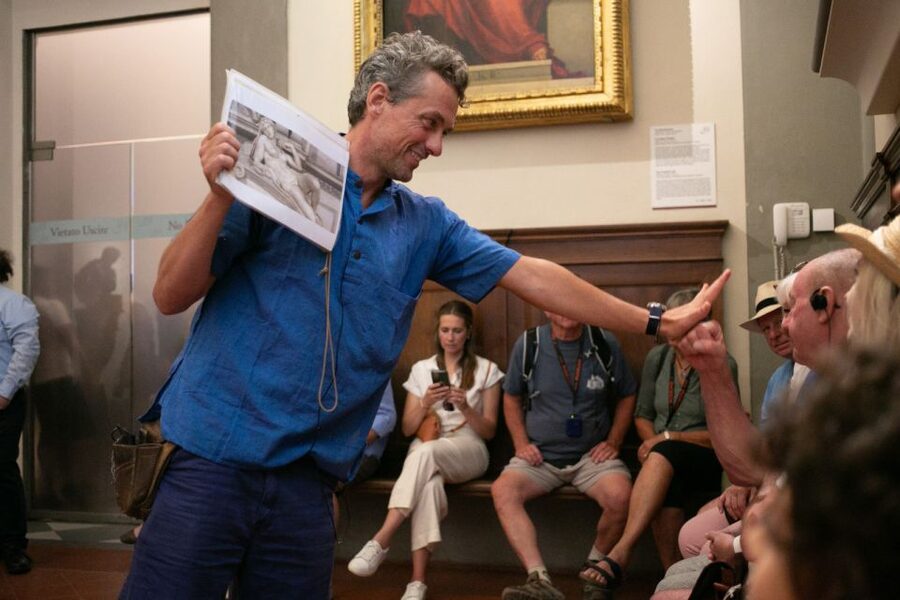
Mario begins with David as the high point of Michelangelo’s early style. From there, he leads you a few steps toward the Prisoners, which represent a later and less polished phase of the artist’s work. The contrast matters. David appears complete, controlled, and triumphant. The Prisoners seem to emerge from the stone, with parts of the marble left unfinished.
The point is not simply to compare two groups of sculptures. Mario uses the contrast to discuss how Michelangelo changed as an artist and how his ideas developed over time. You are encouraged to look at the physical process of carving as part of the message.
That makes this a good choice if you already know the basic story of David and want another way to see it. It also works for beginners because the guide explains the ideas through simple images and metaphors. Families can follow the discussion without needing a background in art history.
More ways to see the David at the Accademia:
- Florence: Timed Entrance Ticket to Michelangelo’s David
★ 4.6 · 16,983 reviews - Florence: Michelangelo’s David Skip-the-Line Entry Ticket
★ 4.5 · 12,764 reviews - Florence Accademia Gallery Tour with Entrance Ticket Included
★ 4.5 · 6,148 reviews
Meeting Mario Gesu outside the Accademia
The meeting point is at the ATM machine beside Libreria Evangelica, directly in front of the Accademia entrance. You should arrive 15 minutes before the scheduled start, since the group must gather and join the museum’s timed entry process.
Mario is more than a conventional museum guide. He is a native Florentine, a historical researcher, and an actor who performs passages from Dante’s Divine Comedy at restaurants and city events. That theatrical background helps explain the energy that runs through this tour.
You should expect an expressive guide who asks questions and invites responses. The format is designed to involve the group, not leave you standing silently while someone recites prepared information.
The headsets are useful inside the Accademia, where several groups may be speaking near the same works. The listed information also asks you to bring headphones, so follow the provider’s instructions before you leave your hotel. Bring identification for children, and carry cash and any disability card that may be needed for your party.
Punctuality matters. The group works around a scheduled museum entry, and a late arrival can be awkward. The provider also asks you to remain available by phone and email the day before in case of last-minute messages.
Entering the Accademia and reaching David
The Accademia is not a huge museum, but David creates a powerful bottleneck. Everyone wants to see the statue, and timed admissions help control the flow. The skip-the-ticket-line arrangement means you avoid the main ticket queue, though you may still encounter a short wait connected with the museum’s grouped entry system.
That distinction is worth understanding. Skip the line does not mean walking straight through every door at any time. You still need to arrive at the correct place and time, and the museum controls admission.
Once inside, the tour builds toward David rather than rushing straight to a photo. Mario may use the waiting period and the approach to establish the basic story, which means your first full look at the statue has some preparation behind it.
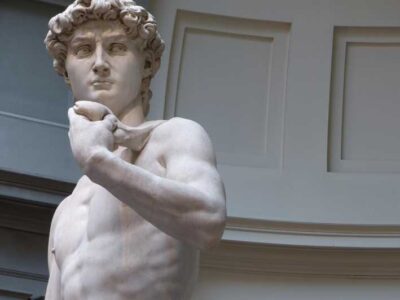
David is familiar from photographs, but the actual scale and placement change the experience. The statue is not just a small object to inspect from several angles. It dominates the room, and the tour gives you a reason to pay attention to details that can disappear when you are focused on getting a picture.
Mario’s central question is not only what David represents, but why Michelangelo presented the figure in this particular way. The discussion places the statue inside the artist’s wider development and asks you to consider the spiritual message that may sit behind the physical form.
David as the peak of Michelangelo’s early style
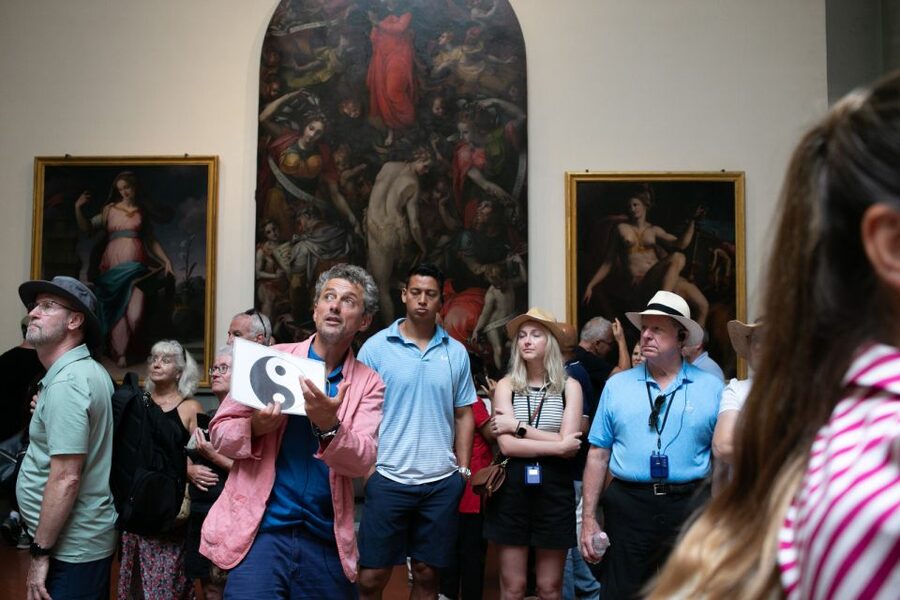
The tour treats David as the summit of Michelangelo’s young style. That framing gives you a useful starting point. You are not just looking at an isolated masterpiece. You are looking at a point in the artist’s development before the later works take him in another direction.
Mario’s method is based on a connected thread running through Michelangelo’s work. The description calls this the red thread, and the tour uses it to link David with the Sistine Chapel and other major works.
The value here is connection. Without that framework, David can feel like a single famous statue separated from everything else Michelangelo did. With it, you are asked to see repeated concerns and changes in the artist’s way of working.
The discussion is spiritual as well as artistic. Mario presents Michelangelo’s work as a way to consider creation, struggle, purpose, and the human search for meaning. You do not need to agree with every interpretation, but the questions can make the visit more memorable than a list of measurements and dates.
This is also where the interactive style matters. Mario asks the group to examine an idea and respond to it. Children can follow the metaphors, while adults may find themselves considering the larger argument behind the sculpture.
More museums and galleries in Florence:
- Florence: Skip-The-Line Uffizi Gallery Timed Entry Ticket
★ 4.5 · 27,832 reviews - Florence: Leonardo Interactive Museum Entry Ticket
★ 4.5 · 11,763 reviews - Uffizi Gallery Small Group Tour with Guide
★ 4.5 · 4,923 reviews - Florence: Accademia Gallery Guided Tour
★ 4.6 · 4,156 reviews
The Prisoners and the move toward mature Michelangelo
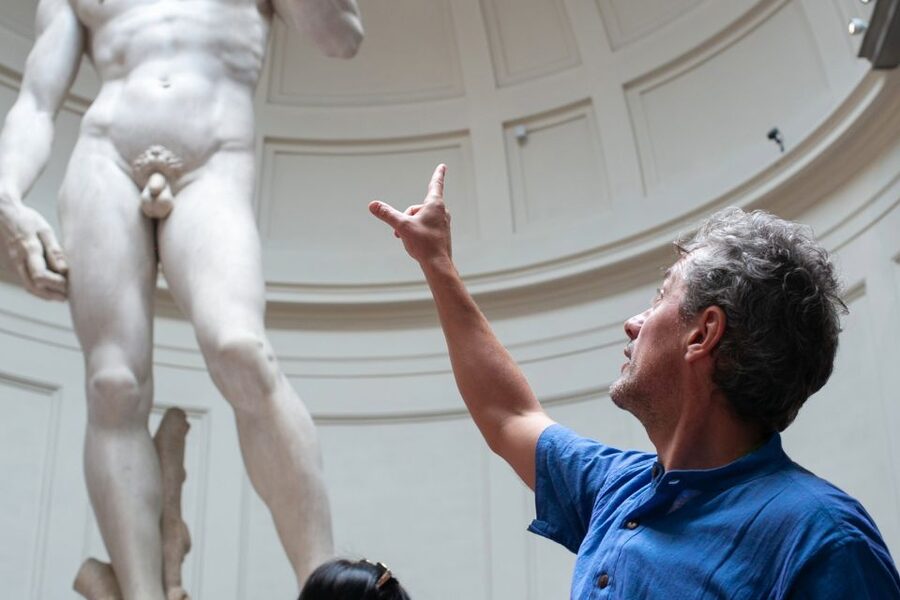
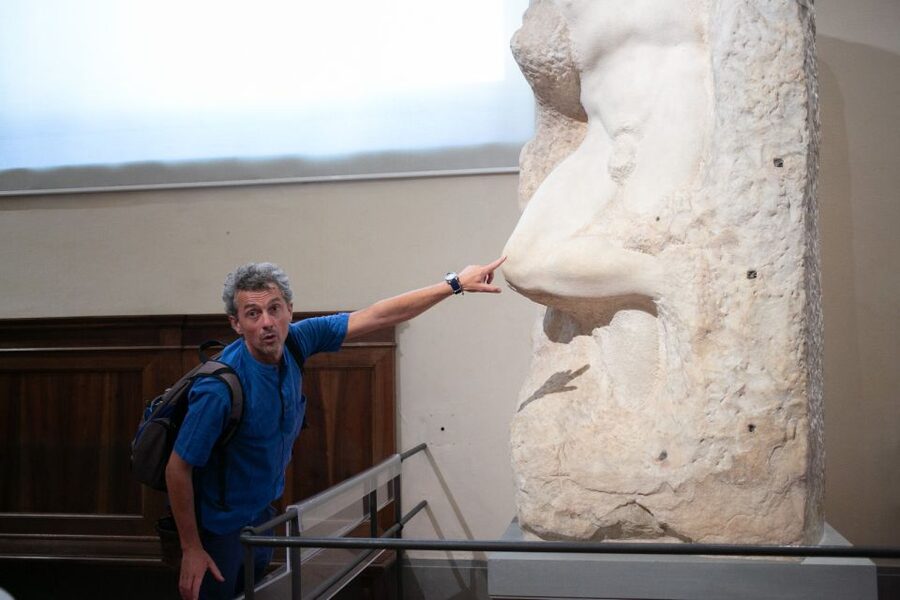
The Prisoners are often overlooked because David receives most of the attention. Here, they are central. Mario presents them as evidence of a mature stage in Michelangelo’s work and uses their unfinished quality to open a discussion about the artist’s creative process.
The unfinished surfaces invite several kinds of looking. You can see figures that appear to be emerging from the stone, but you can also ask what remains hidden and what the artist chose to reveal. That makes the Prisoners a natural bridge to the tour’s wider themes.
This part may be the most useful for you if you have visited museums where unfinished sculptures are treated as incomplete leftovers. The tour asks you to consider unfinished carving as an expressive choice, or at least as a meaningful part of the work’s impact.
Mario’s argument is presented through images and comparisons rather than dense academic language. That keeps the talk accessible, though it also means the experience is interpretive. If you prefer firm conclusions and conventional museum facts, some sections may feel less direct.
The short distance between David and the Prisoners helps. You can compare the works almost immediately, with no bus ride or long walk breaking the thread. The museum setting makes the change in Michelangelo’s style feel concrete.
The connection with the Sistine Chapel
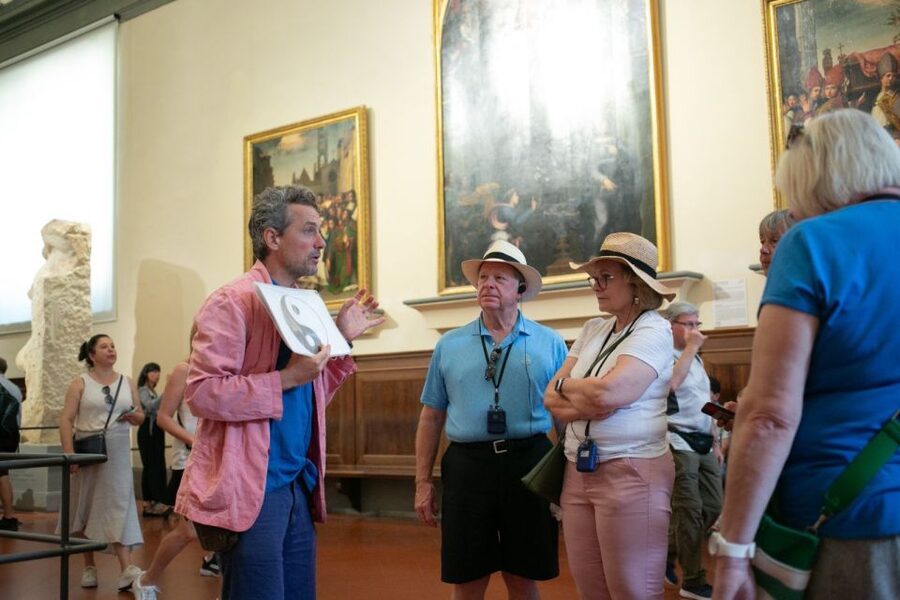
One of the tour’s unusual features is the link between David and the Sistine Chapel. The tour presents this as a key part of the red thread running through Michelangelo’s career.
You will not be visiting the Sistine Chapel during this 75-minute experience. Instead, Mario uses the Accademia works to prepare you to understand the relationship between Michelangelo’s sculpture and his later painted work in Rome.
That connection can be especially helpful if the Sistine Chapel is already part of your Italy plans. You may look at The Creation of Adam differently after considering the ideas introduced here. The tour gives you a way to connect a Florentine sculpture with a work many people know only from reproductions.
The approach is not a full survey of Michelangelo’s life. It focuses on a particular interpretation of his artistic and spiritual development. That focus is a strength if you want a clear theme, but a limitation if you expect a broad lecture covering every commission and period.
What the interactive format feels like
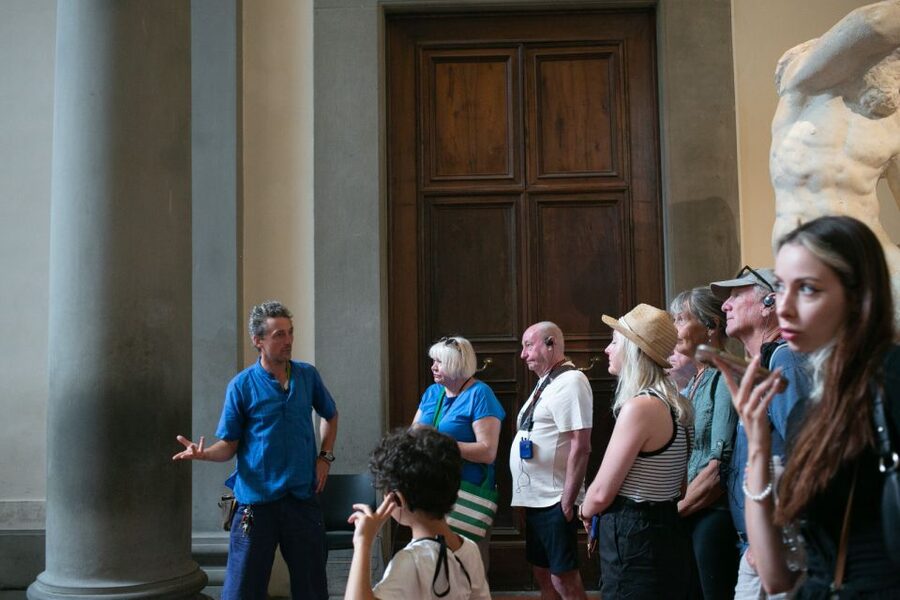
Mario’s method depends on participation. He uses questions to draw the group into the subject and encourages you to form an opinion before he develops the point further.
That can make the tour feel personal. Instead of receiving a finished answer at every turn, you are invited to test an idea. The result is closer to a guided conversation than a standard museum recital.
The format also works across ages. The supplied information specifically presents it as suitable for couples, families with children, and groups of friends. Simple metaphors help younger visitors follow the discussion, while the spiritual and philosophical themes give adults more to consider.
There is a tradeoff. An interactive tour can move at a different pace from a tightly scripted one. It may spend longer on a question that interests the group and less time on minor factual details. You should book it because you want an interpretation, not because you want to cover every room in the museum.
Mario’s theatrical background adds personality. Several comments describe his delivery as lively, passionate, and entertaining, and that matches the design of the experience. You are likely to remember his energy as much as the outline of the lecture.
Time to explore the museum on your own
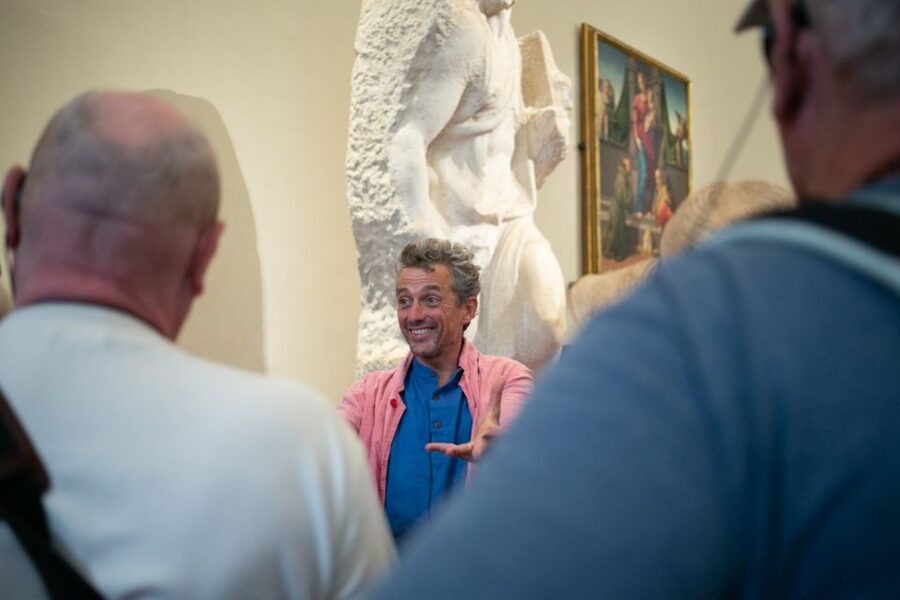
The guided section lasts 75 minutes, after which you can continue visiting the Accademia independently. This is important because the tour is focused rather than exhaustive.
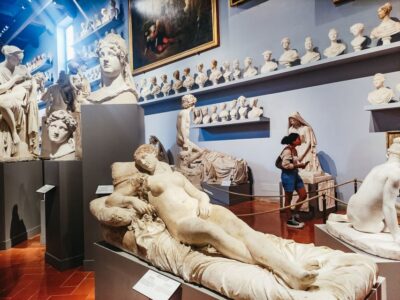
The museum contains more than David and the Prisoners, and you may want time to look at other works at your own pace. The independent period lets you return to David without the group around you, revisit a detail, or explore sections that were not central to Mario’s presentation.
I like this arrangement because it separates interpretation from personal time. You receive a framework first, then have the freedom to decide what deserves another look.
Do not assume the guided portion covers every part of the building. It is designed around Michelangelo’s work and the ideas linking the selected pieces. If your main goal is a complete museum tour, check the exact scope before booking.
Is $57 a fair price?
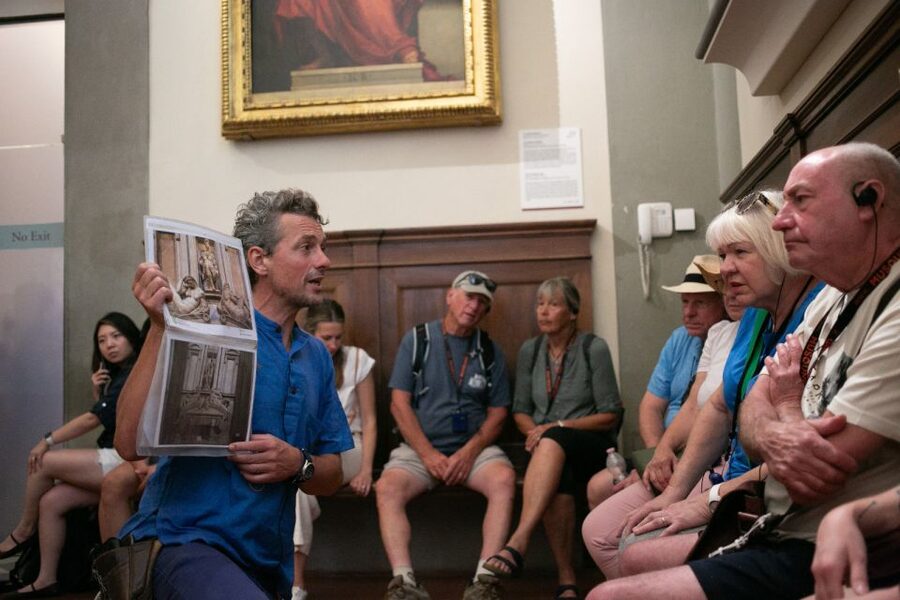
At $57 per person, the value depends on how much you want from the guide. If you only need admission and a quick look at David, the price may feel high. The Accademia is compact, and basic information is easy to find before you arrive.
The price makes more sense if you want Mario’s interpretation, the discussion of the Prisoners, and the connection with the Sistine Chapel. You are paying for a structured way to think about the art, not just access to the room.
Museum tickets are listed among the inclusions, along with the local guide, headsets, and the guided Accademia visit. One booking comment raised a question about an additional entrance charge, so I would confirm the ticket arrangement at the time of booking. That small check prevents an unpleasant surprise.
The reserve-now-and-pay-later option is useful when your Florence schedule is still changing. Free cancellation is available up to 24 hours before the tour for a full refund, according to the stated conditions.
Who should book this Florence experience?
I would point this tour toward:
- First-time Accademia visitors who want help looking beyond the famous pose and taking the Prisoners seriously.
- Families with older children who respond better to questions, stories, and images than to a formal lecture.
- Couples and friends who enjoy discussing art and ideas after leaving a museum.
- Visitors who plan to see the Sistine Chapel and want a connection between Florence and Rome.
- People who dislike dry guided tours but still want expert direction inside a major museum.
- Art lovers seeking a personal interpretation rather than a full chronological account of Michelangelo’s life.
I would hesitate if you want complete independence from the start, dislike group discussion, or mainly want quick access for photographs. The tour is also less suitable if you expect every claim to be presented as settled fact. Mario’s style includes interpretation, theory, and spiritual meaning.
The experience is wheelchair accessible. Since the tour is indoors and lasts 75 minutes, practical comfort still matters, especially if you are arranging several activities on the same day. Leave at least two hours between this and another booked experience so a delayed entry or longer museum visit does not make your day stressful.
My booking advice
Book this if you want to leave the Accademia thinking about Michelangelo rather than simply saying you saw David. Mario Gesu’s strongest qualities are his passion, personal delivery, and ability to connect David with the Prisoners and the Sistine Chapel.
Skip it if you want a neutral audio-guide style visit with lots of dates and little discussion. The tour asks you to listen, answer questions, and consider a spiritual reading of the art.
For most people, the best plan is to take the guided visit early in your Accademia time, then stay afterward and look around independently. That way, Mario gives you the framework, and you get the final word on what the sculptures mean to you.
FAQ
How long does the Accademia Gallery tour last?
The guided tour lasts 75 minutes. You can continue exploring the museum independently after the guided portion.
What does the tour focus on?
The tour focuses on Michelangelo’s David and the Prisoners, including their artistic development, creative process, and spiritual meaning. It also discusses a connection between David and the Sistine Chapel.
Who leads the tour?
The tour is led in English by Mario Gesu, a native Florentine guide, historical researcher, and performer of Dante’s Divine Comedy.
Is museum admission included?
Museum tickets are listed as included with the experience. One supplied booking comment raised a question about an extra entrance charge, so confirm the ticket details when booking.
Where is the meeting point?
Meet at the ATM machine beside Libreria Evangelica, directly in front of the Accademia museum entrance.
How early should I arrive?
Arrive 15 minutes before the scheduled start. Punctuality is recommended because the group follows a timed museum entry.
Is the tour wheelchair accessible?
Yes. The activity is listed as wheelchair accessible.
Recently added around Florence
- Accademia and Uffizi Small-group Guided Tour★ 4.5 · 8 reviews
- The David from Michelangelo.★ 5.0 · 3 reviews
- Combo: Accademia + walking + Uffizi Galleries Guided Tour★ 3.5 · 6 reviews
- The Complete Wine Tour Brunello, Nobile, Chianti wine experience★ 4.0 · 7 reviews
- The Best of Tuscany in 3 Days★ 4.5 · 13 reviews
- The Cooking Lab – Authentic Food Experience★ 5.0 · 113 reviews
- Florence Central Market Food Tour – Private Tour★ 4.0 · 7 reviews
- Family Friendly Florence Private City Tour★ 5.0 · 47 reviews
Accademia Gallery and David Tours, compared.
Timed Entrance Ticket to Michelangelo’s David
Read our review →
Michelangelo’s David Skip-the-Line Entry Ticket
Read our review →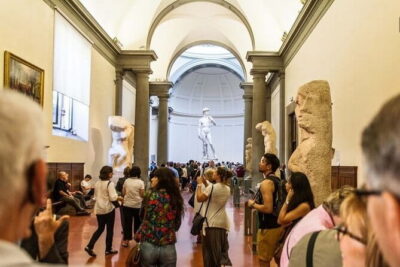
Florence Accademia Gallery Tour with Entrance Ticket Included
Read our review →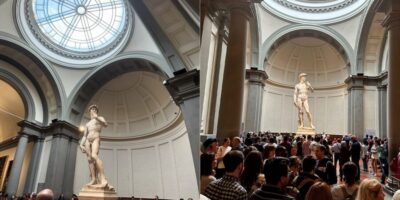
Timed Entry Ticket to Michelangelo’s David & eBook
Read our review →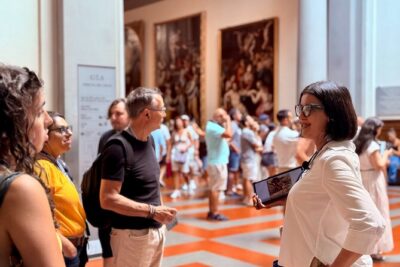
Skip the line: Uffizi and Accademia Small Group Walking Tour
Read our review →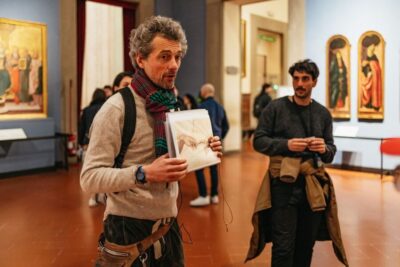
Accademia Gallery Guided Tour with Entry Ticket
Read our review →Browse the lists this tour appears in