
Reviewed · FLORENCE WALKING TOURS
Essential Florence Walking Tour with an Expert Local Guide
Florence’s greatest hits fit into a single morning here, but the real draw is the storytelling between them. Your guide connects Dante, the Medici, Renaissance architecture, guild politics, and tales of betrayal as you walk from Piazza della Repubblica through the old center and across to Oltrarno. I especially like the three-hour route and the chance to taste local gelato while moving between major sights.
I also like that the tour includes both famous monuments and quieter details, such as the facade of Palazzo Rucellai and the frescoes inside Santa Trinita. Guides including Becky and Andrea have earned especially warm praise for clear explanations, good humor, and thoughtful answers. The main consideration is pace: twelve stops in about three hours means most visits are brief, and this is not the tour for a slow, detailed look inside every monument.
Key points to know before you book
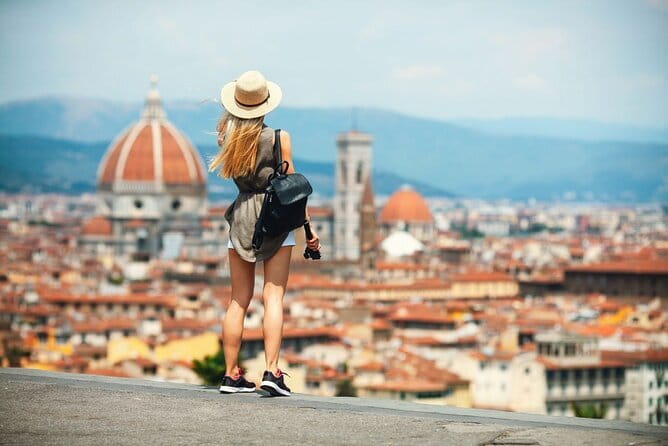
- A strong first-morning orientation: Begin at 9 a.m. and learn how Florence’s main sights fit together before exploring on your own.
- Twelve central stops: The route covers the Duomo, Baptistery, Giotto’s Campanile, Santa Maria Novella, Palazzo Strozzi, Palazzo Pitti, and more.
- Guides make the difference: Becky, Andrea, and Lisa are praised for warmth, storytelling, history, and help with questions.
- Expect a real city walk: Wear comfortable shoes for cobblestones and a route that crosses the Arno into Oltrarno.
- Good value at $40.12: You are paying for a guided introduction rather than museum admission, and the route packs in a lot.
- Small groups may be possible: The maximum is 20 people, though some departures have been much smaller or even private.
Why this three-hour walk works well in Florence
Florence is compact, but it is not always easy to read. A palace may look like a grand private home until someone explains which banking family paid for it. A church facade may seem decorative until you learn how guilds, rival families, and religious orders shaped the city.
That context is the main value here. You move through Florence’s historic core with a guide who explains not only what you are looking at, but why it matters. The stories range from Dante’s life to Medici influence, from architectural change to murder and betrayal. This gives you a useful framework for later museum visits.
The meeting point is Piazza della Repubblica, a central and easy-to-find starting place. From there, the walk reaches major sights without requiring a bus or taxi. The tour ends in Piazza della Signoria, a practical finish near Palazzo Vecchio and other central attractions.
The schedule is brisk but manageable. Each listed stop lasts about 15 minutes, and the route includes bathroom opportunities plus a short rest or coffee break. That matters on a morning spent walking over uneven paving. You should still wear sneakers or other sturdy walking shoes, especially if you are not used to long stretches on cobblestones.
More walking tours in Florence:
- Florence: Guided Walking Tour
★ 4.5 · 3,334 reviews - Skip the line: Uffizi and Accademia Small Group Walking Tour
★ 4.5 · 3,135 reviews - Florence: Guided Walking Tour
★ 4.6 · 1,602 reviews
Orsanmichele and the guild power behind Florence
The first stop is the Church and Museum of Orsanmichele, a building with an unusual past. It began as a loggia used for storing and selling grain before becoming a church connected to Florence’s ancient guilds, known as the Arts.
This is a fine early lesson in how commerce and religion overlapped in Florence. The building’s upper floors contain a museum with original sculptures from the exterior niches, including works associated with Donatello and Ghiberti. The scheduled visit is short and admission is listed as free, so think of this as an introduction and explanation rather than a full museum session.
You will get more from Orsanmichele if you pay attention to the relationship between the building and the city’s working institutions. Florence’s famous art was not created in isolation. It was funded, commissioned, and displayed by powerful professional groups.
Dante, the Duomo, and Florence’s religious center
The tour then passes Museo Casa di Dante, connected with the life and work of Dante Alighieri. The stop is brief, but the guide uses it to place Dante within medieval Florence, rather than treating him as a name detached from the city.
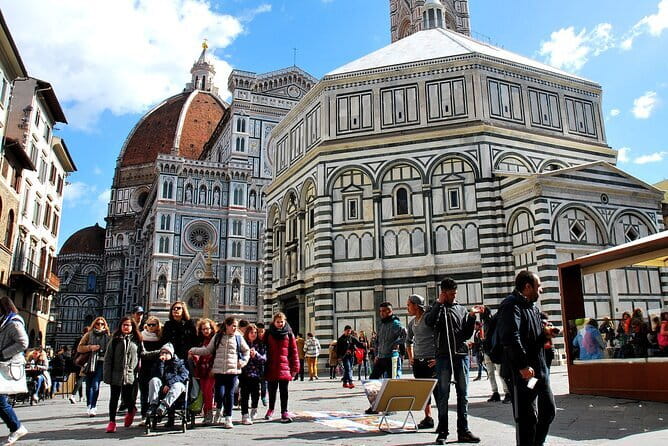
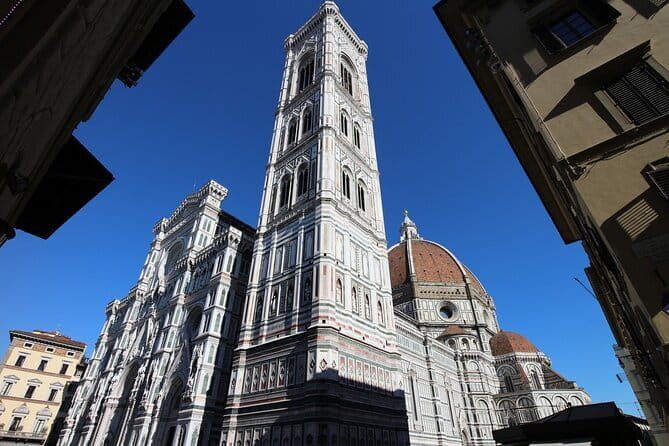
Next comes the Duomo, officially Santa Maria del Fiore. Its enormous masonry dome still dominates Florence, and the cathedral remains the city’s clearest symbol. The guide explains its scale, its place on the site of the earlier church of Santa Reparata, and its importance in the city’s development.
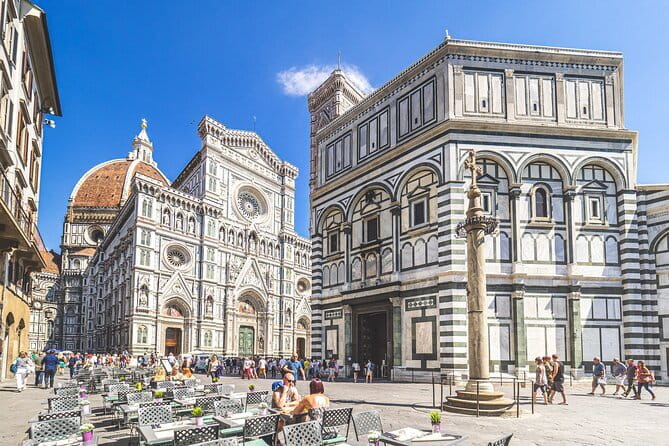
You will also see the Baptistery of San Giovanni, directly in front of the cathedral. It was the traditional place of baptism for Florentines, including Dante, and it also had ceremonial links to knights and poets. Giotto’s Campanile completes the three-part view of Florence’s religious center.
These three Duomo-area stops are useful for orientation, but they are also where the tour’s limitations become clear. Fifteen minutes at each location is enough for exterior context, photographs, and questions. It is not enough for a full look inside the cathedral, the Baptistery, or the bell tower. If you want to climb, study the doors, or see the interior at length, plan a separate visit and check admission arrangements independently.
Santa Maria Novella and the first taste of Renaissance design
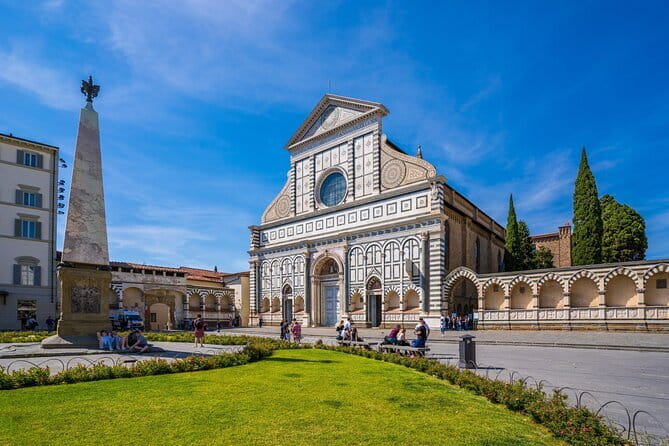
Santa Maria Novella brings the group to one of Florence’s most important Dominican churches. The basilica gives the tour a chance to discuss religious orders, art, and the role of major churches in civic life.
The next stop, Palazzo Rucellai, shifts the subject from church power to Renaissance architecture. The palace is associated with Leon Battista Alberti and Bernardo Rossellino, and its facade uses pilasters and horizontal bands in carefully measured proportion.
A guide can make this kind of stop worthwhile because the building is easy to pass without noticing. Unlike the Duomo, Palazzo Rucellai does not announce itself with a vast dome or a crowded square. Its importance is in the design language: the renewed interest in classical forms, adapted with fresh Renaissance purpose.
This part of the route rewards anyone interested in architecture. If your main goal is to enter museums and see paintings, it may feel less essential. If you want to understand why Florence looks the way it does, it is one of the more useful stops.
A completely different way to spend an afternoon in Florence:
- Florence: Skip-The-Line Uffizi Gallery Timed Entry Ticket
★ 4.5 · 27,832 reviews - Tuscany Day Trip from Florence: Siena, San Gimignano, Pisa and Lunch at a Winery
★ 5.0 · 21,634 reviews - Florence: Timed Entrance Ticket to Michelangelo’s David
★ 4.6 · 16,983 reviews - Florence: Michelangelo’s David Skip-the-Line Entry Ticket
★ 4.5 · 12,764 reviews
Palazzo Strozzi and the public face of wealth
Palazzo Strozzi is one of Florence’s best-known Renaissance palaces. Its construction required the removal of fifteen buildings, a detail that says plenty about the scale of family ambition in the city.
The palace has three matching portals on each side and a heavy, imposing form typical of a powerful urban residence. Here, the guide can explain how architecture communicated status. In Florence, a palace was more than a home. It was a public statement about wealth, family rank, and political reach.
The stop also helps connect the earlier discussion of guilds and banking families with the city you see today. You are not just ticking off another handsome building. You are seeing how rival families competed through stone, proportion, and placement.
Santa Trinita and the frescoes inside
At the Basilica of Santa Trinita, the tour enters the church to see impressive frescoes by Ghirlandaio. This is an important change of rhythm after several exterior stops.
The basilica is closely tied to Florence’s artistic development, and its location near the Santa Trinita bridge makes it a useful link between the central city and the route toward the Arno. The interior visit also gives you a chance to look closely at painted details rather than relying only on broad views of facades and towers.
Because the tour allows about 15 minutes here, you should not expect an exhaustive art lecture. Still, this is one of the itinerary’s more rewarding stops for anyone who wants actual interior art rather than architectural commentary from the street.
Crossing to Oltrarno: Palazzo Pitti and Santa Felicita
The route continues toward the Oltrarno district, across the river from Florence’s main historic center. Palazzo Pitti is the major landmark on this side of the city.
The palace began in 1458 as the residence of banker Luca Pitti. The Medici acquired it in 1549, after which it became the home of Tuscany’s grand dukes. Later it served the Habsburg-Lorraine rulers and, during Florence’s brief period as capital of unified Italy, the House of Savoy.
That sequence gives you a compact lesson in changing political power. Palazzo Pitti was not simply an impressive residence. It reflected who controlled Tuscany at different points in time.
The tour does not promise a full palace visit, and admission is listed as free for the stop. Treat this as a guided look at the building and its place in Florence rather than a substitute for the palace museums. If you want the collections inside, reserve separate time.
Nearby Santa Felicita is one of Florence’s oldest churches. Its location between Ponte Vecchio and Palazzo Pitti makes it a natural stop on the route, and it provides another view of the city’s long religious history. The contrast between grand ducal power at Pitti and the age of this church gives the Oltrarno section a useful sense of time.
The Vasari Corridor and the road back toward Piazza della Signoria
The Vasari Corridor is an elevated passage linking Palazzo Vecchio and Palazzo Pitti, passing through the Uffizi area and over Ponte Vecchio. It was designed so the grand dukes could travel between home and government offices with greater privacy and security.
That story brings politics into focus. The corridor was not built merely as an architectural curiosity. It reflected the uncertain relationship between the ruling family and the people of Florence after the old republic gave way to a new system of government.
You will see the corridor as part of the city rather than take a private tour through it. The route then finishes in Piazza della Signoria, one of Florence’s most important public spaces. Ending here is convenient because you are close to Palazzo Vecchio, the Uffizi, Ponte Vecchio, and the center of the city.
The final location also makes the tour easy to use as a planning tool. You can continue sightseeing nearby, stop for lunch, or return later to places that deserve more time.
Guides, group size, and the human side of the tour
The guide is the most important variable on a walking tour. The strongest feedback here centers on Becky and Andrea, with Lisa also praised for her warmth, humor, and ability to explain Florence to both adults and children.
Becky is repeatedly singled out for clear history, patience with questions, and an engaging manner. Andrea is praised for finding her way around the city, taking family photographs, and adjusting the pace or plan when the group was small. One departure became a private tour at group pricing because no other participants joined, though you should not assume that will happen on your date.
The maximum group size is 20. That is not tiny, but it is still workable for a walking tour, especially if the guide uses a headset. Headpieces have been described as a useful feature, and small groups of around seven or ten have allowed people to hear clearly and ask questions.
You should expect the experience to depend partly on who leads your departure. The available guides have different backgrounds and personalities, but the common strengths are storytelling, local orientation, and practical help. If you have specific interests, ask questions during the walk. The route covers politics, art, commerce, architecture, and daily life, so there is room to steer the conversation.
Is $40.12 a fair price?
At $40.12 per person, this is a reasonable price for a three-hour guided introduction to Florence. You are getting a structured route through twelve major locations, a local guide, historical interpretation, a gelato tasting, and help understanding how the city fits together.
The price is especially fair if this is your first morning in Florence. You can spend the following days returning to the Duomo, Santa Trinita, Palazzo Pitti, or another site with a clearer sense of what you want to see.
It is less useful for you if you already know Florence well or want entry to several museums. The listed stops are mainly short visits, and admission tickets are shown as free. The value lies in the explanations and the route, not in included access to major paid attractions.
The tour is booked on average about 60 days ahead, so popular dates may fill early. Confirmation arrives at booking, and the experience is offered with free cancellation up to 24 hours before the start time. Poor weather or failure to reach the minimum group size can lead to a new date or a full refund.
Who should book this Florence walk?
I would choose this tour for a first visit, especially if you want to get your bearings early. It suits families, couples, and adults who prefer stories and context to a silent march from monument to monument.
It is also a good fit if you want a broad introduction before deciding which interiors deserve your limited time. The route covers enough ground to show you the city’s main shape, from the Duomo to Oltrarno and back toward Piazza della Signoria.
You should think twice if you have limited mobility or strongly dislike walking on uneven streets. Most people can participate, service animals are allowed, and public transportation is nearby, but the tour is still a three-hour city walk. Comfortable shoes are essential.
Should you book the Essential Florence Walking Tour?
Book it if you want history, orientation, and major sights in one morning rather than a series of disconnected photo stops. The route is broad, the price is sensible, and guides such as Becky and Andrea add the personal touch that can make Florence easier to understand.
Skip it if you want long museum visits, a dome climb, or detailed interior tours. For everyone else, this is a practical first step into Florence, with enough architecture, family rivalry, religion, art, and local flavor to give the rest of your stay a stronger foundation.
FAQ
Where does the tour start?
The tour starts at Piazza della Repubblica in Florence.
What time does the tour begin?
The scheduled start time is 9:00 a.m.
Where does the tour end?
The tour ends in Piazza della Signoria.
How long does the walking tour last?
The experience lasts approximately three hours.
What sights are included on the route?
Stops include Orsanmichele, Museo Casa di Dante, the Duomo, the Baptistery of St. John, Giotto’s Campanile, Santa Maria Novella, Palazzo Rucellai, Palazzo Strozzi, Santa Trinita, Palazzo Pitti, Santa Felicita, and the Vasari Corridor.
What happens if the weather is poor or I need to cancel?
You can cancel at least 24 hours before the start time for a full refund. If poor weather or an insufficient number of participants cancels the tour, you will be offered another date or a full refund.
Recently added around Florence
- The David from Michelangelo.★ 5.0 · 3 reviews
- Accademia and Uffizi Small-group Guided Tour★ 4.5 · 8 reviews
- Combo: Accademia + walking + Uffizi Galleries Guided Tour★ 3.5 · 6 reviews
- The Complete Wine Tour Brunello, Nobile, Chianti wine experience★ 4.0 · 7 reviews
- The Best of Tuscany in 3 Days★ 4.5 · 13 reviews
- The Cooking Lab – Authentic Food Experience★ 5.0 · 113 reviews
- Florence Central Market Food Tour – Private Tour★ 4.0 · 7 reviews
- Family Friendly Florence Private City Tour★ 5.0 · 47 reviews
Florence Walking Tours, compared.
Skip the line: Uffizi and Accademia Small Group Walking Tour
Read our review →
Renaissance and Medici Tales Guided Walking Tour
Read our review →
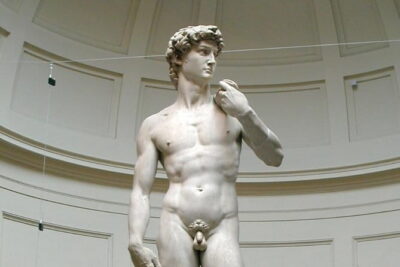
Skip-the-Line Florence Highlights and David Walking Tour
Read our review →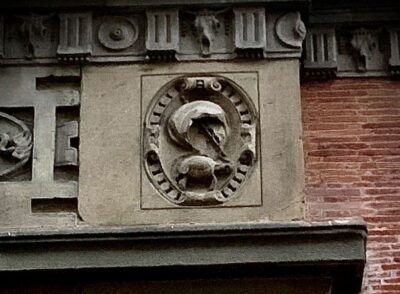
Dark Mysteries and Legends Guided Walking Tour
Read our review →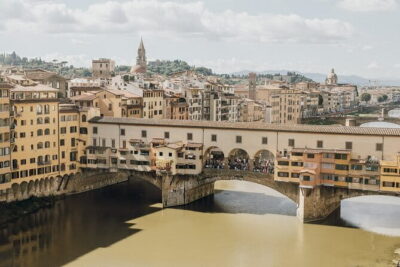
Florence in a Day: Michelangelo’s David, Uffizi and Guided City Walking Tour
Read our review →Browse the lists this tour appears in