
Reviewed · ACCADEMIA GALLERY AND DAVID TOURS
Bargello Museum: Face to Face with Donatello’s David
The Bargello holds one of Florence’s most arresting sculptures: Donatello’s David, a daring bronze youth who looks nothing like the smooth heroes of later art. This one-hour tour gives you a clear route through that story, from Donatello and Verrocchio to Michelangelo and the Della Robbia family. I especially like the reserved museum entry and the radio headsets, since both save time and help you follow the guide in crowded rooms.
I also like the compact focus. You see major works without spending half a day in a museum, and guides such as Matteo, Francesca, Martina, Lara, and Guido have been praised for making difficult art easier to understand. The main caution is that renovation work can close important rooms, including part of the second floor, so the promised route may change.
Key points to know before booking
- Donatello’s David is the star: See the early Renaissance bronze that helped change European sculpture.
- Michelangelo gets serious attention: The route includes Bacchus, Tondo Pitti, Brutus, and David-Apollo.
- Reserved entry is included: Your guide or representative supplies the ticket at the meeting point.
- The tour lasts about one hour: That makes it a useful first visit, with time to look around afterward.
- Headsets keep the commentary clear: You can hear the guide without standing shoulder to shoulder.
- Renovations may alter the route: Some rooms or collections may be closed on the day.
Why the Bargello deserves time in Florence
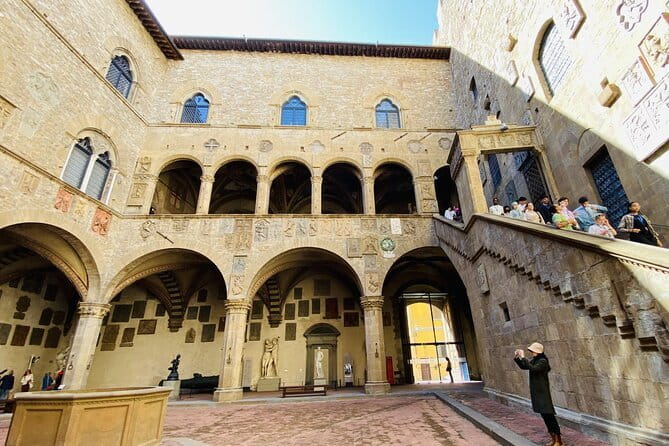
Many people race to Florence’s Uffizi, Accademia, and Pitti Palace. The Bargello deserves a place beside them, especially if sculpture interests you. It occupies a former medieval palace that served as the headquarters of the Capitano del Popolo and later the city’s Podesta. The building then became a police headquarters and prison before taking on its present museum role.
That past matters. You are not entering a purpose-built white gallery. The Bargello’s rooms and courtyards retain the feeling of an old civic palace, which gives the sculptures a strong sense of place. A good guide helps you connect the building’s political past with the art made for Florence’s churches, guilds, and powerful families.
I would not treat this as a general Florence orientation. It is a sculpture tour with a firm focus on the museum’s best-known works. If you want paintings, the Uffizi will serve you better. If you want to understand how artists worked in marble, bronze, ivory, and glazed terracotta, the Bargello is a fine choice.
The score of 4.8 from 31 ratings, with 94 percent recommending the experience, reflects a tour that usually succeeds through its guides. The strongest praise goes to the guides’ ability to explain context, make the art approachable, and keep the hour moving.
More ways to see the David at the Accademia:
- Florence: Timed Entrance Ticket to Michelangelo’s David
★ 4.6 · 16,983 reviews - Florence: Michelangelo’s David Skip-the-Line Entry Ticket
★ 4.5 · 12,764 reviews - Florence Accademia Gallery Tour with Entrance Ticket Included
★ 4.5 · 6,148 reviews
Meeting at Via del Proconsolo
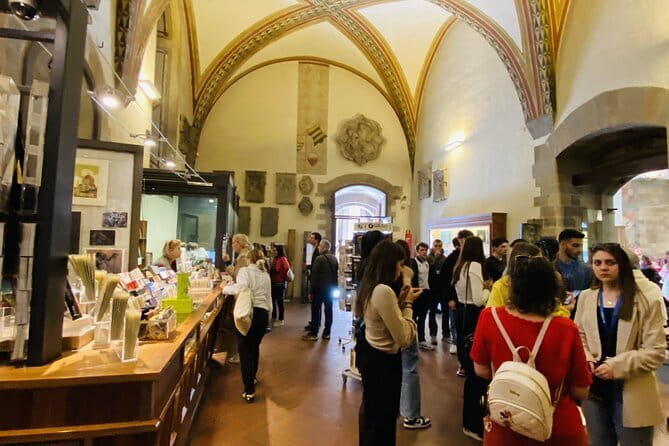
The tour begins at Museo Nazionale del Bargello, Via del Proconsolo 4. You need to arrive before the stated start time. If you arrive late, you cannot join the group, and the booking will not be refunded or moved to another time.
That rule is worth taking seriously in Florence, where a short walk can take longer than expected. Plan your route before the day of the tour and allow extra time to find the entrance. The ticket is delivered by the guide or a representative at the meeting point, so follow the instructions on your booking voucher rather than heading off on your own.
The group can include up to 25 people. That is not a private visit, but the included radio system should make it easier to hear. In one reported case, only two people booked a time slot, creating an almost private tour. You should not count on that, but smaller groups can happen.
First look at the Bargello’s medieval palace
The guide begins with the building and its changing roles. This short introduction is useful because the Bargello can feel more like a fortress or government palace than a museum. You learn how civic power operated in Florence before turning to the artists who filled the city with sculpture.
The ground-floor rooms contain Tuscan works from the 16th century. Here the tour gives particular attention to four Michelangelo works:
- Bacchus
- The Madonna and Child relief known as Tondo Pitti
- Brutus
- David-Apollo
Seeing these works together lets you compare different materials and moods. Bacchus has a playful, unsettling quality. Brutus feels more severe and controlled. David-Apollo raises questions about the subject itself, while Tondo Pitti shows Michelangelo working within the tight limits of a relief.
A guide adds value here because a quick walk through the rooms can leave you with names but no structure. The better guides on this tour, including Martina and Lara, have been praised for giving a short account of Florence and then tying each work to that setting. You get a reason to look closely instead of simply collecting famous titles.
One limitation is the short schedule. Four Michelangelo pieces, several major artists, and two floors require brisk pacing. You will hear the central points, but you will not get a long technical lecture on every work.
Donatello’s David and the early Renaissance
The central stop is the room devoted to early Renaissance sculpture. This is where you meet Donatello’s Saint George, the Lion, and David, along with works by Verrocchio.
Donatello’s David is especially important because it is a free-standing bronze figure, not just a relief attached to a wall or a figure designed for an architectural setting. The sculpture’s youthful body, hat, boots, and relaxed pose give it a strikingly human quality. Your guide can help you notice how unusual that combination was and why the work matters in the development of Renaissance sculpture.
Saint George offers a different kind of energy. It was made as a strong public image, with a firm stance and alert expression. Comparing it with David helps you see Donatello’s range. One figure projects readiness and duty. The other seems more private and ambiguous.
Verrocchio provides another useful comparison. He was both a sculptor and an important teacher in Florence’s artistic world. Looking at his work after Donatello gives you a sense of how styles changed within a single generation.
This part of the route is where a strong guide can make the biggest difference. Francesca has been praised for bringing the past to life and making the subject enjoyable rather than stiff. Another guide, Ivano, was credited with helping visitors gain a deeper appreciation for the collection. That sort of explanation is valuable in a room where several sculptures can look similar at first glance.
Not every guide will have the same style. One assessment described a guide as well informed but too dry, with more attention to general context than to technique and artistic importance. That is a fair warning: the quality of your hour depends heavily on the individual guide assigned that day.
More museums and galleries in Florence:
- Florence: Skip-The-Line Uffizi Gallery Timed Entry Ticket
★ 4.5 · 27,832 reviews - Florence: Leonardo Interactive Museum Entry Ticket
★ 4.5 · 11,763 reviews - Uffizi Gallery Small Group Tour with Guide
★ 4.5 · 4,923 reviews - Florence: Accademia Gallery Guided Tour
★ 4.6 · 4,156 reviews
Cellini, Ammannati, and Giambologna
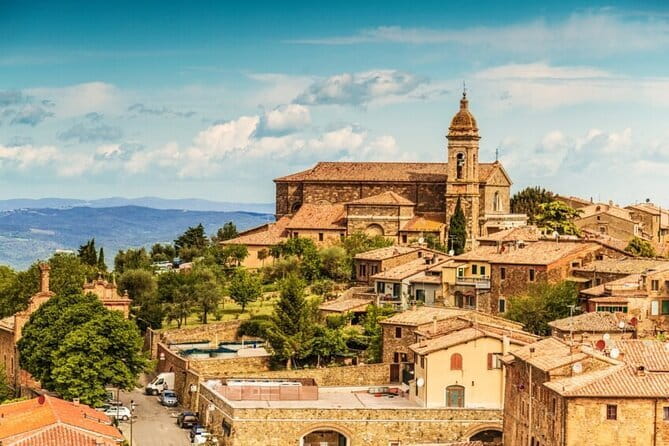
The tour continues through works by Bartolomeo Ammannati, Benvenuto Cellini, and Giambologna. This section widens the story beyond the most famous names.
Giambologna’s Flying Mercury is a highlight. The figure’s lifted pose and sense of motion show how later sculpture could create the impression of movement in a still material. It is the kind of work that rewards a pause, and the guide can point out details you might otherwise miss while moving through the room.
Cellini represents another side of Florentine art, with a reputation for technical skill and courtly display. Ammannati helps fill in the period between the earlier Renaissance and the more theatrical 16th-century style. I like this part of the visit because it keeps the Bargello from becoming only a Donatello and Michelangelo checklist.
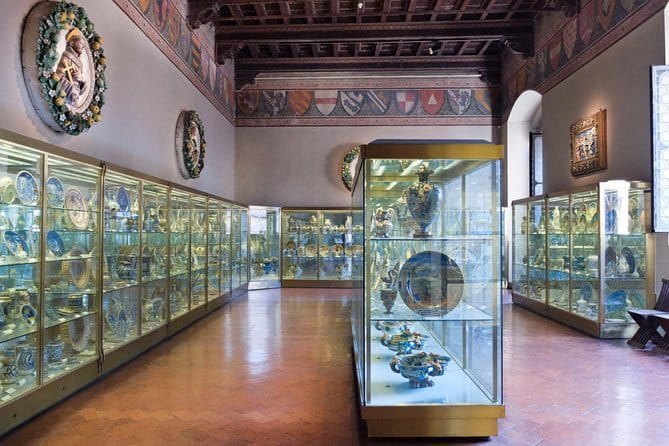
The museum also holds works connected with the Carrand collection, along with ivory pieces and bronzes that include Roman and Byzantine examples. You may not spend long on every item, but the selection shows how broad the museum is. Florence’s sculpture tradition did not develop in isolation. Artists and collectors looked to earlier civilizations, imported objects, and different materials for ideas.
The radio system is useful in these rooms. You can stand close enough to examine a sculpture while still hearing the explanation. Without it, a group of 25 would need to gather tightly around the guide, which would make viewing harder.
The second floor and Della Robbia terracotta
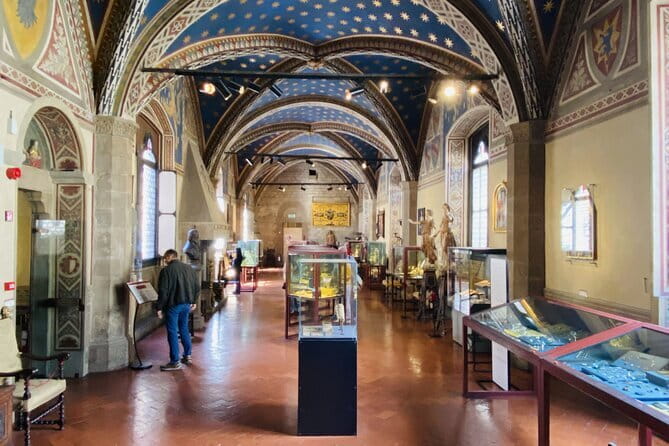
The second floor is devoted to glazed terracotta by Andrea and Giovanni Della Robbia. Their work has a look unlike the bronze and marble downstairs. The bright glazed surfaces and repeated religious themes offer a welcome change of pace after the darker, heavier sculpture rooms.
The Della Robbia family developed a recognizable approach using fired clay with a glossy finish. The tour introduces the pieces as a distinct chapter in Florentine art rather than treating them as a small afterthought. This is helpful if you are more familiar with Michelangelo than with the Della Robbia name.
There is an important practical warning here. Part of the second floor has been closed for renovation at times, including rooms containing pieces the guide considered among the museum’s best. If that happens during your visit, the guide should adapt the route, but you may not see everything described in the planned program.
Renovation closures are outside the tour company’s control, yet they affect value. I would check current museum conditions if the Della Robbia collection is your main reason for booking. If your priority is Donatello and Michelangelo, a partial closure may matter less.
What the one-hour format gives you
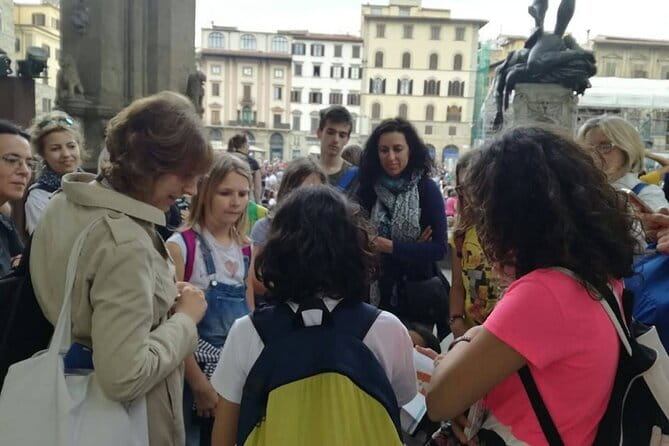
One hour is enough to see the museum’s main artistic arc, but it is not enough for every room. Think of the tour as an introduction and a guided set of highlights. Afterward, you can return to works that caught your attention and explore more on your own.
This format suits a busy Florence schedule. You can fit the Bargello between other sights without giving up an entire morning. It also works well if you are unsure how much art history you want. The guide gives you a framework, then you decide if you want to continue independently.
The drawback is that the pace can feel quick. You will hear about Roman and Byzantine bronzes, ivory, the Carrand collection, 16th-century Tuscan sculpture, Michelangelo, Donatello, Verrocchio, and Della Robbia in a short period. If you want close analysis of technique, symbolism, and restoration, look for a longer museum visit or plan to return after the tour.
Is $58.87 a fair price?
At $58.87 per person, this is not the cheapest way to enter the Bargello. The value comes from the reserved admission, an official certified guide, and a focused explanation of a museum that can be hard to read on your own.
The price makes more sense if you are new to Renaissance sculpture, short on time, or want someone to point out the works that matter most. It is less attractive if you already know the Bargello well or prefer to move slowly with your own audio guide.
A group discount may be available, which could improve the cost for a larger party. The maximum group size is 25, so you should also consider how much personal attention you want. Guides have sometimes handled family groups well, including a party with children aged four and six, but the experience remains an art-focused hour.
The included headset is a small but meaningful part of the value. You do not need to strain to hear, and you can look at the sculpture while the guide speaks. Reserved entry also matters during busy periods, though the skip-the-line guarantee has an exception for museum delays or strikes.
The guides make or break the experience
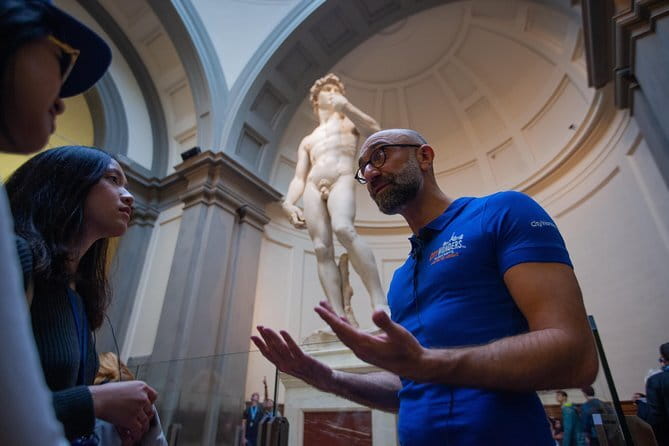
The most praised feature is not a single sculpture. It is the quality of the guide. Matteo has been described as witty, approachable, excited about the subject, and good at linking the art to Florence’s wider story. Francesca has received praise for making history fun and explaining the setting behind the works.
Martina’s approach was noted for being well judged. She gave enough background without taking over the visit, then pointed out areas to explore after the guided hour. Lara was praised for changing the way a visitor looked at art, while Guido provided a clear and informative visit.
Those names show the range of guides used by the provider, but you may not be assigned a particular person. The tour is offered in English. One French-language experience was praised for an excellent French-speaking guide, but the stated offering for this tour is English, so do not book expecting French.
The mixed feedback is useful. If your guide is lively and engaged, the Bargello can become one of the most memorable museum visits in Florence. If the delivery is dry, you will still see an excellent collection, but the tour may feel like a basic walk through labels and dates.
Who should book this Bargello tour?
I would choose this tour for an art lover who wants help seeing sculpture rather than simply entering a museum. It is particularly useful if Donatello, Michelangelo, Verrocchio, or Renaissance technique is high on your Florence list.
It also suits you if you want a short cultural stop. The hour gives you a guided framework, and you can stay afterward to revisit favorite works. Families can take part, and most people can participate. Service animals are allowed.
I would think twice if you dislike fixed pacing, want to inspect every object, or already have a strong background in Renaissance art. Renovation work is another reason to keep expectations flexible, especially if the second floor is essential to your plans.
You must have at least two participants for the tour to run. If the minimum is not met, an alternative or full refund is offered. You can cancel for a full refund up to 24 hours before the start time. Cancellations or changes made inside that window are not refunded or accepted.
Should you book it?
Book this tour if you want Donatello and Michelangelo explained in context, not just pointed out. The reserved entry, headsets, central meeting point, and one-hour length make it easy to fit into a Florence day.
The best reason to book is the guide. Matteo, Francesca, Martina, Lara, Guido, and others have shown how much a skilled explanation can add to the Bargello. The main risks are a guide whose style feels flat and renovation closures that remove part of the planned route.
For most first-time visitors with an interest in sculpture, I think the $58.87 cost is reasonable. Arrive early, confirm the meeting instructions, keep your schedule flexible, and plan to spend extra time afterward with the works that catch your eye.
FAQ
Where does the Bargello Museum tour begin?
It begins at Museo Nazionale del Bargello, Via del Proconsolo 4, 50122 Florence, Italy.
Where does the tour end?
The activity ends back at the meeting point.
How long does the tour last?
The guided tour lasts approximately one hour.
Is museum admission included?
Yes. The entrance ticket with reservation is included and is delivered by the guide or a representative at the meeting point before the tour begins.
Does the tour include skip-the-line entry?
Yes. Skip-the-line access is guaranteed, except in cases such as delays or strikes by museum management.
What language is the tour offered in?
The tour is offered in English.
Are headsets provided?
Yes. A radio system is provided so you can hear the guide clearly.
How many people can join the tour?
The tour can have a maximum of 25 participants.
Is there a minimum number of participants?
Yes. At least two guests are required for the tour to run.
Can I cancel for a refund?
You can cancel up to 24 hours before the experience start time for a full refund. Cancellations or changes made less than 24 hours before the start time are not accepted or refunded.
Recently added around Florence
- Accademia and Uffizi Small-group Guided Tour★ 4.5 · 8 reviews
- The David from Michelangelo.★ 5.0 · 3 reviews
- Combo: Accademia + walking + Uffizi Galleries Guided Tour★ 3.5 · 6 reviews
- The Complete Wine Tour Brunello, Nobile, Chianti wine experience★ 4.0 · 7 reviews
- Florence Central Market Food Tour – Private Tour★ 4.0 · 7 reviews
- The Best of Tuscany in 3 Days★ 4.5 · 13 reviews
- The Cooking Lab – Authentic Food Experience★ 5.0 · 113 reviews
- Family Friendly Florence Private City Tour★ 5.0 · 47 reviews
Accademia Gallery and David Tours, compared.
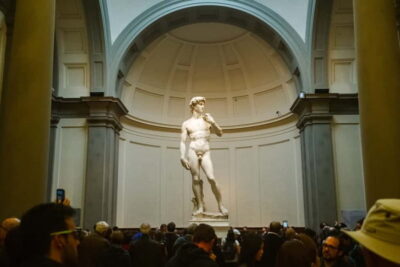
Timed Entrance Ticket to Michelangelo’s David
Read our review →
Michelangelo’s David Skip-the-Line Entry Ticket
Read our review →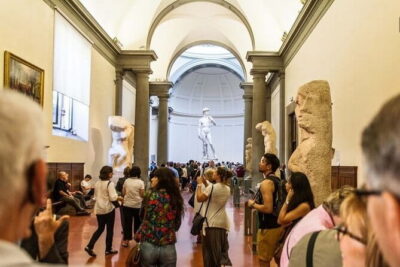
Florence Accademia Gallery Tour with Entrance Ticket Included
Read our review →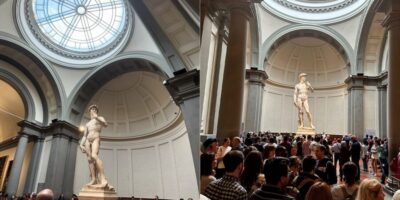
Timed Entry Ticket to Michelangelo’s David & eBook
Read our review →
Skip the line: Uffizi and Accademia Small Group Walking Tour
Read our review →
Accademia Gallery Guided Tour with Entry Ticket
Read our review →Browse the lists this tour appears in