
Reviewed · FLORENCE WALKING TOURS
Art and History in Florence: Small Group Walking Tour
Florence’s story unfolds almost street by street on this brisk walk, from the Medici family’s first palace to the grand Palazzo Pitti across the Arno. You get a useful first look at the Duomo, Uffizi, Ponte Vecchio, and major palaces without spending half a day inside one museum.
I like the compact route and the strong focus on art, power, and family politics. I also like that the guides can add practical advice, including food and wine suggestions, and sometimes adjust the pace or route for the group. The catch is simple: 95 minutes goes quickly, and admission to museums and churches is not included.
Key points to know before you book
- A citywide introduction in 1 hour 35 minutes: The route covers Florence’s best-known sights at a fast but useful pace.
- A strong Medici theme: Palazzo Medici Riccardi, Palazzo Vecchio, the Uffizi, and Palazzo Pitti connect art with money and political power.
- English-speaking guides with different strengths: Francesco, Julia, Giovanni, Raffaello, Luigi, Lorenzo, and others have led tours, with several praised for storytelling and art knowledge.
- Small group in principle, up to 50 people in practice: A tiny group can feel personal, but the published maximum is much larger than the phrase small group suggests.
- No museum admissions included: You see the exteriors and receive explanations, but you need separate tickets to go inside.
- A smart orientation before independent sightseeing: The walk helps you decide which palaces, churches, and galleries deserve your limited Florence time.
Florence in 95 minutes: what this tour really gives you
This is best understood as a guided orientation, not a substitute for visiting Florence’s museums. In just under two hours, you move through the historic center and finish near the major sights on the south bank of the Arno.
The value is in the connections. Florence can feel like a series of beautiful buildings until someone explains who paid for them, why a family needed a particular palace, and how art helped project power. A good guide turns that jumble into a story.
The tour includes an audio guide system, which can help you hear in a larger group. Still, group size matters. The maximum is 50 people, so you should not assume the intimate feel of a private walk. Some departures may be much smaller. One reported group had only two couples, which made it easy to hear the guide and adjust the pace.
The route is packed. Each of the first eight stops is allotted about 10 minutes, followed by 15 minutes at Palazzo Pitti. That timing tells you what to expect: clear explanations, exterior viewing, and plenty of reasons to return later.
More walking tours in Florence:
- Florence: Guided Walking Tour
★ 4.5 · 3,334 reviews - Skip the line: Uffizi and Accademia Small Group Walking Tour
★ 4.5 · 3,135 reviews - Florence: Guided Walking Tour
★ 4.6 · 1,602 reviews
Palazzo Medici Riccardi and San Lorenzo: Florence begins with the Medici
The first stop, Palazzo Medici Riccardi, introduces the family that shaped Florence’s politics, banking, and art. The palace is important not just because it is attractive, but because it shows how private wealth could become public influence.
You will have about 10 minutes here, and entry is not included. That is enough for a guide to explain the building’s role and the Medici family’s rise, but not enough for a proper interior visit. If you want to see the palace inside, treat this walk as a preview and plan a separate visit.
Nearby San Lorenzo adds another piece of the Medici story. The church is free to approach, but any paid areas or additional museum sections are not part of the tour. The stop helps place the family in the religious and civic life of Florence rather than treating the Medici as mere art collectors.
I find this opening useful because it gives the rest of the walk a framework. As you later see Palazzo Vecchio, the Uffizi, and Palazzo Pitti, you already have a sense of the family interests behind many of Florence’s grand projects.
The Duomo: a quick look at Florence’s great cathedral
The Cathedral of Santa Maria del Fiore is one of Florence’s essential sights, and the tour allows about 10 minutes for it. That is enough to take in the exterior and hear about its role in the city, but not enough to climb the dome or explore the cathedral complex at leisure.
Admission is not included. The tour does not promise entry, and you should not book it expecting a shortcut into the cathedral. One guide did take a guest inside when the line was short, but that was an adjustment made on the day, not something you should count on.
The stop is still valuable. Florence’s cathedral is easier to appreciate when you understand that it was a civic statement as much as a place of worship. Look closely at the scale and decoration, then listen for the links between religious purpose, civic pride, and competition among wealthy families.
If the Duomo is a priority for you, arrange a separate visit and allow far more time. This tour gives you context. It does not replace the full cathedral, dome, baptistery, or bell tower experience.
Dante and Palazzo Vecchio: literature, government, and power

The Museo Casa di Dante is next, with another 10-minute stop. The site is tied to Dante Alighieri and the medieval world of Florence. Entrance is not included, so the guide’s role here is to explain the setting and its place in the city’s cultural story.
This short stop works well for anyone who wants more than a parade of Renaissance names. Florence was also a medieval city of rival factions, poets, guilds, and political conflict. Dante helps you see the city before the Medici made their mark.
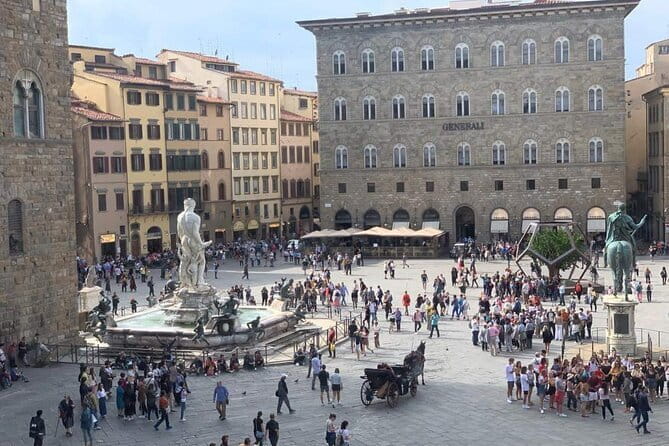
At Palazzo Vecchio, the focus shifts toward government and public authority. The building dominates Piazza della Signoria and remains one of Florence’s clearest examples of political architecture. Again, the tour allows about 10 minutes, and interior entry is not included.
I would pay close attention here to the guide’s explanation of symbols, statues, and family crests. Giovanni, one of the guides praised in the supplied material, was especially good at showing how to read a statue by considering its location, subject, and political purpose. That kind of explanation can change how you look at the sculptures surrounding the square.
More Renaissance and history tours in Florence:
- Tipsy Tour: Guided Bar Crawl In Florence with Dark History
★ 5.0 · 271 reviews - Florence Cooking Course with Historic Local Market Visit
★ 4.5 · 151 reviews - Florence: Medici Family History Tour
★ 4.3 · 93 reviews - Historical Guided Tour of Florence’s Iconic Cathedral
★ 3.5 · 88 reviews
Piazza della Signoria and the Uffizi: art in the open air
Piazza della Signoria is free to visit and gives you one of the best open-air art settings in Florence. The square links Palazzo Vecchio with the Uffizi and contains works that are easier to understand when a guide explains who commissioned them and why they were placed there.
You get about 10 minutes, which is enough for a focused introduction. It is not enough to inspect every sculpture or absorb the square at a slow pace. I would use this section to note the works and subjects you want to revisit later.
The Uffizi follows. The gallery itself requires a separate admission ticket, and this tour does not take you through its collection. That limitation is important. If you came to Florence mainly for Botticelli, Leonardo, Michelangelo, or Caravaggio, you need a dedicated Uffizi plan.
Still, the exterior and surrounding history matter. The Uffizi was connected to the machinery of Florentine government and the Medici world. A guide can help you understand why a gallery sits where it does and how art became part of the city’s public identity.
Several guides have been praised for explaining artistic timelines, religious influences, and architecture in plain English. Raffaello, described as an art history professor, is particularly suited to travelers who want a more academic explanation. Francesco is known for combining history with humor and lively storytelling.
Ponte Vecchio: a short crossing with a long story
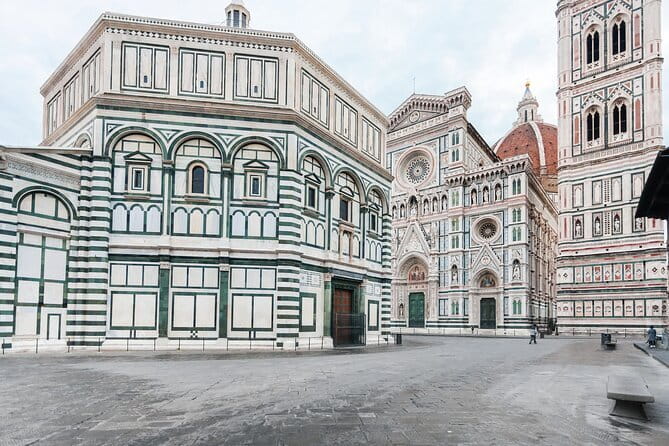
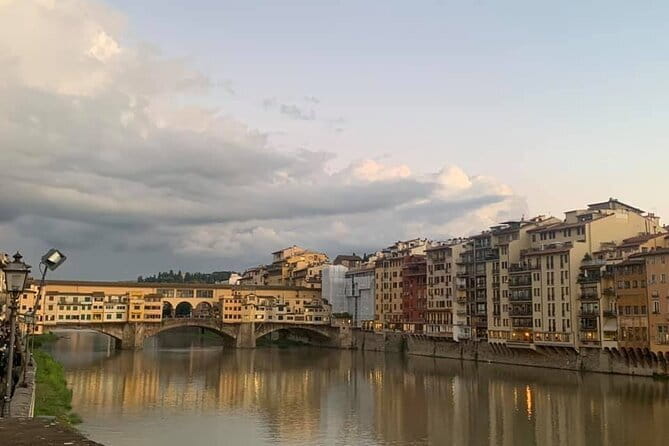
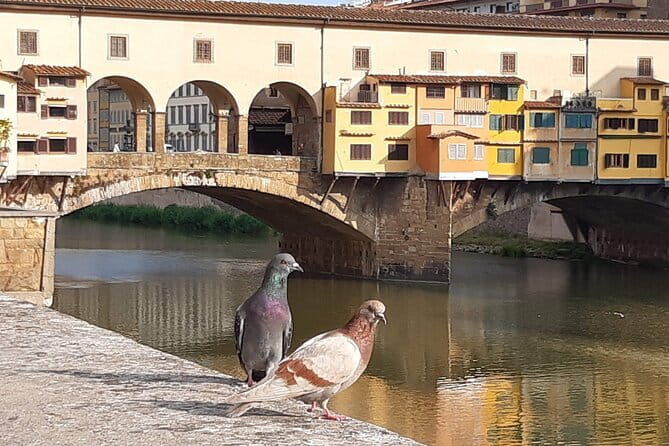
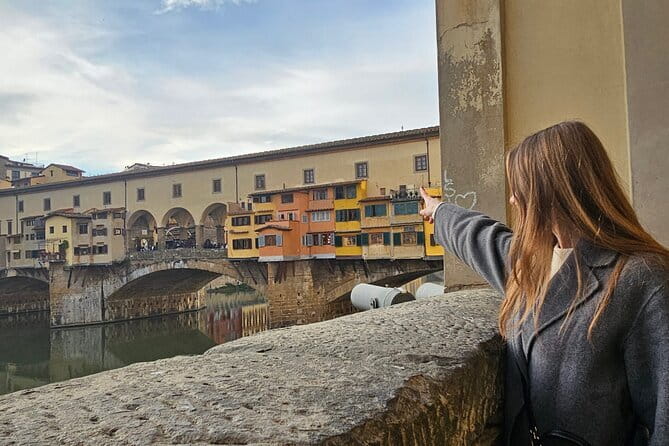
Ponte Vecchio is one of the few stops that is completely free to experience on the walk. You cross or approach the bridge while the guide explains its place in Florence’s commercial and architectural story.
The bridge can be crowded, and 10 minutes is a sensible amount of time for a group walk. You will not have time for extended browsing in the shops, photography from every angle, or a quiet pause above the Arno.
I like this stop because it changes the mood. After churches, palaces, and government buildings, Ponte Vecchio brings you back to daily trade and movement through the city. It also sets up the final stop, Palazzo Pitti, which sits across the river in a different part of Florence.
Palazzo Pitti: the Medici move across the Arno

The final stop is Palazzo Pitti, with about 15 minutes allotted. The palace was built by the merchant Luca Pitti as a display of wealth and power aimed at rivals, including the Medici. In 1549, Eleanor of Toledo, wife of Cosimo I, bought it, and the palace became the official home of the Medici grand dukes after Cosimo moved from Palazzo Vecchio.
That story makes Pitti more than a large palace. It shows how Florence’s ruling family used architecture to mark a new phase of power. The Boboli Gardens were laid out behind it, adding another layer to the palace’s role as a court residence.
The complex includes several separate attractions:
- Galleria Palatina
- Appartamenti Reali
- Galleria d’Arte Moderna
- Galleria del Costume
- Museo degli Argenti
- Boboli Gardens
None of these admissions is included. The 15-minute stop gives you a useful introduction and helps you decide if Pitti deserves a later visit. I would not try to squeeze the palace museums and Boboli Gardens into this walking tour. They need their own block of time.
The route description says the activity ends back at the meeting point, Florence Tours on Via Camillo Cavour. Since the final sightseeing point is Palazzo Pitti, confirm the exact return arrangement when you meet the guide. The published information identifies the start and end as the same meeting point.
The guides make the biggest difference
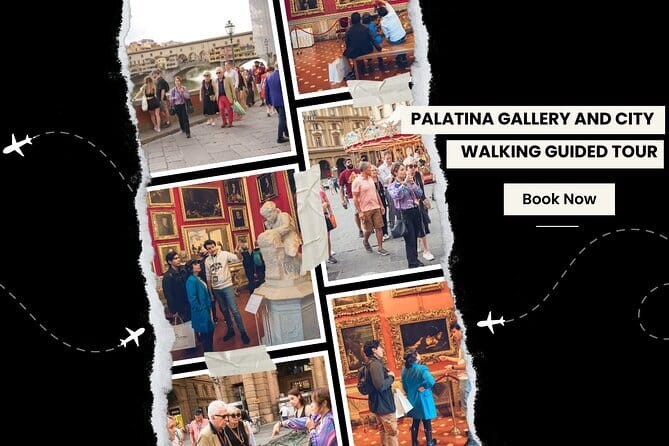
The strongest part of this experience is the quality and personality of the guide assigned to your departure. Names associated with the tour include Francesco, Julia, Giovanni, Raffaello, Luigi, Lorenzo, Monica, Carmen, John, and Zeynep Arzu.
Francesco receives especially strong praise for energy, humor, superb English, and his ability to explain Florence without turning the walk into a lecture. He also has experience as a school history teacher and, in one account, as a chef. That combination can be useful when you want history, local food advice, and a relaxed conversation.
Julia is noted for adapting the route, sharing restaurant and wine suggestions, and helping guests fit the walk around another appointment. Giovanni is praised for clear English, choosing shady places when possible, and explaining aristocratic families, buildings, and statues. Raffaello offers a more art-history-focused approach.
You cannot assume you will receive a particular guide unless the operator confirms it. You can, however, expect the best version of the tour when your guide tells stories rather than reciting names and dates. The most useful explanations connect a statue, palace, or church to the people who commissioned it and the message they wanted to send.
One practical warning: a last-minute guide change once caused a 10 a.m. departure to move to 1 p.m. The issue was resolved well, but it shows why you should leave some flexibility around this walk if your day includes timed museum tickets or trains.
Is $30.01 a fair price?
At $30.01 per person, this is a reasonable price for a guided introduction to central Florence, especially if you are arriving without much background. You are paying for a guide, an audio system, and a carefully connected route through several major sights.
The price is less attractive if you expect museum entry or a long interior visit. You will still need separate tickets for the Uffizi, Palazzo Pitti, Palazzo Medici Riccardi, the Duomo complex, and other paid sites. Think of this as a city walk that helps you spend those additional admission fees wisely.
I see the best value for first-time visitors, families who need a clear overview, and anyone who wants to understand Florence before choosing which museums to enter. If you already know the city well and have a firm list of museums, you may prefer to put the same 95 minutes toward a single collection.
The fact that the tour is often booked well ahead of time, around 51 days in advance on average, suggests that planning early can matter during busy periods. Free cancellation is available up to 24 hours before the start time, but changes or cancellations inside that window are not accepted for a refund.
Who should book this Florence walk?
I would book it if you want a fast introduction to the city’s central sights and prefer a human explanation to reading guidebook panels. It suits you especially well if the Medici, public art, architecture, and political history interest you.
Families may appreciate the short stops and changing scenery. The guides have adjusted explanations for younger guests, and the walk can include practical tips that help with the rest of your day.
I would think twice if your main goal is interior art. The Uffizi, Pitti Palace, and the Duomo deserve more time than this route allows. You could still take the walk first, but do not let it replace the museum visits you came to Florence to make.
The walk is offered in English, uses a mobile ticket, and is near public transportation. Most people can participate, but this is still a city walking tour with several stops and a published group limit of 50 people. Wear comfortable shoes and expect outdoor sightseeing rather than a seated presentation.
The bottom line: a useful first chapter, not the whole book
This is a good-value Florence orientation with an unusually wide route for its short duration. I especially like the way it links the Medici palaces, civic buildings, churches, statues, and river crossing into one story.
Book it early in your Florence stay if you want help choosing what to visit afterward. Ask questions, note the guide’s food and wine suggestions, and return to the places that catch your attention. Skip it if you have already planned every minute around museum interiors or if you want a slow, detailed art tour.
For most first-time visitors, the tour does its job well: it gives you the city’s basic structure, shows you where the major sights fit together, and leaves you with a better plan for the rest of your time.
FAQ
How long does the walking tour last?
The tour lasts approximately 1 hour and 35 minutes.
What language is the tour offered in?
The tour is offered in English.
How much does the tour cost?
The listed price is $30.01 per person.
Where does the tour start?
The meeting point is Florence Tours, Via Camillo Cavour, 21R, 50129 Firenze FI, Italy.
Where does the activity end?
The activity information states that it ends back at the meeting point.
Are museum and church entrance tickets included?
No. Entrance to the museums and churches is not included.
Is admission to Piazza della Signoria included?
Piazza della Signoria is listed as free admission, so no separate entrance ticket is required for the square.
Is an audio guide included?
Yes. The tour includes the use of audioguide systems.
How large can the group be?
The published maximum is 50 travelers, although some departures may be much smaller.
Can I cancel for a full refund?
Yes, if you cancel at least 24 hours before the experience start time. Cancellations made less than 24 hours before the start time are not refunded.
Recently added around Florence
- Accademia and Uffizi Small-group Guided Tour★ 4.5 · 8 reviews
- The David from Michelangelo.★ 5.0 · 3 reviews
- Combo: Accademia + walking + Uffizi Galleries Guided Tour★ 3.5 · 6 reviews
- The Complete Wine Tour Brunello, Nobile, Chianti wine experience★ 4.0 · 7 reviews
- The Best of Tuscany in 3 Days★ 4.5 · 13 reviews
- The Cooking Lab – Authentic Food Experience★ 5.0 · 113 reviews
- Florence Central Market Food Tour – Private Tour★ 4.0 · 7 reviews
- Family Friendly Florence Private City Tour★ 5.0 · 47 reviews
Florence Walking Tours, compared.
Skip the line: Uffizi and Accademia Small Group Walking Tour
Read our review →
Renaissance and Medici Tales Guided Walking Tour
Read our review →
Skip-the-Line Florence Highlights and David Walking Tour
Read our review →
Dark Mysteries and Legends Guided Walking Tour
Read our review →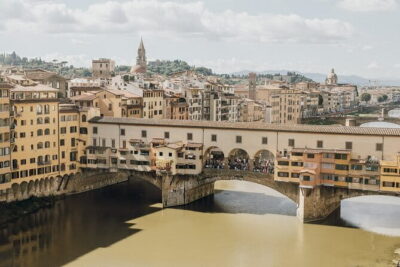
Florence in a Day: Michelangelo’s David, Uffizi and Guided City Walking Tour
Read our review →Browse the lists this tour appears in