
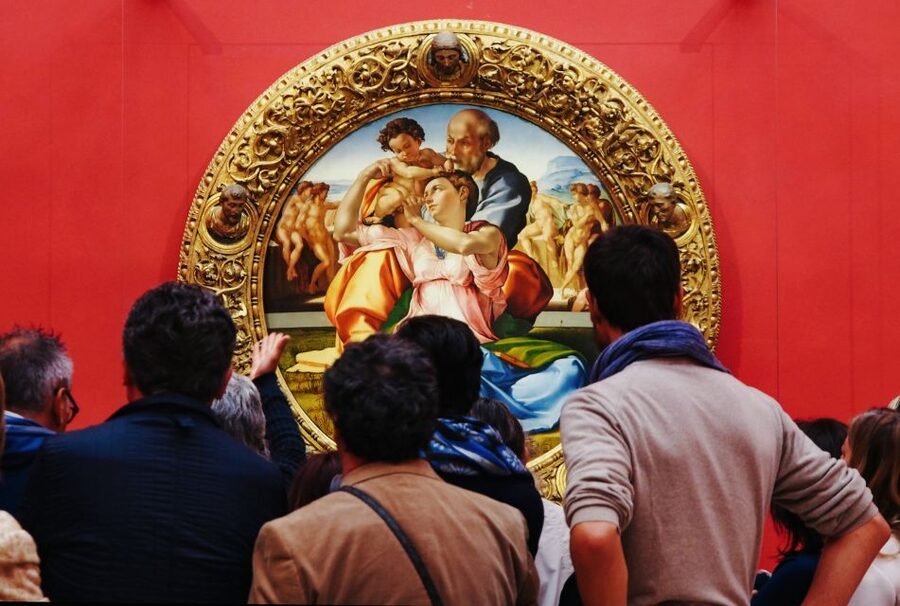
Reviewed · UFFIZI GALLERY TOURS
Florence: Uffizi Priority Ticket & Masterpieces Audio App
The best part of this Uffizi experience is simple: you spend less time hunting for the ticket office and more time with Botticelli, Leonardo, Michelangelo, and Caravaggio. A host meets you near the Benvenuto Cellini statue, hands over your timed ticket, and points you toward the entrance.
I like the clear meeting point and the freedom to explore alone. I also like the self-paced audio app, which helps you focus on major works without tying you to a live group. The main catch is that priority entry does not remove the museum’s security check, and the app works only if you prepare your phone and bring earphones.
Key points at a glance

- Meet under Benvenuto Cellini’s statue: Look for an ACCORD host in a yellow vest at the corner of the ticket office and Via Lambertesca.
- Priority entry saves time: You skip the ticket-buying and ticket-pickup lines, though everyone still passes through security.
- The audio app favors famous works: Hear about Botticelli’s Birth of Venus, Leonardo’s Annunciation, Caravaggio’s Medusa, and more.
- You set the pace: A quick visit can take about two hours, while art lovers may need four hours or much longer.
- Bring the right gear: Install the app on Wi-Fi before arrival, charge your phone, and pack your own headphones.
- The price covers more than admission: At about $31, you pay the official adult ticket price plus timed access, host assistance, and the audio service.
Why the Uffizi deserves your time

The Uffizi is not a small collection you can casually pass through in half an hour. It follows the development of Italian art from the Middle Ages into the Renaissance and beyond, with paintings, sculpture, and ancient Roman copies of lost Greek works.
The building itself is part of the experience. The long upper-floor corridors are lined with ancient statues and busts collected by the Medici family. You move from room to room through a sequence that makes the museum feel like both a palace and a picture gallery.
The famous works draw most people here, and they are worth seeing in person. Botticelli’s Birth of Venus has the instant recognition of a picture you have seen many times, yet the scale and delicate details are different on the wall. Leonardo’s Annunciation rewards a slower look, especially if you enjoy tracing how the artist handles space, landscape, and the figures’ gestures.
You will also find Giotto, Michelangelo, and Caravaggio. The collection is much larger than its greatest hits, so the audio app is useful as a filter. It helps you choose where to pause rather than trying to read every label in the building.
More ways into the Uffizi:
- Florence: Skip-The-Line Uffizi Gallery Timed Entry Ticket
★ 4.5 · 27,832 reviews - Florence: Skip-the-Line Uffizi Small Group Tour
★ 4.6 · 5,926 reviews - Uffizi Gallery Small Group Tour with Guide
★ 4.5 · 4,923 reviews
Finding the host near the Cellini statue
The meeting point is in front of the Uffizi, under the Loggia near the statue of Benvenuto Cellini. More exactly, look at the corner of the Uffizi ticket office and Via Lambertesca for an ACCORD staff member wearing a yellow vest.
Arrive 15 minutes early. This matters because you need to locate the host, receive your ticket, and join the correct entry process for your reserved time. The meeting point is central, but Florence’s streets around the Uffizi can be confusing if you are rushing.
The host is there to manage admission rather than lead a museum tour. That distinction is important. You receive help getting started, but you do not follow a live art historian through the galleries.
Several people have found the staff easy to locate and helpful when ticket questions arise. One guide named Leticia has been especially praised for clear explanations in sessions where extra assistance was provided. Still, you should book this product expecting host support and an audio app, not a guaranteed personal guide.
What priority entry really means
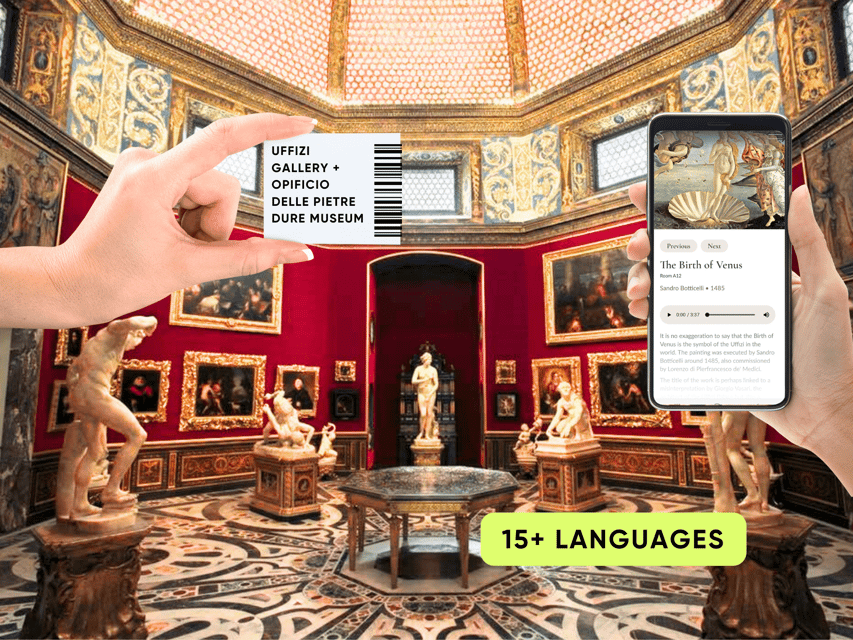
The ticket lets you avoid the standard ticket-buying line and the separate ticket-pickup line. In busy periods, this can be a major advantage. The regular queue may stretch well beyond the museum entrance, while the priority process moves you toward the correct door with less uncertainty.
You do not skip security. Every person must pass through the museum’s check, and at the busiest times this can take about 10 to 15 minutes. Some visitors still wait in a short admission line even with a priority ticket, especially when the museum is crowded or many timed entries arrive together.
That is why I would call this priority access, not instant entry. The ticket removes the most annoying part of visiting the Uffizi, but it cannot control security procedures or the flow inside the museum.
Morning entry is a sensible choice if the schedule suits you. A 9:30 start has worked well for people who wanted a calmer beginning, though crowd levels change by day. The reserved time gives you a better plan than simply turning up and hoping for a quiet hour.
Using the audio app inside the museum
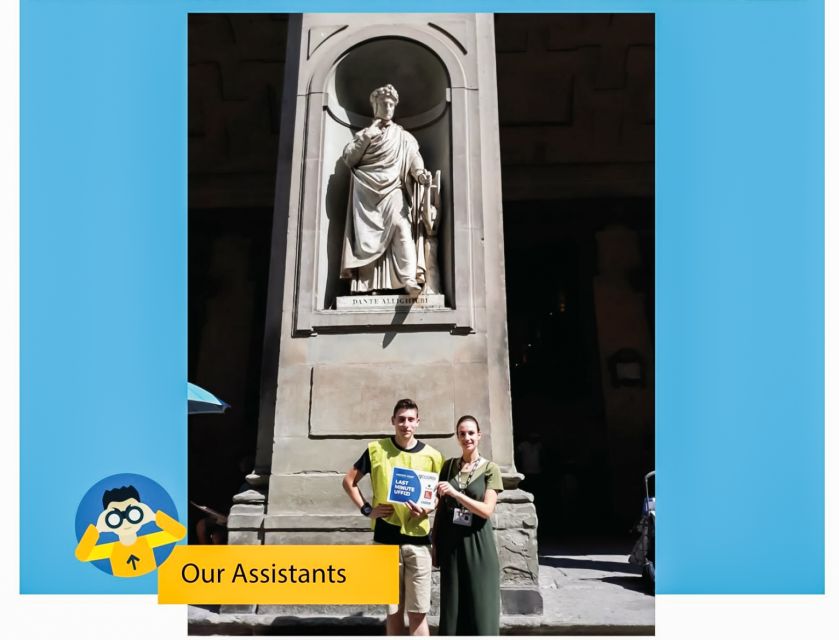
You receive instructions and a link or QR code for the audio application with your voucher. Install it before you reach the Uffizi, ideally the day before while connected to Wi-Fi.
This preparation is not optional busywork. Downloading an app on a crowded street, with weak signal and a group waiting to enter, can turn a smooth visit into a frustrating one. The installation instructions have not always been perfectly clear across different browsers, so give yourself time to test the app before leaving your accommodation.
Bring your own earphones. They are not supplied, and several people have been unable to use the audio because they arrived without them. A charged phone is just as important. The museum visit can last several hours, and audio, maps, photographs, and general phone use all consume power.
The app is available in English, Italian, Turkish, Spanish, French, German, Chinese, Portuguese, Polish, Japanese, Russian, Dutch, Korean, Hungarian, Greek, Croatian, Romanian, and Ukrainian. The listed host languages are English and Italian.
The content focuses on selected works rather than explaining every painting. That is helpful in an enormous museum, but it also means the app is not a full replacement for a live specialist. Some people find it clear and efficient, while others want more detail or a better map.
More audio guide and self-guided tours in Florence:
- Florence: Michelangelo’s David Entrance Ticket and Audio App
★ 4.3 · 1,901 reviews - Florence: Uffizi & Accademia Priority Tickets with Audio App
★ 4.4 · 1,253 reviews - Florence: Eco-Friendly Golf Cart City Tour with Audio Guide
★ 4.6 · 1,094 reviews - Florence: Uffizi Skip-the-Line Ticket & Digital Audio Guide
★ 4.2 · 1,044 reviews
A sensible route through the galleries
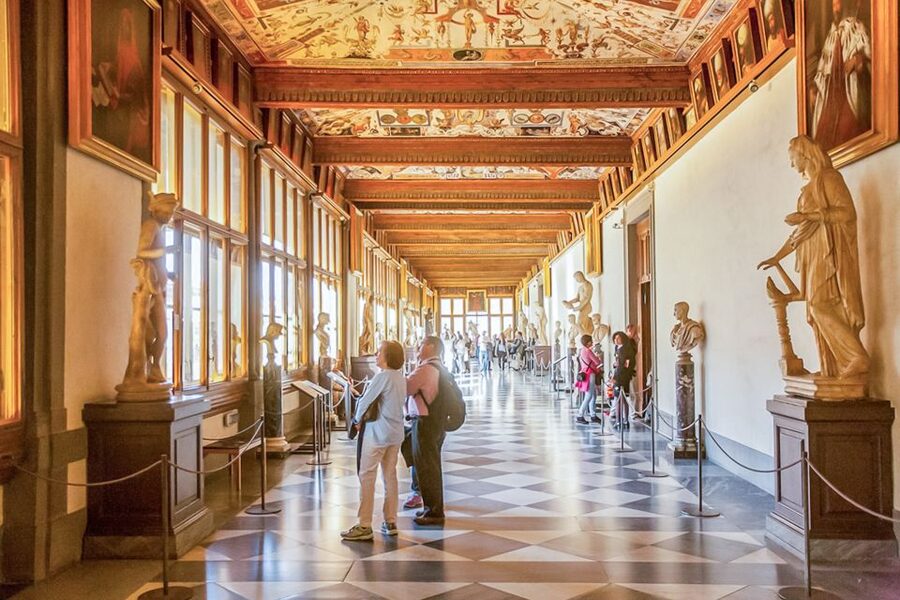
After security, you follow the museum’s marked route through the upper floors. Arrows above doorways help with direction, and the rooms naturally lead from one to another. Even so, a basic map would make the visit easier, particularly if you want to return to a favorite painting.
Start with the major medieval and early Renaissance works instead of racing straight to Birth of Venus. Giotto and other early masters help you see how painting changed over time. The comparison makes the later Renaissance rooms more meaningful.
As you continue, give yourself time with Leonardo’s Annunciation. The audio explanation can point out details that are easy to miss when the room is crowded. Leonardo’s work is not only about the figures. Look at the arrangement of the setting, the treatment of the natural world, and the careful balance between the two main characters.
Botticelli’s Birth of Venus is one of the museum’s main stops. Expect other people to gather here, particularly during the busiest hours. The painting is famous, but it is not the only reason to linger in the room. Botticelli’s nearby works help show the range of his style and the tastes of the Florentine court.
Caravaggio’s Medusa offers a sharp change of mood. Its force comes from the expression and the dramatic treatment of the subject. It is a good example of why the Uffizi should not be treated as a one-artist museum.
You can also see Michelangelo’s only painting on wood, along with ancient statues and busts displayed along the corridors. The sculpture collection changes the rhythm of the visit. After several rooms of paintings, these marble and stone figures give your eyes a different kind of detail to study.
How long should you allow?
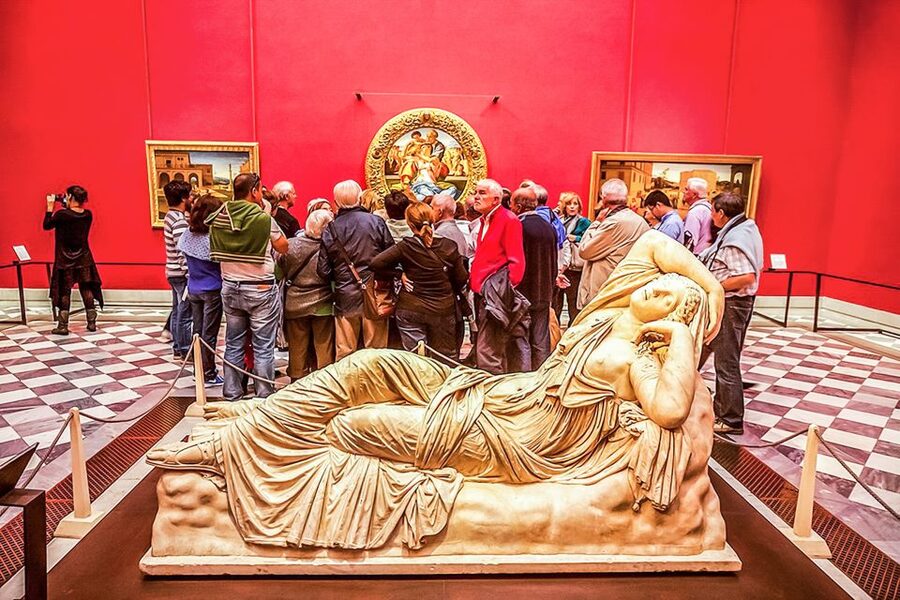
The advertised duration is one day, meaning your ticket is valid for the reserved visit date rather than describing a fixed guided schedule. Once inside, you control the pace.
Plan on two to four hours for a useful visit. Two hours can cover the major works if you follow the audio highlights and keep moving. Four hours gives you time to pause, read labels, study the sculpture, and step away when the rooms feel crowded.
Art lovers could easily spend most of a day here. The collection is large enough that a second look at the less famous rooms can be as rewarding as the headline paintings.
There is a small café on a terrace inside the museum. A break can help, especially if you are visiting in the warmer months or have children with you. You may then leave or continue through the galleries.
Be ready for stairs. One account notes roughly 120 steps to reach the starting point, with an elevator available for the descent. The activity is wheelchair accessible, but anyone with limited mobility should still allow extra time and ask staff for the most suitable route.
The Vasari Corridor and the view after your visit

After leaving the Uffizi, walk along the outside of the Vasari Corridor. This historic passage connects the Uffizi with the Pitti Palace, and the exterior gives you attractive views of Florence’s streets and architecture.
This is not a tour of the corridor itself. The experience only suggests viewing it from outside, so keep your expectations clear. It is a pleasant add-on after the museum, especially if you want to continue toward the river and the Pitti Palace area.
The walk also gives you a needed change of pace. The Uffizi asks for steady concentration, and Florence is best enjoyed when you alternate indoor art with streets, bridges, and open views.
Is $31 a fair price?

The listed price is about $31 per person. The official adult Uffizi ticket is €29, while EU visitors aged 18 to 25 pay a reduced €2 and visitors aged 0 to 17 enter free under the stated museum pricing.
That comparison matters. If you qualify for a reduced or free official ticket, this package is harder to justify on admission cost alone. You are paying for the booking arrangement, host assistance, priority handling, and mobile audio content.
For a full-price adult visiting during a busy period, the extra cost can be reasonable. The value comes from avoiding the wrong line, finding the correct entrance, and having a ready-made introduction to the key works. I would not book it mainly for the audio app, since the audio is useful but fairly basic for people seeking detailed art criticism.
A bonus selection of Tuscan food tastings is also included, with examples such as extra-virgin olive oil, truffle products, schiacciata, and cantuccini. Treat this as an added extra rather than the reason to choose the experience. The real purchase is organized Uffizi entry.
The booking is non-refundable, so check your Florence plans before paying. That is particularly important if your schedule is still changing.
Who will get the most from this visit?
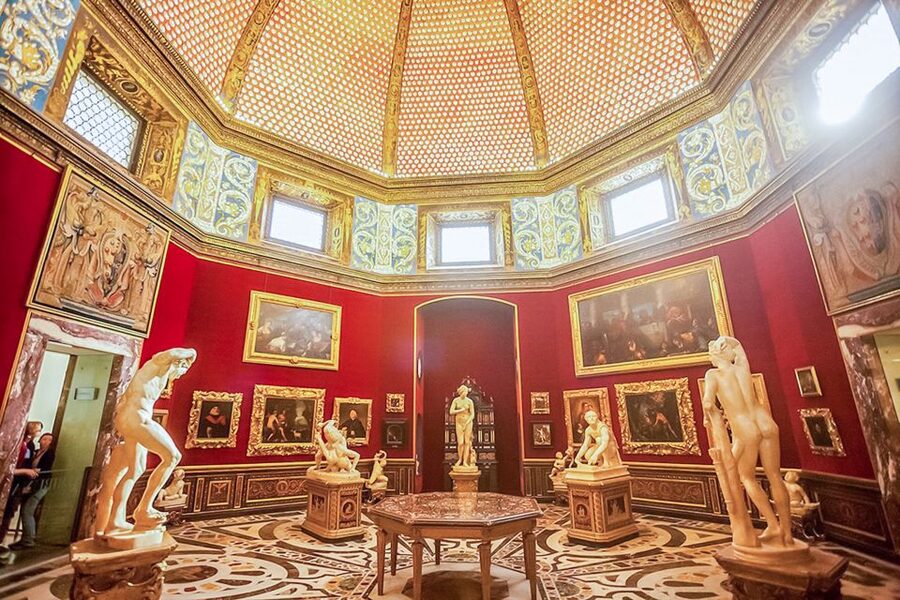
This suits you if you want to see the Uffizi without committing to a live group tour. You can listen to selected explanations, skip sections that interest you less, and stop for photographs or a break.
It is also a good fit for a first visit. The museum can feel overwhelming, and a shortlist of key works gives you a firm starting point. Families and mixed-interest groups may appreciate being able to separate briefly and move at different speeds.
Choose a live guided tour instead if you want extended discussion, questions answered on the spot, or a detailed explanation of the museum’s rooms and artistic movements. The product includes an English-speaking or Italian-speaking host for entry support, not a guide who stays with you throughout.
You should also choose this only if you are comfortable using your phone. The app is central to the experience, and no earphones are included.
Practical details before you go
Carry a passport or ID card for every visitor, including children. Security rules allow one water bottle of up to 500 milliliters per person inside the museum.
Large bags and luggage are not allowed. Pets are not allowed either. Keep your belongings light so security is quicker and your hands are free for your phone and headphones.
Install the audio app before arrival, charge your phone fully, and save the meeting instructions where you can find them. Arriving early is the simplest way to avoid a stressful start.
Should you book this Uffizi experience?
Book it if your priority is organized timed entry with freedom inside. The host support, clear meeting place, and priority ticket are the strongest parts, especially during crowded periods. The audio app gives you enough structure to make sense of the major paintings without forcing you into a fixed group.
Skip it if you qualify for a very cheap museum ticket, dislike phone-based tours, or want a full art-history lesson from a live guide. For most first-time adult visitors with limited time, though, $31 is a fair price for reducing the admission hassle and getting straight to the Uffizi’s essential works.
FAQ
Where is the meeting point?
Meet at the corner of the Uffizi Gallery ticket office and Via Lambertesca, near the statue of Benvenuto Cellini. Look for an ACCORD staff member wearing a yellow vest.
How early should I arrive?
Arrive 15 minutes before your reserved entry time so you can find the host, collect your ticket, and join the entry process without rushing.
Does the ticket skip the security check?
No. All visitors must pass through security. At busy times, this check can take about 10 to 15 minutes.
Is there a live guide inside the Uffizi?
No. The activity includes host assistance at entry and a mobile audio app. It does not include a live guide who accompanies you through the galleries.
Do I need to bring headphones?
Yes. Earphones are not included, and the audio guide is installed on your smartphone.
Can I use the audio app in my language?
The app is listed in English, Italian, Turkish, Spanish, French, German, Chinese, Portuguese, Polish, Japanese, Russian, Dutch, Korean, Hungarian, Greek, Croatian, Romanian, and Ukrainian.
Can I bring water into the museum?
Yes. Each visitor may bring one bottle of water with a maximum size of 500 milliliters.
Is the Uffizi accessible by wheelchair?
The activity is listed as wheelchair accessible. The museum route may include stairs, including a reported staircase of about 120 steps to the starting point, with an elevator available for the descent.
Recently added around Florence
- Accademia and Uffizi Small-group Guided Tour★ 4.5 · 8 reviews
- The David from Michelangelo.★ 5.0 · 3 reviews
- Combo: Accademia + walking + Uffizi Galleries Guided Tour★ 3.5 · 6 reviews
- The Complete Wine Tour Brunello, Nobile, Chianti wine experience★ 4.0 · 7 reviews
- The Best of Tuscany in 3 Days★ 4.5 · 13 reviews
- The Cooking Lab – Authentic Food Experience★ 5.0 · 113 reviews
- Florence Central Market Food Tour – Private Tour★ 4.0 · 7 reviews
- Family Friendly Florence Private City Tour★ 5.0 · 47 reviews
Uffizi Gallery Tours, compared.

Skip-The-Line Uffizi Gallery Timed Entry Ticket
Read our review →


Skip the line: Uffizi and Accademia Small Group Walking Tour
Read our review →
Uffizi Gallery and Accademia Gallery Guided Tour
Read our review →
Uffizi Gallery Small-Group Guided Tour with Ticket
Read our review →
Michelangelo’s David, Accademia & Uffizi Small Group Tour
Read our review →
Accademia & Uffizi Museums: Small Group Tour with Optional Lunch
Read our review →Browse the lists this tour appears in