
Reviewed · ACCADEMIA GALLERY AND DAVID TOURS
3 hour Walking Tour Statue of David and Florence Highlights
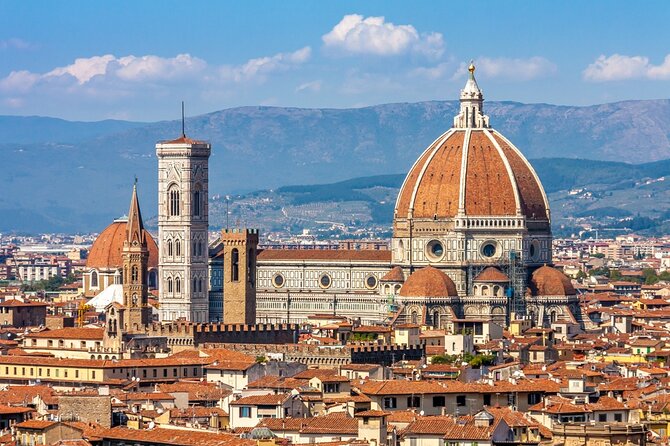
Florence puts an astonishing amount of art into a small historic center, and this tour begins with its greatest crowd-puller: Michelangelo’s David inside the Accademia Gallery. From there, you walk through the city’s central streets, pausing at the Duomo, Ponte Vecchio, the Porcellino fountain, and the sculpture-filled Piazza della Signoria.
I like two things right away. First, you get an Accademia reservation instead of gambling on a last-minute David ticket. Second, the route gives you useful bearings on your first day, with a local guide connecting art, politics, religion, and daily life. The guides named in the feedback, including Bianca, Valerie, Sonia, Pamela, and Martina, were praised for clear explanations and a personal touch.
The main catch is that skip-the-line does not mean walk straight in. The Accademia has only two metal detectors, so groups can still wait at the reserved entrance. Much of the rest of the tour is outdoors, and rain, heat, crowds, or tired feet can change the mood.
Key points to know before booking
- David comes first: You spend about an hour inside the Accademia, with admission included.
- Ten central Florence stops: The route covers major squares, churches, bridges, fountains, and palaces in roughly three hours.
- Most sights are exterior visits: The Duomo, Baptistery, Orsanmichele, and Santa Croce are viewed from outside.
- Local guides shape the experience: Bianca, Valerie, Sonia, Pamela, and Martina are among the guides praised for clear history and art explanations.
- Small-group format: The maximum is 19 people, and radio headsets may be supplied depending on group size.
- A useful first-day walk: You finish at Santa Croce, after crossing much of the compact historic center on foot.
Why David is the right place to begin
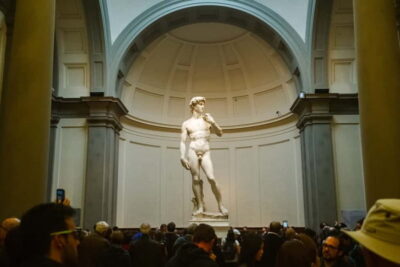
The Accademia Gallery is the one stop here that requires a ticket and timed planning. That makes it a sensible anchor for the morning or afternoon. You enter with a reserved admission ticket and spend about an hour inside, where Michelangelo’s David is the main event.
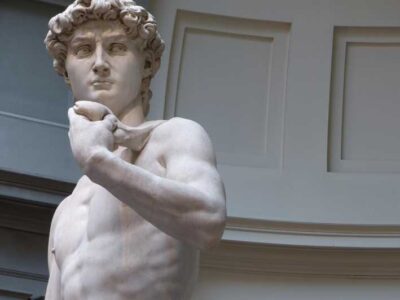
David is more impressive in person than photographs suggest. The scale, the polish of the marble, and the way the figure fills the gallery are hard to grasp on a screen. A guide can also help you look beyond the famous face and hands, explaining the sculpture’s artistic choices and place in Renaissance Florence.
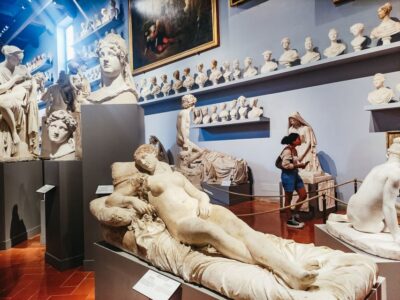
The Accademia contains other Michelangelo works as well, so this is not simply a quick stop for one statue. Still, do not expect a long museum visit. The schedule gives you about an hour, and the tour must keep its timed entry moving.
The reservation saves you from the much longer uncertainty of turning up without a ticket. But keep your expectations realistic. The museum checks every person at security, and only two metal detectors are available. Even with a reserved group entrance, a line can form.
Arrive early. The guide is expected at the meeting point five to ten minutes before departure, and the Accademia is strict about entry times. If you arrive late, the group leaves and you may miss the museum visit.
The gallery also has firm bag rules. Drinks are not allowed except for a water bottle of no more than 0.5 liters. Umbrellas must fold or be left in the proper stands, and bulky items larger than 40 by 30 by 18 centimeters, including large backpacks and luggage, are not permitted. There is no cloakroom, so pack light.
More ways to see the David at the Accademia:
- Florence: Timed Entrance Ticket to Michelangelo’s David
★ 4.6 · 16,983 reviews - Florence: Michelangelo’s David Skip-the-Line Entry Ticket
★ 4.5 · 12,764 reviews - Florence Accademia Gallery Tour with Entrance Ticket Included
★ 4.5 · 6,148 reviews
From the Duomo to the Baptistery
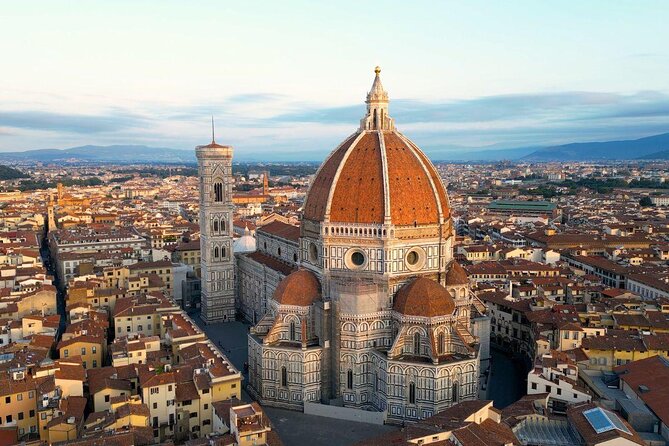
After the Accademia, the walk turns toward the Duomo complex. You see the Cathedral of Santa Maria del Fiore from outside, with its famous dome and Giotto’s Bell Tower rising above the city.
This is a short stop, about 15 minutes, so the guide’s explanation matters. The cathedral took shape across the Gothic and Renaissance periods, and its dome remains the visual center of Florence. You get context for the building rather than an interior visit or a climb.
That limitation is important. Cathedral and dome entry is not included. If you want to enter the church, climb the dome, or visit the bell tower, you need separate arrangements. This tour works best as an orientation, not as a substitute for a full Duomo ticket.
The Baptistery of St. John comes next, also viewed from outside. Its patterned marble facade and bronze doors are among Florence’s most recognizable sights. The doors helped ignite the artistic changes associated with the Renaissance, and a good guide can turn what looks like a quick photo stop into a short lesson in competition, patronage, and design.
You spend only about ten minutes here. That is enough for a focused explanation and a look at the exterior, but not enough for a detailed architectural study.
Piazza della Repubblica and the city beneath your feet
Piazza della Repubblica receives only about five minutes, yet its location gives it unusual importance. The square marks the center of the ancient Roman city of Florentia.
The site has also served very different purposes over time, including a central market and the Jewish Ghetto. That layered past makes it a useful reminder that Florence is not only a collection of Renaissance masterpieces. Streets and squares have changed roles many times.
This is one of the tour’s faster transitions. You should not expect a long pause or a deep architectural talk here. Instead, use the stop to understand the city’s layout and the way modern Florence sits over Roman foundations.
Orsanmichele, a barn turned church
The Church and Museum of Orsanmichele offers one of the route’s more unusual stories. The building began as a barn before becoming a church tied to the guilds that controlled much of medieval Florence.
From outside, you can see its place in the city’s commercial and religious life. The building contains a Gothic tabernacle and works linked to early Renaissance sculpture, including Donatello’s Saint George. Since the visit remains outside, your guide’s storytelling carries much of the value.
This is a good example of why a walking guide can add something beyond a list of famous names. Florence’s major monuments are only part of the picture. Guilds, markets, trade, and civic power helped shape the art you came to see.
The stop lasts around five minutes, so keep your eyes open and stay close to the guide. Busy streets and groups can make it easy to lose sight of the meeting point.
More walking tours in Florence:
- Florence: Guided Walking Tour
★ 4.5 · 3,334 reviews - Skip the line: Uffizi and Accademia Small Group Walking Tour
★ 4.5 · 3,135 reviews - Florence: Guided Walking Tour
★ 4.6 · 1,602 reviews - Florence: Renaissance and Medici Tales Guided Walking Tour
★ 4.8 · 1,549 reviews
The Porcellino and Florence’s small rituals
At the Fontana del Porcellino, you get a lighter moment. The bronze wild boar sits beside a Renaissance loggia that covers a street market. The familiar custom is to place a coin in the boar’s mouth, a ritual said to help bring you back to Florence.
This stop takes about ten minutes. It is not a major art lesson, but it gives the walk a bit of local character and a simple activity you can share with children or companions. Bring a coin if you want to take part, though the tour does not include personal expenses.
The fountain can be crowded, and the area is part of an active market street. Keep wallets and phones secure in any busy public place, and do not let the playful stop distract you from the guide’s meeting instructions.
Ponte Vecchio and the Medici passage
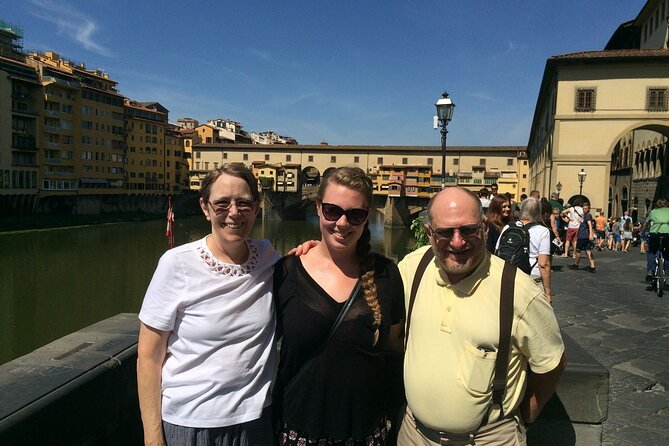
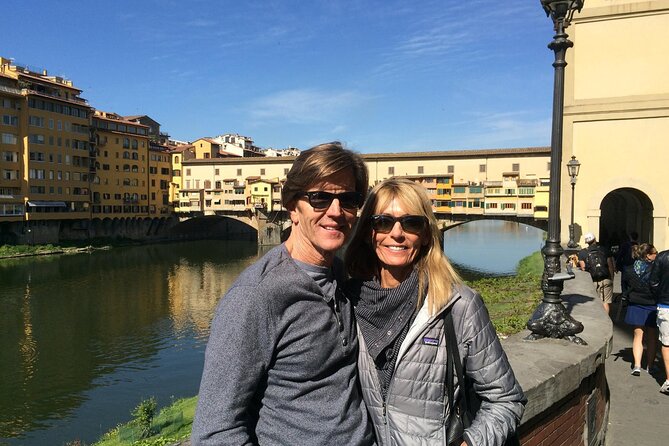
From the Porcellino, the route continues to Ponte Vecchio. This is Florence’s most famous bridge, lined with jewelry shops and crossed above by the Vasari Corridor.
The bridge survived the destruction that affected other crossings during World War II, and its present form followed the flood of 1333. The Vasari Corridor once gave the Medici family a private route above the street, allowing them to move between important buildings without mixing with the crowds below.
You get about ten minutes here. That is enough to view the bridge, hear its political story, and take photographs, but not enough to explore every shop or study the corridor in detail. The bridge is also one of the most crowded parts of central Florence, so the experience may feel less peaceful than the photographs suggest.
I would use this stop to listen first and photograph second. The guide can point out features you might otherwise miss, including the elevated passage and the way the bridge functions as both a historic monument and a working shopping street.
Piazza della Signoria, Florence’s outdoor sculpture room
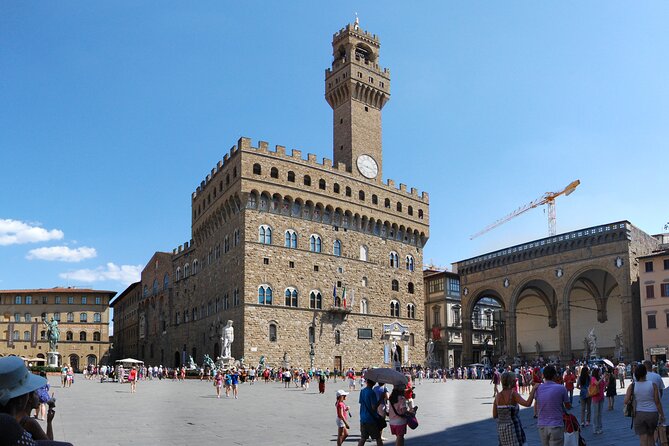
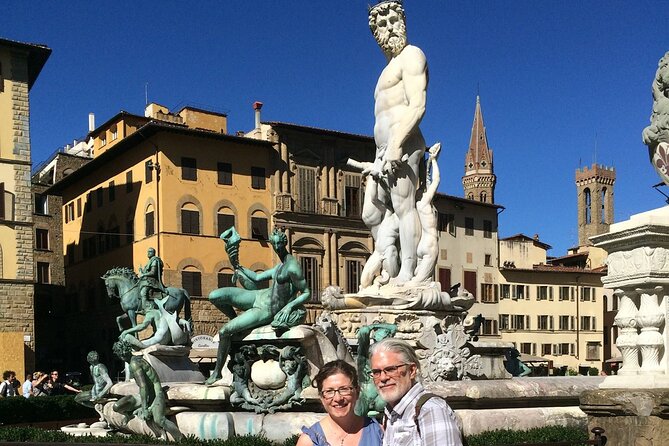
Piazza della Signoria is one of the strongest outdoor stops on the walk. It has long served as Florence’s political center, with Palazzo Vecchio facing a remarkable display of sculpture.
The square works like an open-air museum. You see Cellini’s Perseus, the Fountain of Neptune, and Giambologna’s Rape of the Sabines, along with other sculptures around the loggia. Several are original works, not just later copies placed for decoration.
A fifteen-minute stop gives the guide room to explain how art served power in Florence. The sculptures were not placed here by accident. They helped communicate political strength, civic pride, religious ideas, and the wealth of the ruling class.
This is a spot where a guide’s art background can make a real difference. Bianca was praised for explaining both Florence’s history and its art, while other guides were credited with adapting their explanations to the group. If you enjoy learning why a sculpture looks the way it does, rather than simply identifying it, this portion should reward your attention.
San Firenze and a Leonardo connection
Piazza San Firenze is a brief five-minute stop, but it brings several notable buildings into one view. You can see the Bargello palace and tower, the Church of San Firenze, and Palazzo Gondi.
A plaque on Palazzo Gondi records that Leonardo da Vinci lived there while painting the Mona Lisa. The stop is short, yet it adds a personal detail to the city’s artistic story. Florence becomes less abstract when you can connect a famous artist to a particular building and street.
You will not enter these sites during the tour. Think of this as a visual pause and a chance to ask a question before the walk continues toward Santa Croce.
Finishing at Santa Croce
The final stop is the exterior of Santa Croce, a major example of Tuscan Gothic architecture. The church was built in 1296 and is associated with the tombs of Michelangelo, Machiavelli, and Galileo.
The tour ends in Piazza Santa Croce, in front of the church. This is a useful finish because you are left in a historic square with a major landmark directly in front of you, rather than being returned to the starting point.
Santa Croce itself is not included inside the tour. You should also dress with later visits in mind. Places of worship require clothing that covers shoulders and knees, and unsuitable clothing can prevent you from entering parts of the route. Since this walk includes church exteriors but may lead you toward religious sites, modest clothing is the easy choice.
How the three hours feel on foot
The route lasts about three hours and links ten stops across central Florence. The city center is compact, but the tour still involves steady walking, standing, street crossings, and time outdoors.
I would wear comfortable shoes and check the weather before setting out. One poor-weather experience involved heavy rain, which made the outdoor portions less enjoyable. The route has little shelter during many of its explanations, and crowds can make the pace feel less relaxed.
The maximum group size is 19 people. That is not a private tour, but it is small enough to remain manageable when the guide uses radio headsets. Headsets depend on group size, so do not assume they will always be supplied.
The guides are a major part of the experience. Bianca received repeated praise for clear explanations, flexibility, and early arrival. Valerie was noted for enthusiasm and personal attention. Sonia made extra room for questions in a very small group, while Pamela was praised for guiding a small party. Martina was credited with taking time to explain details.
Your guide will vary, so do not book expecting a specific person unless the booking clearly confirms one. The useful pattern is that the tour depends on a local English-speaking guide who can connect the stops and answer questions as you walk.
Is the $3 price a good value?
At a listed price of $3, the tour looks remarkably inexpensive. The real value is not the walking route alone, since you can pass many of these exterior sights independently. The important inclusion is the Accademia admission and timed group access to David.
For someone who cannot find an independent Accademia ticket, the tour can be a practical way to secure the museum visit while gaining a city introduction. Several people booked it for that reason and ended up appreciating the added art and history explanations.
For an independent-minded person who already has David tickets and has researched Florence, the value is less clear. You might prefer to walk the streets at your own pace and spend longer at the Duomo, Ponte Vecchio, or Piazza della Signoria. The route gives you a broad first look, not long visits at each place.
The tour is strongest when you want structure, context, and a quick orientation. It is weaker if you expect every listed monument to include interior access.
Who should book this Florence walk?
I would recommend it for a first visit, especially if you want to see David early in your stay and learn how the center fits together. Families can benefit from the short stories, the Porcellino coin ritual, and the variety of stops. The route also suits people who prefer an art-and-history explanation to reading labels alone.
It is a good match for anyone with limited time in Florence. In three hours, you cover the Accademia, the Duomo area, Roman Florence, guild history, Medici power, Renaissance sculpture, Ponte Vecchio, and Santa Croce.
I would think twice if you have mobility limits, dislike walking in crowds, or need indoor shelter. Most stops are outside, and the tour does not include seats, church interiors, the dome, or extended museum time.
Free cancellation is available if you cancel at least 24 hours before the start time. Inside that window, the payment is not refunded, and last-minute changes are not accepted. The meeting point is by the equestrian statue of Cosimo I in Piazza della Signoria, and the end point is in front of Santa Croce.
Should you book it?
Book this tour if David tickets are hard to find and you want a smart first look at Florence rather than a stand-alone museum entry. The local explanations, compact route, and small-group limit give the walk more substance than simply ticking off monuments.
Skip it if you already have Accademia entry, prefer to explore alone, or want to enter the Duomo and Santa Croce. For most first-time visitors, though, this is an efficient introduction with one essential museum visit and a strong run through Florence’s central sights.
FAQ
Is Michelangelo’s David included?
Yes. Entry to the Accademia Gallery is included, with a reserved skip-the-line group ticket. Security checks can still cause a wait at the entrance.
Does the tour enter the Duomo?
No. The Cathedral of Santa Maria del Fiore and its surrounding complex are viewed from outside. Entry to the cathedral and dome is not included.
Does the tour enter Santa Croce?
No. Santa Croce is viewed from outside, and the tour ends in front of the church.
How long does the tour last?
The walk lasts approximately three hours.
Where does the tour start?
It starts at the equestrian statue of Cosimo I in Piazza della Signoria, Florence.
Where does the tour end?
It ends in Piazza Santa Croce, in front of the Santa Croce church.
How large is the group?
The maximum group size is 19 people. Radio headsets may be used depending on the group size.
What should I wear?
If you plan to enter a place of worship, your clothing must cover your shoulders and knees. The itinerary itself includes the Duomo and Santa Croce from outside, but appropriate clothing is still advised.
Can I bring luggage into the Accademia?
No large luggage, bulky objects, large backpacks, helmets, or items over 40 by 30 by 18 centimeters are allowed. The gallery has no cloakroom, and drinks are limited to water bottles no larger than 0.5 liters.
More three-hour experiences in Florence
- Private Florence Tour: 3-Hour Walking Tour with a Licenced Guide
★ 5.0 · 233 reviews - 3 Hour Florence Pasta Making & Unlimited wine
★ 5.0 · 24 reviews - Inferno Florence Private 3-Hour Tour
★ 4.8 · 20 reviews - Florence: Medieval & Renaissance Private 3-Hour Walking Tour
★ 4.8 · 16 reviews
Recently added around Florence
- Accademia and Uffizi Small-group Guided Tour★ 4.5 · 8 reviews
- The David from Michelangelo.★ 5.0 · 3 reviews
- Combo: Accademia + walking + Uffizi Galleries Guided Tour★ 3.5 · 6 reviews
- The Complete Wine Tour Brunello, Nobile, Chianti wine experience★ 4.0 · 7 reviews
- The Cooking Lab – Authentic Food Experience★ 5.0 · 113 reviews
- Florence Central Market Food Tour – Private Tour★ 4.0 · 7 reviews
- The Best of Tuscany in 3 Days★ 4.5 · 13 reviews
- Family Friendly Florence Private City Tour★ 5.0 · 47 reviews
Accademia Gallery and David Tours, compared.
Timed Entrance Ticket to Michelangelo’s David
Read our review →
Michelangelo’s David Skip-the-Line Entry Ticket
Read our review →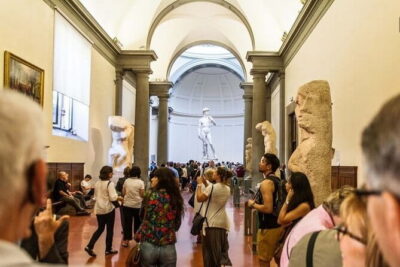
Florence Accademia Gallery Tour with Entrance Ticket Included
Read our review →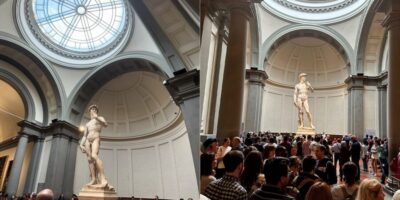
Timed Entry Ticket to Michelangelo’s David & eBook
Read our review →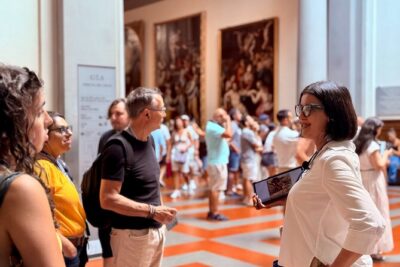
Skip the line: Uffizi and Accademia Small Group Walking Tour
Read our review →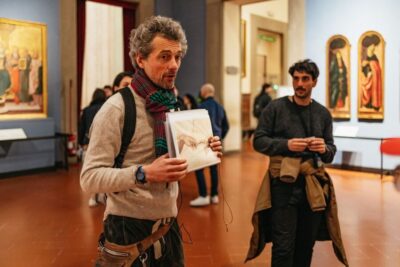
Accademia Gallery Guided Tour with Entry Ticket
Read our review →Browse the lists this tour appears in