
Reviewed · FLORENCE DUOMO TOURS
Duomo Museum & Baptistry: Cathedral Complex & Bell Tower
Florence’s cathedral complex is best understood from several angles: the sculpture museum, the golden Baptistery, and the climb that brings you close to Brunelleschi’s dome. This tour links those pieces in about two hours and fifteen minutes, with a local guide handling the art and history while you tackle the stairs and views.
I like the museum’s original Gates of Paradise, Michelangelo’s unfinished Pietà Bandini, and the rare chance to see the dome’s structure from close range. I also like the small-group format, which can make a big difference in crowded Florence. The main drawback is clarity: the cathedral interior is not included, and the exact climb option must be checked carefully when booking.
Key points to know
- Michelangelo and Ghiberti: See the Pietà Bandini and the original Gates of Paradise inside the Opera del Duomo Museum.
- A serious stair climb: The dome route brings close views of the cathedral’s artwork and wide views over Florence.
- The main cathedral is not part of the guided visit: Entering Santa Maria del Fiore is free, but you must join its line separately.
- Small groups help: The advertised group size is generally small, with a maximum of 19 people and an aim of about 12.
- The Baptistery is a separate building: Its golden mosaics and bronze doors are not the same thing as the museum or cathedral.
- Allow extra time after the tour: Included self-guided tickets remain valid for 72 hours at eligible sites.
What this Florence Duomo tour actually covers
The word Duomo can cause confusion in Florence. It may refer to the cathedral, the entire cathedral complex, or simply Brunelleschi’s famous dome. This experience covers several separate buildings and collections, but it does not provide a guided visit inside the main cathedral.
The guided portion includes the Opera del Duomo Museum and the Baptistery. The tour also includes the dome climb according to the experience description, while the ticket details mention a self-guided Giotto’s Bell Tower climb if that option is selected. Check your booking confirmation closely so you know if you are climbing Brunelleschi’s dome, Giotto’s campanile, or both.
The tour begins at the Opera del Duomo Museum on Piazza del Duomo. It ends near Giotto’s Bell Tower. You do not get hotel pickup, so plan to reach the meeting point on your own. Florence’s center is easy to reach by public transportation, but Piazza del Duomo can be crowded and confusing, especially around the Baptistery doors.
The meeting instructions deserve care. Keep the exact address and guide description on your phone, and arrive early. At least one tour group had trouble finding a guide in the crowd because the meeting directions appeared to identify two different spots. A flag or sign may be hard to spot at waist height among the people around the square.
More Duomo and cathedral tours in Florence:
- Florence: Duomo Cathedral Guided Tour
★ 3.9 · 5,970 reviews - Florence: Brunelleschi’s Dome Climb Entry Ticket & Duomo
★ 4.5 · 3,815 reviews - Florence: Duomo Guided Tour with Optional Dome Climb Upgrade
★ 4.1 · 3,706 reviews
Inside the Opera del Duomo Museum
The museum is the intellectual heart of this experience. It holds original works made for Florence’s cathedral complex, many of which were moved indoors to protect them from rain, pollution, and time.
You begin in the large Sala del Paradiso. Here, a full-size reconstruction of the cathedral’s original medieval façade gives you a better idea of how the front of the building once looked. Forty statues decorate the reconstruction, including works by Donatello. This is not just a storage room for displaced sculpture. It helps you see how the cathedral once functioned as a complete visual program.
Across from the reconstructed façade are the original bronze Gates of Paradise by Lorenzo Ghiberti. The doors now displayed in the museum are the real masterpieces, not copies exposed to Florence’s weather. Their detailed biblical panels reward a slow look, especially after your guide explains how they fit into the Baptistery’s entrance.
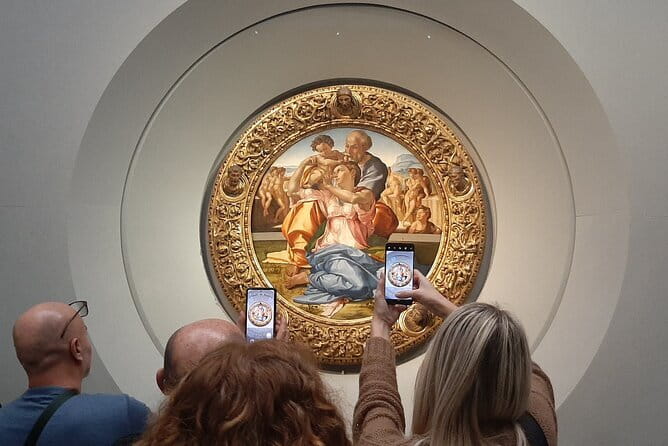
Michelangelo’s Pietà Bandini is another major stop. Michelangelo worked on it for his own tomb, which gives the sculpture a personal and unfinished quality. You also see Donatello’s wooden Penitent Magdalene, a powerful piece with a deliberately stark, almost unsettling appearance. The museum’s strongest moments come when the guide explains not only who made each work, but why it was created for this particular religious setting.
A gallery devoted to Brunelleschi’s dome displays original fifteenth-century tools and wooden models. These objects make the engineering problem easier to grasp. Brunelleschi had to create the enormous dome without the conventional wooden centering that would have supported it during construction. The models and tools give you a physical sense of the planning behind the familiar red roof.
The visit ends at the Brunelleschi Terrace, a particularly useful stop for photographs. You get a close view of the dome’s surface and a different angle from the one available in the piazza. The museum portion lasts about 45 minutes, so it is focused rather than exhaustive. If you want to study every sculpture at length, you will need to return during your 72-hour ticket period.
The Baptistery’s gold mosaics and famous doors
The Baptistery of San Giovanni sits directly across from the cathedral. Its octagonal shape and white and green marble make it easy to recognize, but the interior is the real surprise.
The ceiling contains more than 1,000 square meters of thirteenth-century golden mosaics. Biblical scenes and the Last Judgment cover the interior overhead, creating a surface that glows when light catches the gold. Your guide can help you read the arrangement rather than simply admire the glitter.
The Baptistery also carries major civic importance. This is where famous Florentines, including Dante Alighieri, were baptized. The building therefore belongs to Florence’s religious identity, but it also connects to the city’s public life and artistic competition.
The eastern bronze doors are known as the Gates of Paradise. The original doors are now in the museum, while the Baptistery itself lets you see the setting for which they were made. That distinction matters. If you expect to see the original Ghiberti panels on the building, you may be surprised to find them preserved indoors.
The guided Baptistery visit lasts about 30 minutes. That is enough to understand the main features, but not enough for a slow, independent study of every mosaic. If the Baptistery matters greatly to you, use your ticket validity to return on your own if permitted by the current entrance arrangements.
Piazza del Duomo puts the complex together
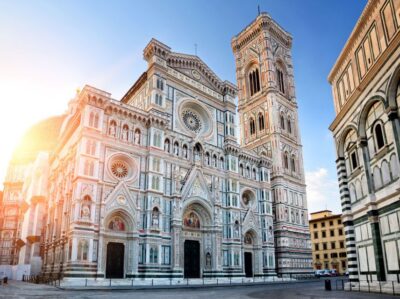
The 15-minute stop in Piazza del Duomo can seem brief, but it gives you the view that ties the separate buildings together. From the square, you see Santa Maria del Fiore, Giotto’s Bell Tower, and the Baptistery as one carefully planned religious center.
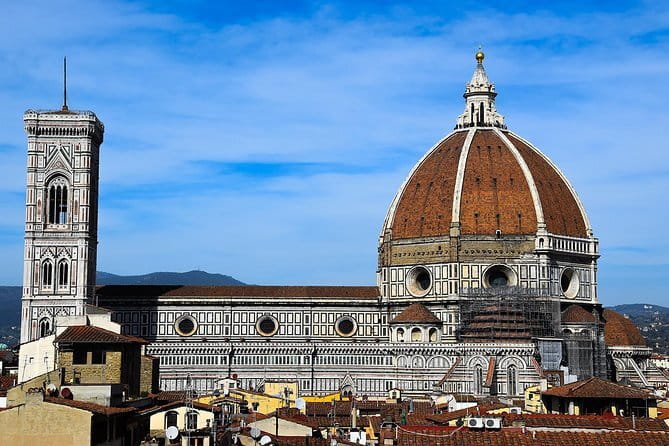
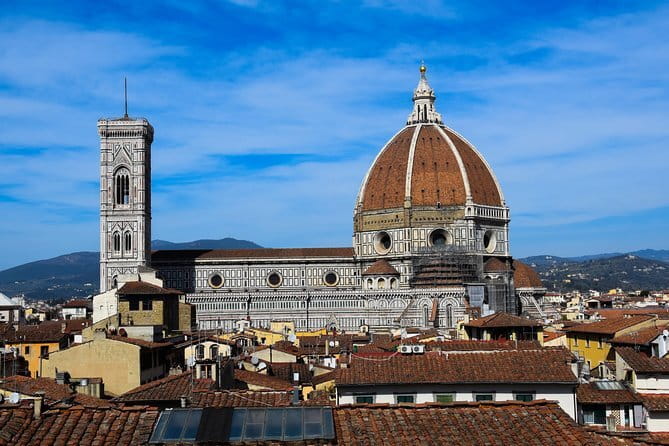
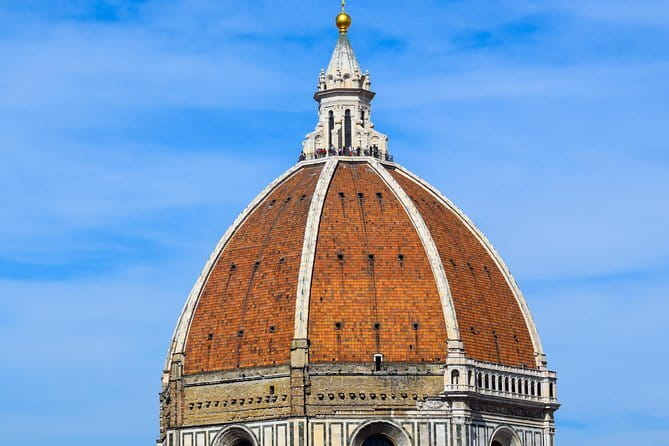
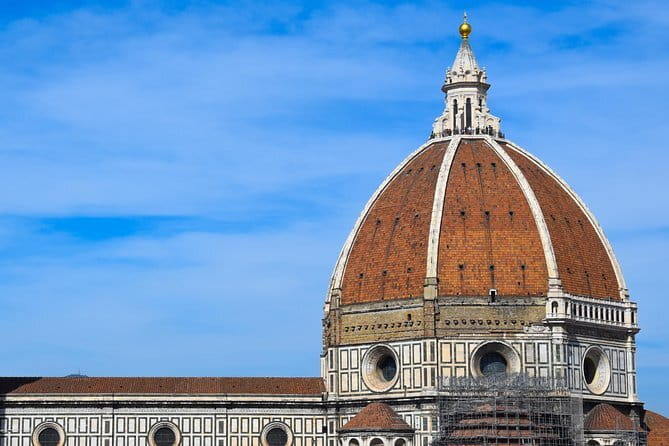
The cathedral’s exterior uses white, green, and pink marble in elaborate geometric patterns. Brunelleschi’s red-tiled dome dominates the view, while Giotto’s Bell Tower adds a tall, narrow counterpoint beside it. The Baptistery, lower and older in appearance, completes the trio across the street.
This is a good place to listen to the explanation of Florence’s move from medieval architecture toward the Renaissance. You can also take a short break here, perhaps with gelato and a view of the cathedral façade. The tour description specifically points to enjoying the exterior over a scoop of gelato, a simple pleasure that suits this busy square.
Do not expect a quiet setting. Piazza del Duomo is one of Florence’s most crowded points. Keep your meeting instructions handy, stay close to the guide, and avoid wandering off for photographs until you know where the group will regroup.
More museums and galleries in Florence:
- Florence: Skip-The-Line Uffizi Gallery Timed Entry Ticket
★ 4.5 · 27,832 reviews - Florence: Leonardo Interactive Museum Entry Ticket
★ 4.5 · 11,763 reviews - Florence Accademia Gallery Tour with Entrance Ticket Included
★ 4.5 · 6,148 reviews - Uffizi Gallery Small Group Tour with Guide
★ 4.5 · 4,923 reviews
The dome climb: hard work with a real payoff
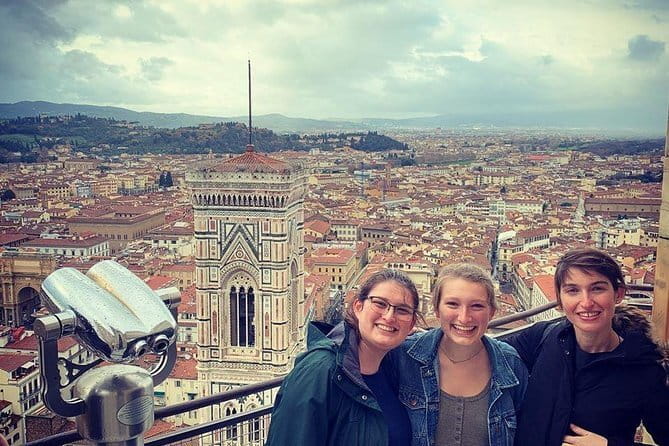
The climb is the most physically demanding part of the experience and the part most likely to shape your overall opinion. The route takes you upward through the structure of Brunelleschi’s dome, giving you close views of the interior artwork as well as the city below.
You should expect narrow stairs and a moderate level of exertion. One helpful detail from the experience is that there are places to rest along the way. Even so, this is not a casual lift ride. Wear tennis shoes or other secure footwear, and avoid wide-legged trousers that can catch or feel awkward on tight stairs. A cool day is preferable to hot weather, since the climb can feel tiring.
The reward comes in two forms. First, you see the dome’s interior decoration and construction at close range. Second, you reach a high viewpoint over Florence. The red roofs, church towers, and surrounding city make the effort worthwhile for many people.
The guide explains Brunelleschi’s achievement as you climb, which gives the route more meaning than simply going up for a photograph. Still, the tour’s timing and ticket language require attention. The main description emphasizes a guided dome climb, while the included items separately identify a self-guided Giotto’s Bell Tower climb when that option is selected. Read the exact option name before paying.
If you cannot climb, tell the operator as soon as possible. One particularly considerate arrangement allowed one person to remain with the first part of the tour while a company representative helped with access to the church, and a companion completed the climb. That kind of help may not be guaranteed, but it shows why it is worth raising mobility concerns early.
What is not included
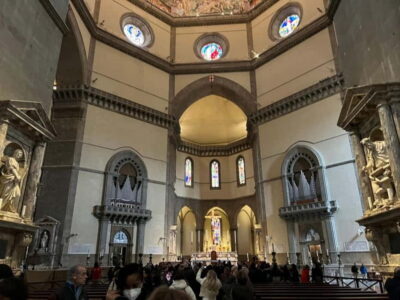
The largest omission is the interior of Santa Maria del Fiore. Entrance to the cathedral itself is free, but you must wait in its separate line. The guided tour does not take you inside, and the visit can leave you thinking you have seen the Duomo when you have actually seen the museum, Baptistery, dome, and surrounding square.
The Crypt of Santa Reparata is included as a self-guided ticket. The same applies to the Giotto Bell Tower when that option is selected. There is no guide service for either the crypt or the bell tower.
This arrangement can work well if you like setting your own pace. You can return to the crypt or tower within the stated 72-hour ticket validity instead of rushing through every site in one morning. It works less well if you want one continuous guided explanation of the whole complex.
Hotel pickup is not included, and personal expenses are your responsibility. Tips for the guide are optional.
Guide quality and group size
The guide can make this tour either a lively introduction or a rushed walk through famous names. The strongest guide experiences described two specific qualities: clear expertise and real enthusiasm for Renaissance art.
Silvia received especially warm praise for her passion and ability to answer questions without watching the clock. Francesco was also singled out for keeping a small group interested for more than two hours. Another guide was described as finishing a master’s degree in Renaissance art, which suggests that the company sometimes assigns guides with serious academic preparation. Your guide will vary by date, so do not book on the assumption that Silvia or Francesco will lead your group.
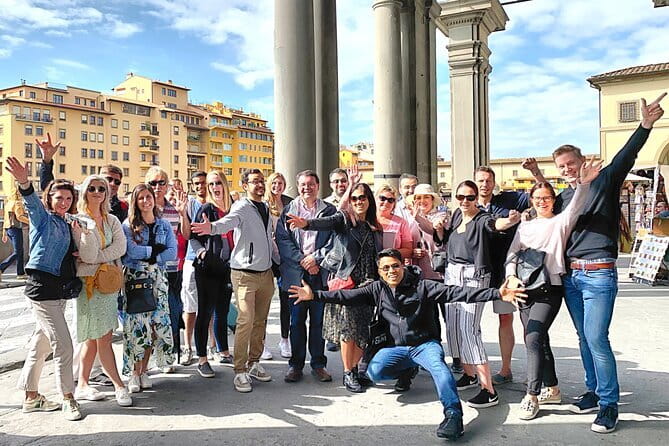
The tour uses headsets, a useful feature in the echoing museum and noisy piazza. You can hear the explanation without standing shoulder to shoulder with the guide. The group limit is 19, with the company aiming for groups of about 12. That is not a private tour, but it is much easier to manage than a large coach group.
The weaker experiences involved rushing, limited explanation, and poor organization at the start. A guide who moves too quickly can make the museum feel like a checklist, especially if art is not already your main interest. If you prefer a long, quiet look at each sculpture, a self-guided museum visit may suit you better.
Is $76.88 a fair price?
At $76.88 per person, this is not the cheapest way to see the cathedral complex. You are paying for a guide, reserved or organized access to several important sites, headsets, and the convenience of combining the museum and Baptistery in one outing.
The value improves if you want help making sense of Michelangelo, Donatello, Ghiberti, and Brunelleschi. The museum contains a lot of major art, and the dome’s engineering can be difficult to understand from a guidebook alone. The small-group format also has real value in a crowded part of Florence.
The price feels weaker if you mainly want to enter the main cathedral. That entrance is free, though the line can be long, and this tour does not take you inside. It is also less appealing if you do not care for sculpture or if you expect every ticketed site to include guided service.
Because the tour is commonly booked well ahead, often around 73 days in advance, reserve early if your Florence dates are fixed. Before confirming, check the exact climb option and the meeting point. Those two details affect the value more than a small difference in price.
Who should book this experience?
I would recommend it to a first-time Florence visitor who wants a clear introduction to the cathedral complex and does not want to research every separate ticket. It is especially good for anyone interested in Renaissance sculpture, the history of Florence’s religious buildings, or Brunelleschi’s dome.
It also suits people who appreciate a moderate physical challenge and want a high viewpoint over the city. Wear good shoes, choose a cooler time if possible, and allow enough energy for the stairs.
I would be cautious if your priority is the cathedral interior. You will need to visit that separately. I would also be cautious if you dislike crowds, have difficulty with stairs, or want a very slow museum visit.
Book this tour if you want the art and architecture explained as one connected story, with the museum and Baptistery as the main guided stops. Skip it if you mainly want a quick photograph of the exterior or a free walk through the piazza. For the best result, confirm the climb, arrive early at the museum meeting point, and use the 72-hour self-guided tickets to see the remaining sites at your own pace.
FAQ
How long does the Duomo Museum and Baptistery tour last?
The experience lasts approximately 2 hours and 15 minutes. The museum visit takes about 45 minutes, the Piazza del Duomo stop about 15 minutes, and the Baptistery visit about 30 minutes, with additional time for the guided portion and climb.
Is the main cathedral interior included?
No. The tour does not include guided entry into Santa Maria del Fiore. Entry to the cathedral is free, but you must wait in its separate line.
Does the tour include a dome climb?
The experience description includes a guided climb connected with Brunelleschi’s dome. The ticket information also refers to a self-guided Giotto’s Bell Tower climb when that option is selected. Check the exact option on your booking confirmation.
Is the Baptistery the same building as the Duomo Museum?
No. The Opera del Duomo Museum is behind the cathedral, while the Baptistery is the octagonal building directly in front of it. The museum holds original works from the complex, including Ghiberti’s Gates of Paradise.
What art will I see in the museum?
The museum includes the original Gates of Paradise by Lorenzo Ghiberti, Michelangelo’s Pietà Bandini, Donatello’s wooden Penitent Magdalene, a reconstruction of the cathedral’s medieval façade, and displays about Brunelleschi’s dome.
Are tickets for the crypt included?
Yes. The experience includes a self-guided entrance ticket to the Crypt of Santa Reparata. The ticket is not guided.
Can I climb Giotto’s Bell Tower?
A self-guided ticket for Giotto’s Bell Tower is included if you select that option. The provided information does not identify a guided bell tower visit.
What size are the tour groups?
The company aims to keep groups small, with about 12 people per group. The stated maximum is 19 travelers.
Can I cancel for a full refund?
Yes, if you cancel at least 24 hours before the experience start time. Changes or cancellations made less than 24 hours in advance are not accepted for a refund. If poor weather or an insufficient number of bookings cancels the experience, you can receive a different date or a full refund.
Recently added around Florence
- Accademia and Uffizi Small-group Guided Tour★ 4.5 · 8 reviews
- The David from Michelangelo.★ 5.0 · 3 reviews
- Combo: Accademia + walking + Uffizi Galleries Guided Tour★ 3.5 · 6 reviews
- The Complete Wine Tour Brunello, Nobile, Chianti wine experience★ 4.0 · 7 reviews
- The Best of Tuscany in 3 Days★ 4.5 · 13 reviews
- The Cooking Lab – Authentic Food Experience★ 5.0 · 113 reviews
- Florence Central Market Food Tour – Private Tour★ 4.0 · 7 reviews
- Family Friendly Florence Private City Tour★ 5.0 · 47 reviews
Florence Duomo Tours, compared.
Brunelleschi’s Dome Climb Entry Ticket & Duomo
Read our review →
Duomo Guided Tour with Optional Dome Climb Upgrade
Read our review →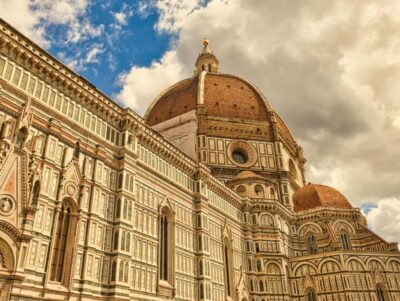
Skip-the-Line Duomo, Baptistery, Giotto Bell Tower
Read our review →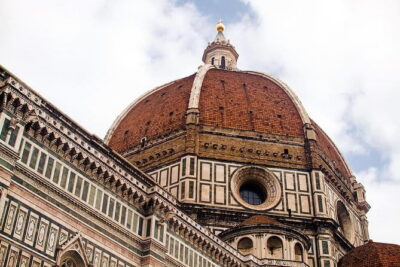
Best of Florence: Small Group Tour Skip-the-Line David & Accademia with Duomo
Read our review →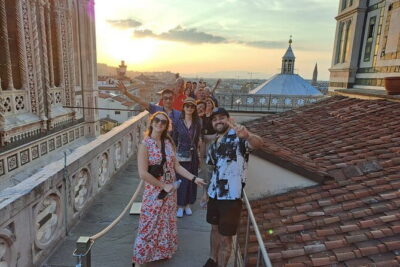
Florence Skip-the-Line Duomo Tour with Guide & Brunelleschi Dome
Read our review →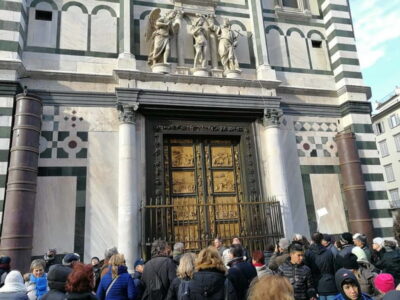
Duomo Area Tour and Brunelleschi Dome Climb Ticket
Read our review →Browse the lists this tour appears in