
Reviewed · ACCADEMIA GALLERY AND DAVID TOURS
Accademia Gallery: Michelangelo’s David, A Symbol of Strength.
Michelangelo’s David is the reason most people come to the Accademia Gallery, and seeing it in person is a genuine Florence highlight. This one-hour tour gets you through the reserved-entry process, then places David at the center of a quick but useful look at the museum.
I like the short, focused route, which gives you the main works without filling your head with a flood of dates. I also like the chance to stay inside afterward and revisit David or explore the rooms alone. The main catch is that the meeting spot at Via Ricasoli 57 can be hard to identify, so arrive early and allow time to find your guide.
Key points to know before booking
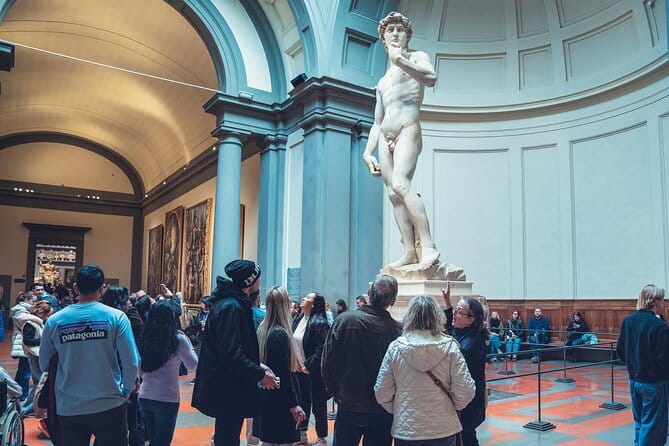
- David is the main event: Learn how Michelangelo created the famous marble figure and why it became a symbol of Florence.
- Reserved entry saves time: Skip-the-line access is guaranteed except during museum delays or strikes.
- The tour lasts about one hour: It is a good fit before another museum, lunch, or a timed activity.
- You see more than David: The route includes the Hall of the Colossus, the Hall of the Prisoners, and the Gipsoteca Bartolini.
- Headsets are supplied: A radio system helps you hear the guide in busy galleries.
- You can continue alone: After the guided portion, you may remain in the museum and look around at your own pace.
Why David deserves more than a quick photograph
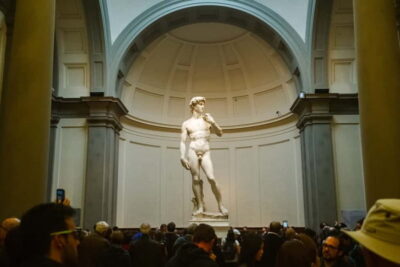
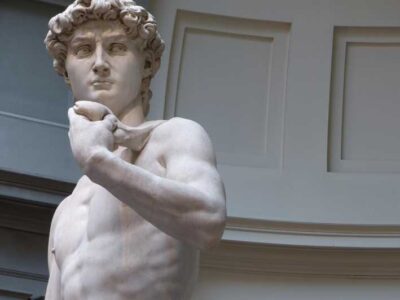
David is familiar before you arrive. You have probably seen photographs, schoolbook illustrations, and souvenir versions of the statue. None of that prepares you for its size, the controlled tension in the body, or the way Michelangelo turned a block of marble into a figure that seems ready to act.
The statue is roughly 17 feet tall, and its scale matters. From close by, you can study the hands, face, muscles, and alert expression in a way that a picture cannot provide. A guide can also give the work a useful setting instead of leaving you to admire it without knowing why it mattered.
The tour focuses on the story behind David as well as the sculpture itself. You learn about Michelangelo’s choices, the making of the statue, and the place it holds in Florence’s artistic identity. That background helps you notice why the figure feels tense rather than relaxed, and why the pose communicates readiness before any action begins.
The Tribune, where David is displayed, is the emotional center of the visit. You will have time to take in the statue, listen to the explanation, and ask questions. Guides named in the experience feedback include Pam, Pamela, Matteo, Rosie, Francesco, Gabriella, Gayla, Hilaria, and Hilary. The tone can vary by guide, but the strongest reports describe an engaging, friendly approach that works well with families and first-time art museum visitors.
More ways to see the David at the Accademia:
- Florence: Timed Entrance Ticket to Michelangelo’s David
★ 4.6 · 16,983 reviews - Florence: Michelangelo’s David Skip-the-Line Entry Ticket
★ 4.5 · 12,764 reviews - Florence Accademia Gallery Tour with Entrance Ticket Included
★ 4.5 · 6,148 reviews
The Hall of the Colossus gives David a setting
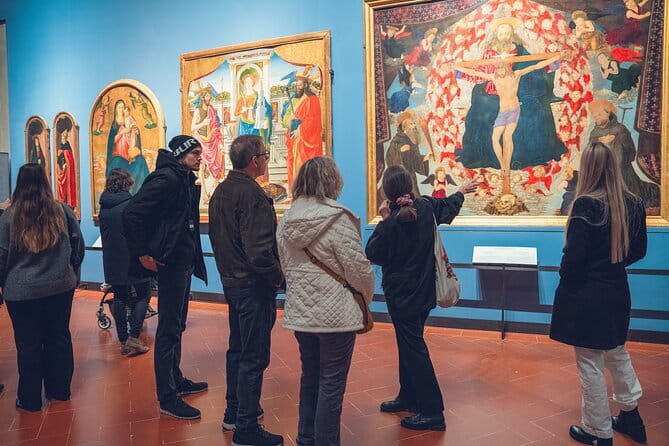
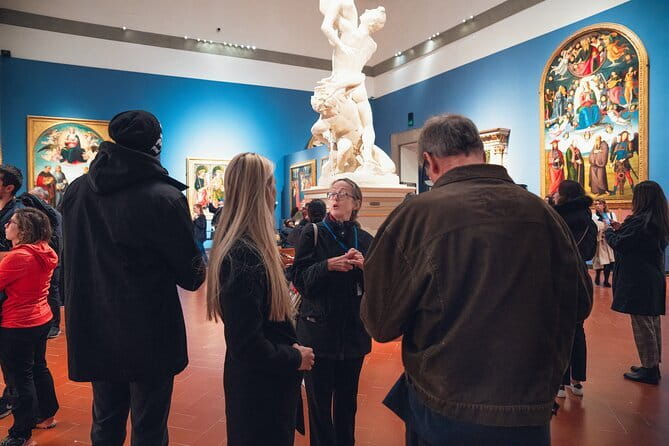
The tour does not rush straight to David. It begins with works in the Hall of the Colossus, including Giambologna’s Rape of the Sabines, the Cassone Adimari, and Domenico Ghirlandaio’s St. Stephen between St. James and St. Peter.
This opening section helps you adjust to the museum. You see how the Accademia is not only a shrine for one famous statue. It also holds paintings, sculpture, and works connected to Florence’s long artistic tradition.
Giambologna’s Rape of the Sabines is especially useful as a first stop because it rewards a slow look at movement and form. The title refers to a violent episode from Roman legend, but the sculpture’s twisting figures also show how a sculptor can make hard marble appear to turn and strain.
You should not expect a full lesson on every object in the room. The tour has only about an hour, so the guide selects important pieces and keeps the pace moving. That is a benefit if you want an overview, but it may feel brief if you prefer to linger at each painting.
Michelangelo’s unfinished Slaves show the work in progress
In the Hall of the Prisoners, the guide turns to Michelangelo’s unfinished Slaves. These figures look as if they are struggling to emerge from the marble, and they offer a useful contrast with the completed David.
Here, you can think about the physical act of sculpting. David appears finished, polished, and fully alive. The Slaves leave parts of the stone untouched, allowing you to see the figure and the material at the same time.
The guide also connects Michelangelo with artists such as Fra’ Bartolomeo, Pontormo, and Granacci. These names may mean little to you before the visit, but the point is clear: Michelangelo did not work in isolation. The people around him, the workshops he knew, and the artistic habits of Florence shaped his work.
This is one of the most useful parts of the tour for anyone who wants more than a photo stop. The unfinished statues make the craft visible. You get a better sense of how much labor, planning, and judgment went into the finished masterpiece.
The Tribune brings you face to face with David
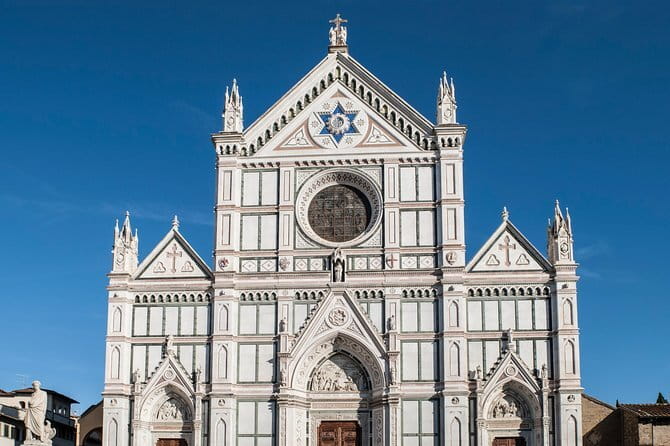
The guide spends the most important part of the visit in the Tribune, explaining David in detail. This is where the tour earns its keep.
A self-guided visit gives you freedom, but it may leave you wondering what to look for. The guide can point out details in David’s posture, expression, proportions, and finish. You can also ask questions while the statue is directly in front of you.
The statue is often surrounded by people, particularly during Florence’s busy periods. The supplied headsets are useful here. You do not need to stand shoulder to shoulder with the guide to hear the explanation, and you can keep your eyes on the artwork rather than leaning in.
One practical note came through clearly in the experience details: the headsets are provided, so use them. One person had trouble hearing after choosing not to use the earphones. The radio system is not decorative equipment. It helps preserve your attention in a crowded room.
The Tribune’s left wing includes Allori’s Coronation of the Virgin Mary. It is not as famous as David, but it gives the tour another chance to show how painting and sculpture share the museum. The guide may give it less time than Michelangelo’s statue, which is sensible given the short format.
More museums and galleries in Florence:
- Florence: Skip-The-Line Uffizi Gallery Timed Entry Ticket
★ 4.5 · 27,832 reviews - Florence: Leonardo Interactive Museum Entry Ticket
★ 4.5 · 11,763 reviews - Uffizi Gallery Small Group Tour with Guide
★ 4.5 · 4,923 reviews - Florence: Accademia Gallery Guided Tour
★ 4.6 · 4,156 reviews
The Gipsoteca adds a quieter final stop
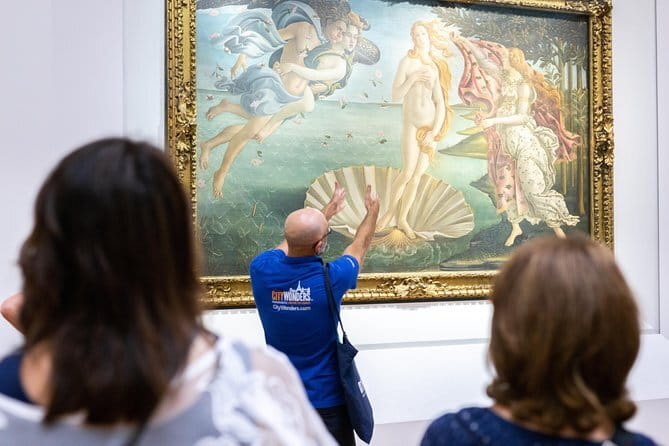
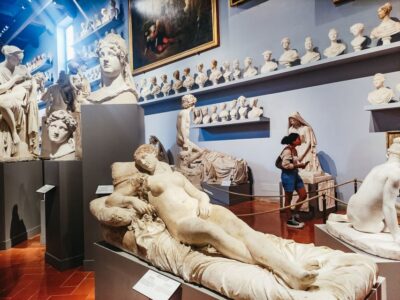
The Gipsoteca Bartolini contains plaster casts, including the Reclining Venus, as well as casts associated with Arnolfo, Brunelleschi, and Lorenzo Monaco. This area is different from the dramatic room holding David.
Plaster casts can seem less exciting than marble or painted panels, but they help explain how artists studied and reproduced sculpture. The room also gives you another view of the museum’s purpose. The Accademia is not simply a building designed around one celebrity artwork. It includes teaching materials, models, and works linked to the study of art.
The itinerary also mentions a documentation center on the first floor. The guided portion may not spend much time there, and the one-hour schedule does not allow for a long research stop. Think of the Gipsoteca as a final glimpse rather than a full second tour.
One hour is a strength, not a weakness
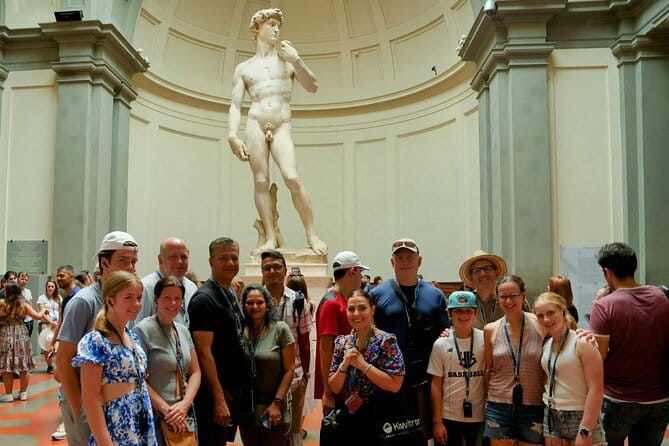
An hour inside an art museum can feel short, but here it is a sensible limit. The Accademia’s most famous works can be covered without making the visit feel like a marathon.
I especially like this format if you are pairing the Accademia with the Uffizi, a walking tour, or another fixed appointment. One person used the short visit before heading to the Uffizi, and that kind of planning makes sense. You get a clear introduction, then keep the rest of your day open.
The tour is also useful for families and mixed-interest groups. A child may not want a long lecture on Renaissance sculpture, while an adult may want enough context to understand what makes David special. The guides described by name, including Rosie and Francesco, were praised for keeping explanations friendly, clear, and suitable for families.
After the guided hour, you can return to David or inspect the other displays on your own. That balance is important. You receive direction when the museum is unfamiliar, then regain freedom once you know where the main works are.
What the $55.63 price buys you

At $55.63 per person, this is not the cheapest way to enter the Accademia. The value comes from combining admission, reserved access, and a live English-speaking guide.
If you are already comfortable with art museums and have no trouble arranging entry, you may prefer an ordinary ticket and your own pace. The extra cost makes more sense if your Florence schedule is tight, if you want the story behind David, or if you want to avoid spending part of your day in an entry line.
The reservation is especially useful during peak periods. Skip-the-line access is guaranteed except when the museum itself is delayed or affected by a strike. That guarantee does not mean you should arrive casually. The tour has a strict start time, and arriving late means you cannot join or receive a refund.
The maximum group size is 19 people, though some departures may be much smaller. One group had only four people, and another became a private tour. You should not book expecting a private experience, but a small group is possible, particularly outside the busiest periods.
Meeting point and timing require care
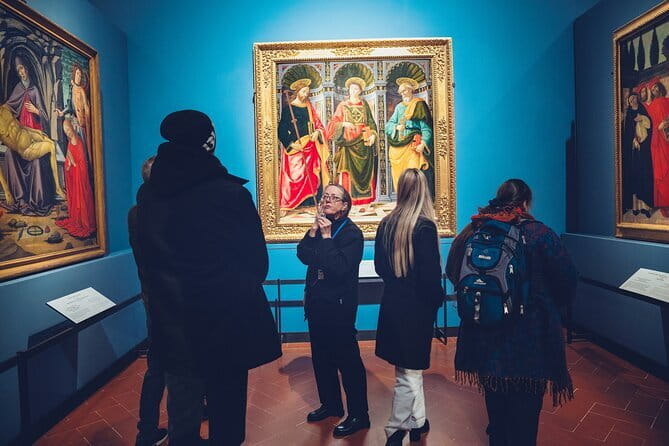
The meeting point is Via Ricasoli 57, 50121 Florence, at the Accademia Gallery area. This is a specific doorway rather than an obvious office with a large tour-company sign, so it can take a moment to confirm that you are in the right place.
I would arrive at least 15 minutes early. The activity information warns that late arrivals cannot join. The strict rule matters because the guide must enter during a reserved time slot, and the museum will not hold the group for someone still searching the street.
Keep your booking confirmation available and pay close attention to the exact meeting instructions. This is the one part of the experience that could create needless stress, especially if you are coming from another part of Florence.
There is no hotel pickup, transportation, food, or drink included. The activity begins and ends at the meeting point, so plan your route through Florence before the tour day.
The main strengths and limitations
The strongest feature is the guide-led explanation of David. Guides such as Pam and Pamela received especially warm praise for clear pacing, useful detail, and enthusiasm. Matteo was singled out for keeping an entire family engaged, while other guides were praised for humor and a relaxed manner.
The reserved entry is the second major advantage. The Accademia is a compact museum with a very popular centerpiece, and waiting outside can be a poor use of time. Getting inside quickly gives you more room in your day.
The tour is also efficient. You cover several important works, but the guide does not try to explain every object in the building. That makes it a good first visit, though art specialists may want a longer private tour.
The weak point is consistency at the meeting point. Clearer directions would help, and one experience included a guide who seemed less familiar with the gallery than expected. A rare operational problem also occurred when a guide failed to arrive. A refund was processed, but that kind of failure can be especially upsetting when the visit is tied to a birthday or another fixed occasion.
The experience has a minimum of two people. If that minimum is not reached, the activity can be canceled after confirmation, with an alternative or full refund offered.
Who should book this Accademia tour?
I would choose this tour if you are visiting Florence for the first time, want to see David without wasting time in line, or prefer a human explanation to an audio guide. It is also a good match for families, older relatives, and anyone who wants the main points without spending half a day in a museum.
The short format works well for a packed schedule. You can visit the Accademia in the morning, stop for lunch, and still have time for the Uffizi or Florence’s streets and churches.
I would think twice if you dislike fixed schedules, want to study every room at length, or already know the Accademia well. In those cases, a basic entry ticket may give you more freedom for less money.
Book at least 24 hours ahead if your plans might change. Cancellation is free up to that point, but changes or cancellations inside 24 hours are not refunded. The tour is often booked well ahead, with an average booking lead time of 42 days, so popular time slots may disappear early.
Should you book it?
Yes, if David is high on your Florence list and you want a fast, well-framed introduction. The best reasons are the reserved entry, the live guide, the radio headsets, and the chance to continue exploring alone after the formal tour.
The $55.63 price is fair for a time-sensitive visit, but it is not a bargain ticket. Book it for convenience and context, not simply for admission. Arrive early at Via Ricasoli 57, use the headset, and treat the one-hour route as an introduction rather than the final word on the museum.
FAQ
How long does the Accademia Gallery tour last?
The guided portion takes about one hour. Afterward, you can remain in the gallery and revisit David or see other works on your own.
Is admission to the Accademia Gallery included?
Yes. The price includes an entrance ticket with a reservation for the Accademia Gallery.
Does the tour include skip-the-line entry?
Yes. Reserved access is included and is guaranteed except in cases such as museum delays or strikes by museum management.
What language is the tour offered in?
The tour is offered in English.
Are headsets provided?
Yes. A radio system is provided so you can hear the guide during the museum visit.
Where does the tour begin?
It begins at Via Ricasoli 57, 50121 Florence, Italy. The activity ends back at the meeting point.
What happens if I arrive late?
You will not be able to join if you arrive after the tour start time, and you will not receive a refund or rescheduled tour.
Can I cancel for a full refund?
Yes, if you cancel at least 24 hours before the experience start time. Cancellations or changes made less than 24 hours ahead are not refunded.
Recently added around Florence
- Accademia and Uffizi Small-group Guided Tour★ 4.5 · 8 reviews
- The David from Michelangelo.★ 5.0 · 3 reviews
- Combo: Accademia + walking + Uffizi Galleries Guided Tour★ 3.5 · 6 reviews
- The Complete Wine Tour Brunello, Nobile, Chianti wine experience★ 4.0 · 7 reviews
- The Best of Tuscany in 3 Days★ 4.5 · 13 reviews
- The Cooking Lab – Authentic Food Experience★ 5.0 · 113 reviews
- Florence Central Market Food Tour – Private Tour★ 4.0 · 7 reviews
- Family Friendly Florence Private City Tour★ 5.0 · 47 reviews
Accademia Gallery and David Tours, compared.
Timed Entrance Ticket to Michelangelo’s David
Read our review →
Michelangelo’s David Skip-the-Line Entry Ticket
Read our review →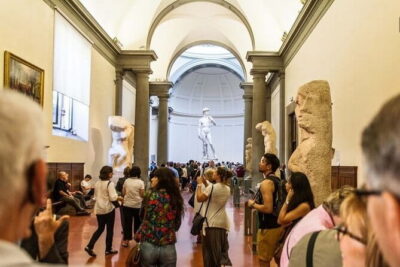
Florence Accademia Gallery Tour with Entrance Ticket Included
Read our review →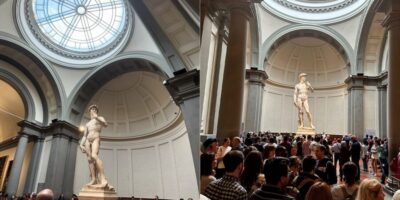
Timed Entry Ticket to Michelangelo’s David & eBook
Read our review →
Skip the line: Uffizi and Accademia Small Group Walking Tour
Read our review →
Accademia Gallery Guided Tour with Entry Ticket
Read our review →Browse the lists this tour appears in