
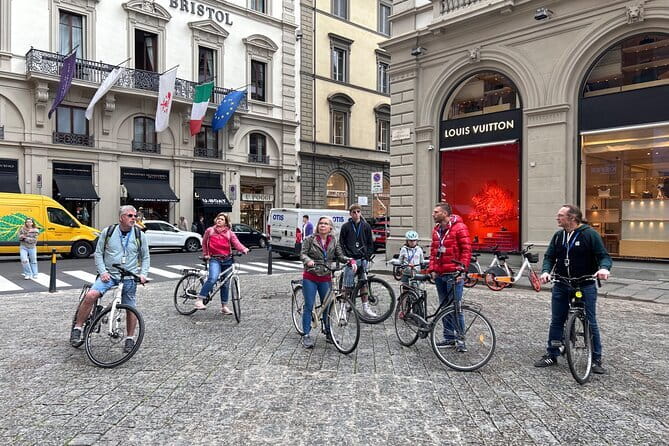
Reviewed · FLORENCE BIKE AND E-BIKE TOURS
Florence Untold Bike Tour
Florence Untold turns the city center into a moving history lesson. You pedal from the Duomo to Ponte Vecchio, then into stories of Medici plots, plague legends, Renaissance artists, medieval pranks, and the birth of the Negroni. Guide Roberto keeps the pace lively, funny, and easy to follow.
I like the way the tour covers many central sights in two hours, and I like its unusual details, such as the wine window, the cheating cow, and the story behind Florence’s jewelry bridge. The tour also suits families well, with several children and teenagers enjoying Roberto’s storytelling.
The main drawback is practical: the bicycle costs an extra €8 per person, paid on the day. You also need to ride confidently, and two hours can feel short if you want to stop often or absorb every story.
Key points to know before you book
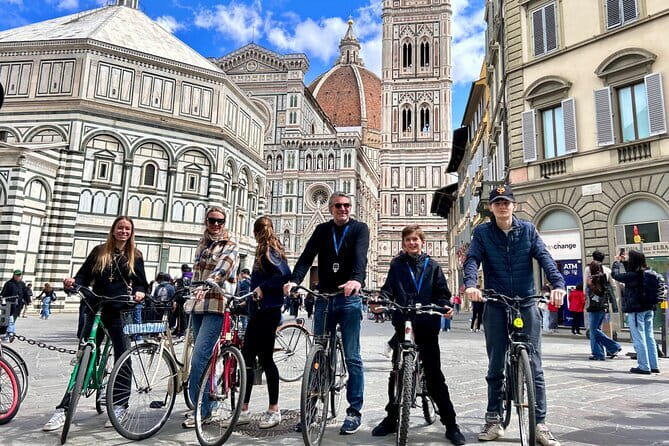
- Roberto is the heart of the tour: His humor, energy, and storytelling turn familiar monuments into memorable characters and events.
- You see central Florence quickly: The route links the Duomo, Baptistery, Ponte Vecchio, Palazzo Vecchio, Uffizi area, and more.
- The stories go beyond the standard highlights: Expect Medici power struggles, the Pazzi Conspiracy, medieval prostitution streets, wine windows, and local jokes.
- The listed price is not the final activity cost: You pay $42.05 per person for the tour, plus €8 for bicycle hire on the day.
- It works for families and mixed groups: Children as young as 11 and 12 enjoyed the format, while adults gained fresh context about Florence.
- Bad weather can change the plan: The tour requires good weather, with a different date or full refund offered if poor conditions cause cancellation.
Why a bicycle works well in Florence
Florence is compact, but its sights are spread across a surprisingly busy central area. A bike lets you connect the main squares and palaces faster than walking, while still keeping you close to the streets, facades, and small details that make the city memorable.
Do not expect a hard cycling workout. The route is designed around seeing and listening rather than speed. One useful point to understand is that much of the experience is storytelling at stops, not constant pedaling. You cover ground efficiently, but you also pause for explanations.
That makes this a good first activity in Florence. You get a map in your head, learn how the major buildings relate to one another, and hear enough background to make later museum visits more rewarding. If you already know Florence well, Roberto’s lesser-known tales may still give you a new angle.
The group can include up to 20 people. That is small enough to keep the route manageable, but it is not a private tour by default. Some departures may feel intimate, while others will have a full group. Multiple start times make it easier to fit the ride around museum reservations and other plans.
More bike and e-bike tours in Florence:
- Tuscany Bike Tours Through the Chianti Hills with Wine Tasting
★ 5.0 · 1,300 reviews - Florence: E-Bike Tour with Michelangelo Square
★ 4.5 · 1,035 reviews - Florence: 2-Hour Guided Sightseeing Bike Tour
★ 4.5 · 1,004 reviews
Meeting Roberto near Via della Pergola
The tour starts at Via della Pergola, 8 R, in central Florence, and returns to the same meeting point. The return-to-start format is useful because you are not left trying to find your way across town after the ride.
Roberto is the guide most closely associated with the experience. His strength is not simply reciting dates. He links people, buildings, scandals, art, and odd local customs into one readable story. His delivery is clear enough for younger listeners, and he uses humor without losing the historical thread.
That matters in Florence, where every few steps can produce another church, palace, statue, or famous name. A guide who only lists facts can make the city feel like a catalogue. Roberto gives the facts a plot, moving from power and religion to art, family rivalry, and everyday Florentine life.
You receive confirmation when booking. The tour is offered in English, and mobile tickets are accepted. Service animals are allowed, and the meeting point is near public transportation.
The hospital, anatomy, and Florence’s artists
One early stop focuses on the world’s oldest hospital, along with its connection to anatomy teaching and major artists such as Leonardo and Michelangelo. This sets up one of the tour’s useful themes: Florence was not only a city of paintings and grand churches. It was also a place where medicine, observation, teaching, and artistic study met.
For you, the value of this stop is the link between a working institution and the better-known Renaissance story. Artists needed to understand the human body, and medical study helped shape the era’s approach to anatomy and realism.
The stop is more about explanation than admission. This is an outdoor city tour, so you should not expect a museum visit or an extended interior exploration unless separately arranged. Still, the context helps you see Renaissance art with a sharper eye later in the day.
The Duomo, Baptistery, and the power of a city center
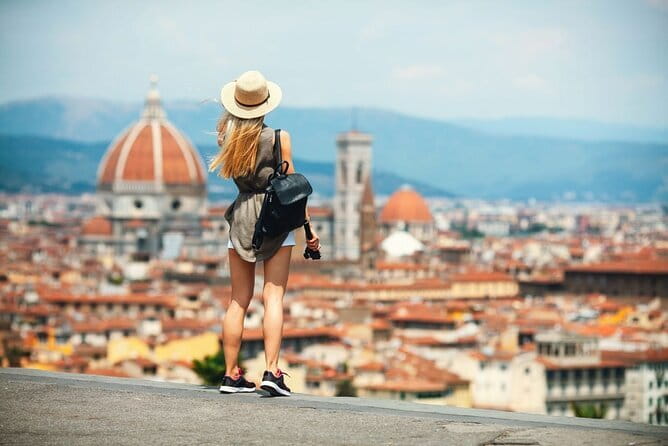
The route then reaches Brunelleschi’s Dome and the Cathedral of Santa Maria del Fiore, followed by the San Giovanni Baptistery. These are the postcard sights, but Roberto places them inside Florence’s political and artistic story.
The Duomo complex can feel overwhelming when you first see it. The striped marble, enormous dome, bell tower, and Baptistery compete for attention. A short explanation helps you sort out what you are looking at and why the group of buildings matters.
This is also where a bike tour has a clear limit. The guide can point out details and explain the setting, but you will not climb the dome or tour the cathedral interiors as part of the two-hour ride. Plan a separate visit if those are priorities, and reserve that time independently.
Still, seeing the complex from the street gives you a strong orientation. You can return later with a better sense of how the cathedral, Baptistery, and surrounding squares fit together.
A completely different way to spend an afternoon in Florence:
- Florence: Skip-The-Line Uffizi Gallery Timed Entry Ticket
★ 4.5 · 27,832 reviews - Tuscany Day Trip from Florence: Siena, San Gimignano, Pisa and Lunch at a Winery
★ 5.0 · 21,634 reviews - Florence: Timed Entrance Ticket to Michelangelo’s David
★ 4.6 · 16,983 reviews - Florence: Michelangelo’s David Skip-the-Line Entry Ticket
★ 4.5 · 12,764 reviews
Roman Florence, Medici politics, and the Pazzi Conspiracy
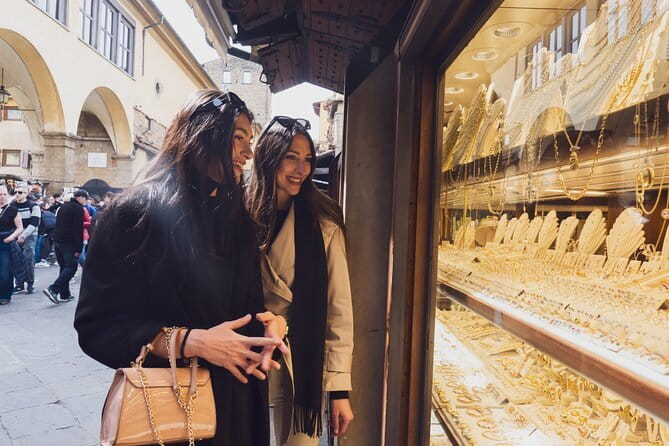
The tour turns from monuments to power. At the Roman Forum area and the Column of Abundance, Roberto traces Florence from its Roman foundations through the Medici era.
This portion covers a large cast: Cosimo the Elder, Lorenzo the Magnificent, Giuliano de’ Medici, the Pazzi Conspiracy, the pope, the Vatican, the dukes, and the grand dukes. You also hear about Catherine of France and Catherine de’ Medici, along with the changing relationship between Florence, the papacy, and ruling families.
That sounds like a lot for one stop, but it is one reason the tour works best as an introduction rather than a final word on Florentine history. You get the broad pattern: merchant wealth became political authority, family rivalry shaped public life, and art often served power.
The Pazzi Conspiracy gives the story a sharp human edge. Instead of treating the Medici as a single famous family, the tour brings in competing personalities, alliances, religious authority, and violent ambition. If you enjoy political stories, this section may be one of the strongest parts of the ride.
Strange statues, plague memories, and local legends
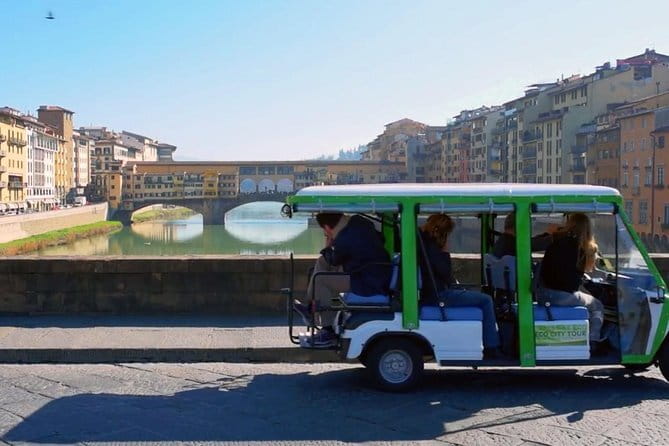
Florence is full of serious marble, solemn churches, and celebrated masterpieces. Roberto also makes room for the city’s stranger side.
You see the Devil of Giambologna, a statue tucked into a corner, and hear the story connected with a Tuesday afternoon during the plague of the 12th century. The precise appeal here is the contrast: a small, easily missed object becomes a doorway into local memory and superstition.
Another stop centers on the pillar of San Zanobi and a miracle. The tour also brings in the Pisan buckets, described as a prank, and the cheating cow, known as La mucca del duomo. These stories make the route feel less like a parade of famous names and more like a walk through a city that has kept its jokes and odd tales.
I especially like this kind of material because it gives you something to look for after the tour. Grand monuments are easy to find in a guidebook. A tucked-away statue or local joke is easier to remember and more fun to point out to your companions.
Wine windows and a medieval street of prostitution
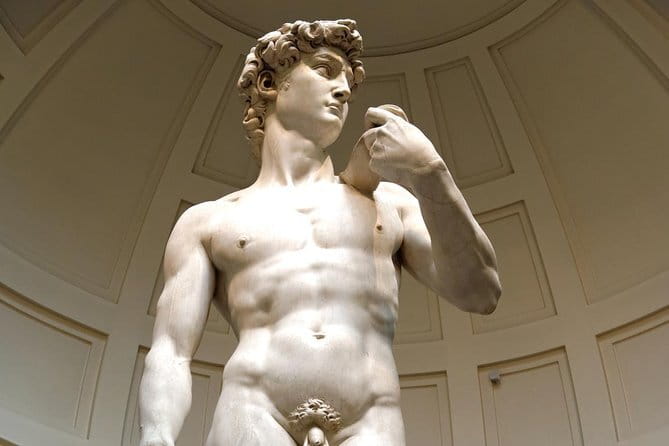
The tour also explores the wine window tradition and a medieval street associated with prostitution. These details widen the picture of Florence beyond churches, artists, and wealthy families.
The wine window points to the long relationship between Florentine homes, merchants, and wine selling. The prostitution street adds a more uncomfortable but useful reminder that medieval cities were shaped by ordinary business, social rules, and public regulation as much as by religion and art.
This section may appeal to adults who want the city’s less polished stories. Families can still follow the historical point, but parents may prefer to decide in advance how much context to give younger children.
Tornabuoni Street, palaces, and the Negroni’s birthplace
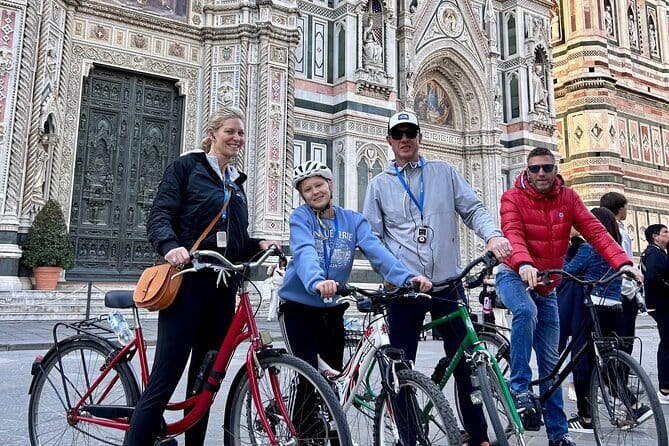
On Tornabuoni Street, Roberto discusses Palazzo Strozzi and Palazzo Corsini, two names that help explain Florence’s old power and wealth. The street itself offers a good setting for considering how elite families used grand residences to display status.
The route also stops near Bar Giacosa, identified as the home of the Negroni cocktail. This is a satisfying modern connection to the older city. Florence’s story is not locked in the Renaissance. Its streets continue to produce cultural details that visitors recognize around the world.
The stop also shows why the tour suits people who want more than a checklist. You are not only told that a palace is important. You are given a chain of connections between family ambition, architecture, luxury, and the city’s later food and drink culture.
Ferragamo, the Justice Column, and changing Florence
The Ferragamo Museum and the Justice Column bring the route into more recent times while keeping the focus on public identity and style. The Ferragamo name connects Florence with fashion and design, while the column adds another layer of civic symbolism.
You should think of this as an outdoor introduction, not a museum tour. The bicycle ride can tell you why a place matters and point out where to return, but it does not include admission to the Ferragamo Museum.
This is a useful reminder that Florence is more than its Renaissance core. Art, craft, fashion, commerce, and public monuments all continue to shape the city. If you have several days, you can use these pointers to choose which interiors deserve your own time.
Ponte Vecchio and the jewelry bridge
Ponte Vecchio is one of the route’s essential stops. Roberto explains how it became associated with jewelry and how it came to be regarded as Florence’s oldest bridge.
The bridge is easy to admire and easy to misunderstand. Its shops and crowded walkway can make it seem like a picturesque shopping street suspended over the river. The explanation gives you a better sense of how its use changed and why the bridge became such a strong symbol of Florence.
Cycling here is mainly about arriving, stopping, and listening. Do not expect to speed across the bridge. The point is the story and the view, not a race through one of Florence’s busiest landmarks.
This stop is also a good reason to take the tour early in your stay. Later, you can cross Ponte Vecchio on foot with more awareness of its role in the city, rather than seeing it as only a famous photo spot.
Palazzo Vecchio, the Uffizi, and Renaissance power
The route continues to Palazzo Vecchio, the seat of Florence’s government since 1299. From here, Roberto connects the building with the Uffizi Gallery, Leonardo da Vinci, Michelangelo’s David, Benvenuto Cellini, and Cosimo Primo.
This is another place where the tour helps organize a crowded set of names. Palazzo Vecchio is not just a grand building beside a famous square. It represents government, civic pride, family control, and the public display of artistic power.
The nearby Uffizi is treated as part of that story. You will not tour its galleries on this activity, and you will not see David inside the Accademia as part of the ride. Instead, you get the location and the historical links, then can visit the museums separately.
That division is sensible. Trying to include major museum interiors in a two-hour bike ride would make the experience rushed. Use the tour to decide what deserves a longer stop later.
Dante, Gemma Donati, and the final stories
The last part of the route turns toward the Tower of Corbizi and Donati, along with Gemma Donati, the wife of Dante Alighieri. Dante is presented as a central figure in the development of modern Italian language.
This stop gives the tour a literary ending. After hearing about rulers, artists, doctors, merchants, and conspirators, you finish with the writer whose work helped shape the language spoken across Italy.
It also reinforces the tour’s preference for connections. You are not simply shown a tower. You are introduced to the families and people tied to it, then linked to Dante and Florence’s wider cultural influence.
Price, bicycle fee, and what you receive
The advertised tour price is $42.05 per person. Add the required €8 bicycle-hire charge per person, paid on the day. Because the fee is separate, include it when comparing this activity with walking tours or other bike excursions.
For the money, you receive about two hours with an English-speaking local guide, a bicycle, and a route through many of central Florence’s major sights. I consider that fair value if you want an efficient introduction and enjoy history delivered through stories rather than a formal lecture.
The value is weaker if you mainly want long photo stops, museum entry, or a relaxed ride with little commentary. The tour packs in many places and themes, so you should arrive ready to listen and keep moving.
The activity has free cancellation up to 24 hours before the start time for a full refund. Changes or cancellations inside that window are not accepted for a refund. Since good weather is required, poor conditions may lead to a different date or a full refund.
Who should book this Florence bike tour?
I would choose this tour for a first or second day in Florence, especially if you want a quick orientation before visiting museums. It is also a strong match for families with older children and teenagers, since the stories have enough humor and drama to hold attention.
Couples and solo visitors can enjoy it too. The ride has attracted mixed groups, including couples, a solo participant, and families, and the guide adapts to different ages and needs.
I would think twice if you do not know how to ride a bicycle, dislike city cycling, or want a quiet, slow-paced experience. The tour is also less suitable if rain is likely and you have no flexibility in your schedule.
Should you book Florence Untold?
Book it if you want Florence explained through memorable people, odd details, and lively storytelling. Roberto’s style is the strongest reason to choose it. He brings humor to subjects that can otherwise blur together, and his explanations are clear enough for children while still offering fresh context to adults who have visited Florence before.
The extra €8 bike charge and two-hour limit are the main cautions. You will not enter the major museums or climb the Duomo, and the route may feel full if you want time at every stop.
For a fast, engaging introduction to central Florence, I would book it early in your stay. Then use the places and stories you liked most to plan your own slower visits.
FAQ
How long does the Florence Untold Bike Tour last?
The tour lasts approximately two hours.
What language is the tour offered in?
The tour is offered in English.
How much does the bicycle cost?
Bicycle hire costs an additional €8 per person, paid on the day of the tour.
Where does the tour start?
The meeting point is Via della Pergola, 8 R, 50121 Firenze FI, Italy.
Where does the tour finish?
The activity ends back at the meeting point.
How many people can join the tour?
The tour has a maximum group size of 20 people.
What happens if bad weather cancels the tour?
If poor weather causes cancellation, you will be offered a different date or a full refund.
Recently added around Florence
- Accademia and Uffizi Small-group Guided Tour★ 4.5 · 8 reviews
- The David from Michelangelo.★ 5.0 · 3 reviews
- Combo: Accademia + walking + Uffizi Galleries Guided Tour★ 3.5 · 6 reviews
- The Complete Wine Tour Brunello, Nobile, Chianti wine experience★ 4.0 · 7 reviews
- The Best of Tuscany in 3 Days★ 4.5 · 13 reviews
- The Cooking Lab – Authentic Food Experience★ 5.0 · 113 reviews
- Florence Central Market Food Tour – Private Tour★ 4.0 · 7 reviews
- Family Friendly Florence Private City Tour★ 5.0 · 47 reviews
Florence Bike and E-Bike Tours, compared.
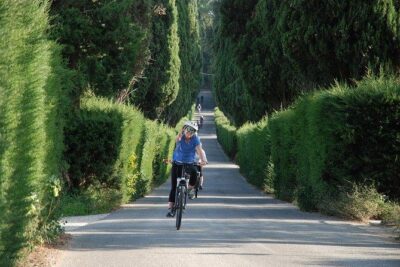
Tuscany Bike Tours Through the Chianti Hills with Wine Tasting
Read our review →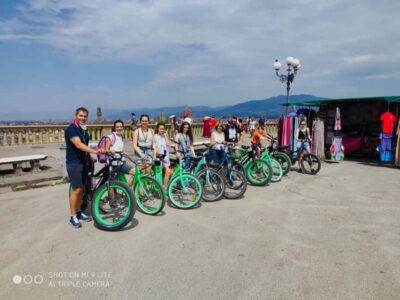
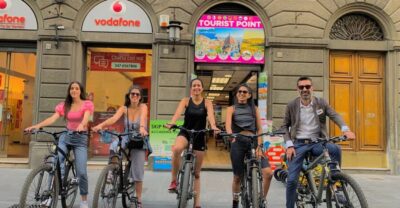
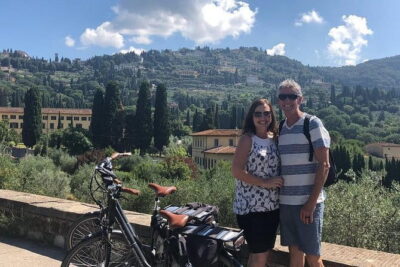
Private Self-Guided E-Bike Ride in Tuscany with Vineyard Visit
Read our review →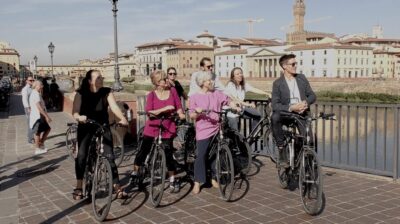
Florence Vintage Bike Tour–guided, small group or private option
Read our review →
Browse the lists this tour appears in