
Reviewed · UFFIZI GALLERY TOURS
Artful Eight: 8 Wonders of Florence in Accademia, Center & Uffizi
Florence’s greatest hits fit into one tightly planned afternoon here: Michelangelo’s David, Botticelli’s Venus and Primavera, Leonardo’s Annunciation, and Michelangelo’s Tondo Doni. You also walk between the Accademia and Uffizi, with brief stops at the Duomo and Piazza della Signoria.
I like the small maximum of nine, which gives the guide room to explain artistic styles and painting details instead of shouting over a crowd. I also like the route itself: it links two major museums with the streets and squares that make Florence feel like a living museum. The main drawback is the pace. Three hours is enough for highlights, not a leisurely museum visit.
Key points at a glance
- Four major Uffizi masterpieces: Focus on Botticelli’s Primavera and Birth of Venus, Leonardo’s Annunciation, and Michelangelo’s Tondo Doni.
- Michelangelo’s David in context: The Accademia visit begins with the artist’s life and unfinished Prisons before reaching David.
- A useful walking connection: The route passes the Duomo and Piazza della Signoria between the two galleries.
- Small-group format: The maximum is nine people, a practical size for questions and clear explanations.
- Convenient finish: You end inside the Uffizi and may continue through the collection on your own.
- Afternoon timing: The tour starts at 2:00 p.m. and lasts about three hours.
Why this compact Florence tour works
I see this as an orientation course for first-time visitors who want the major Renaissance names without spending an entire day in museums. The route gives you two of Florence’s essential collections, plus a short outdoor look at the city’s central monuments.
The art is the main event, but the walking sections matter. Florence can feel like a string of unrelated sights when you rush from museum to museum. Here, the walk from Via Ricasoli to the Uffizi helps connect the Accademia, cathedral complex, civic square, and riverfront museum district.
The group limit of nine is one of the strongest features. A small party makes it easier to hear the guide and ask why a work matters, not just what it is called. The guide also explains artistic styles and the meaning behind selected paintings, which is particularly useful if Renaissance art usually feels like a wall of unfamiliar names.
Still, you should arrive ready to keep moving. The schedule assigns 50 minutes to the Accademia, 50 minutes to the outdoor walk and explanations, and about 80 minutes to the Uffizi. That is efficient, but it leaves little time for side rooms or long private contemplation.
More ways to see the David at the Accademia:
- Florence: Timed Entrance Ticket to Michelangelo’s David
★ 4.6 · 16,983 reviews - Florence: Michelangelo’s David Skip-the-Line Entry Ticket
★ 4.5 · 12,764 reviews - Florence Accademia Gallery Tour with Entrance Ticket Included
★ 4.5 · 6,148 reviews
Starting with Michelangelo’s unfinished Prisons
Meet at 2:00 p.m. on Via Ricasoli, near the Accademia Gallery. The first section introduces Michelangelo and leads you to the room containing the Prisons, also called the Slaves, where the figures appear to struggle out of the marble.
These works are especially useful before seeing David because they show Michelangelo’s non-finito approach. You can look at the rough stone around the emerging bodies and consider how much of the final effect comes from carving and how much comes from leaving material untouched.
The scheduled time here is about 25 minutes. That is enough for a focused explanation, but not enough to study every sculpture in the gallery. If you already know the Prisons well, this part may feel brief. If you are new to Michelangelo, it gives you a visual key for understanding his work before the tour reaches its best-known sculpture.
The guide’s role is important in this room. A bare identification of the works would not do much. The value comes from explaining Michelangelo’s life, his working method, and how the unfinished surfaces change the way you read the figures.
Meeting David at the Accademia
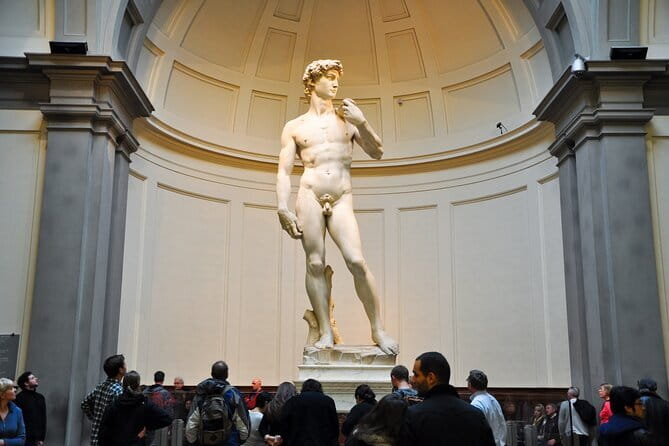
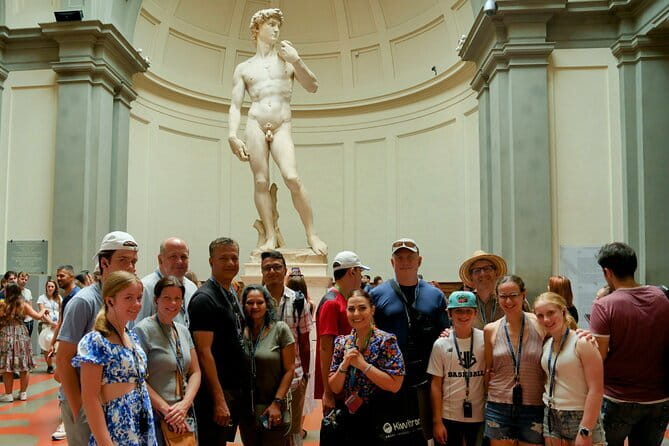
The next 25 minutes center on Michelangelo’s David. This is the point most people have in mind when they book the Accademia, and the tour gives it a separate section rather than treating it as a quick stop on the way out.
David is not simply a large marble figure. It presents a young hero before the fight with Goliath, tense and alert rather than celebrating victory afterward. The sculpture’s scale, physical detail, and intense expression are easier to appreciate when someone helps you look beyond the famous name.
A guided visit is useful here because the statue rewards close attention. You can notice the pose, the turn of the head, the hands, and the way Michelangelo makes the figure feel ready for action. The explanation can also help you understand why this sculpture became such a powerful symbol of Florence.
The limitation is time. You may want to circle the statue, step back, and view it from several angles, yet 25 minutes passes quickly. I would treat this as a strong introduction, then return to the Accademia later only if David and Michelangelo are your central interests.
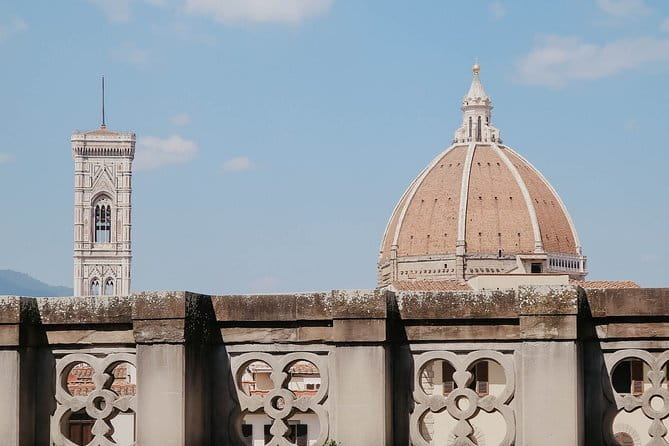
The Duomo from the street
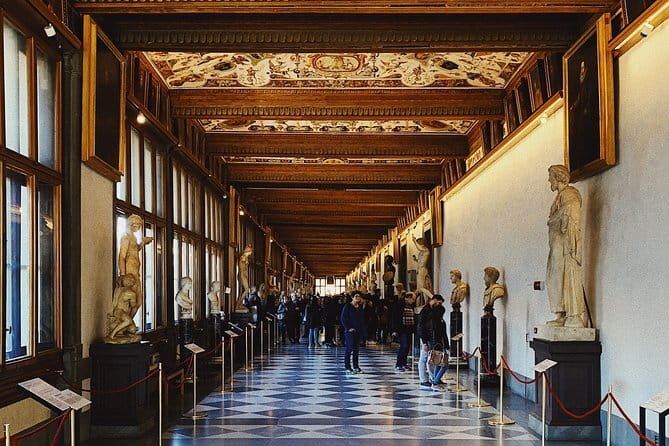
After the Accademia, you walk toward the Uffizi and stop for an outdoor explanation of the Duomo complex. This includes Santa Maria del Fiore, the cathedral, and the Baptistery.
No admission to the cathedral complex is included in this tour. That distinction matters because you should not expect to enter the cathedral, climb the dome, or visit the Baptistery as part of the afternoon. You get an outside explanation while moving through central Florence.
For a short tour, this is a sensible use of time. The cathedral is one of the city’s defining sights, and a guide can point out how its parts fit together before you return to the museum route. You also get a change of setting after the Accademia’s indoor galleries.
The outdoor section lasts about 25 minutes. Florence’s center is easy to reach by public transportation, and the meeting point is near transit, but you should still allow time to find Via Ricasoli. The tour begins at a fixed time, so arriving early is wiser than trying to locate the group at the last minute.
More ways into the Uffizi:
- Florence: Skip-The-Line Uffizi Gallery Timed Entry Ticket
★ 4.5 · 27,832 reviews - Florence: Uffizi Priority Ticket & Masterpieces Audio App
★ 4.2 · 6,402 reviews - Florence: Skip-the-Line Uffizi Small Group Tour
★ 4.6 · 5,926 reviews - Uffizi Gallery Small Group Tour with Guide
★ 4.5 · 4,923 reviews
Piazza della Signoria and Palazzo Vecchio
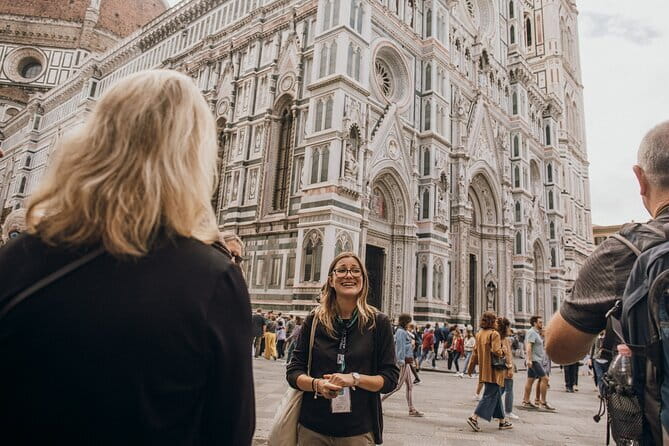
The next stop is Piazza della Signoria, described during another roughly 25-minute section before entering the Uffizi. This square works as an open-air museum, with sculpture and architecture placed directly in the public space.
The guide also explains Palazzo Vecchio, Florence’s historic town hall. Even if you are not entering the palace, the short talk helps you read the square as more than a photo stop. Political power, public art, and the Medici story meet here.
A short break follows before the Uffizi visit. That pause is welcome. The tour asks you to absorb a lot of information in a small space of time, and a few minutes to reset can make the final museum section easier to enjoy.
Again, the outdoor explanation is not an admission visit. The package includes the Accademia and Uffizi tickets, but not entry to the Duomo complex or Palazzo Vecchio. If you want to see those interiors, plan separate visits.
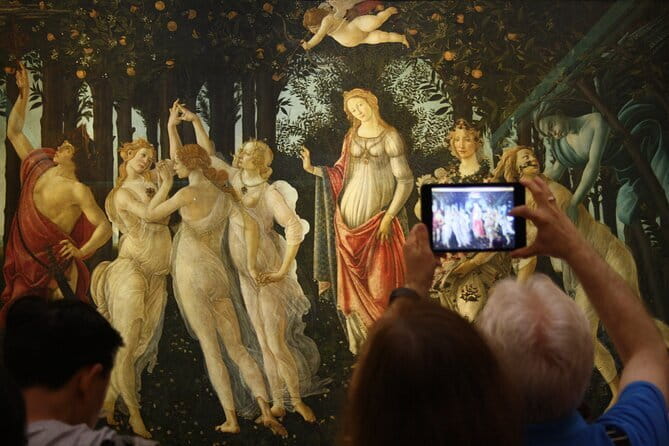
Botticelli’s Primavera at the Uffizi
The Uffizi section begins with Botticelli’s Primavera, one of the museum’s best-known paintings. The allotted time is about 20 minutes.
This is a good choice for a guided start because Primavera can seem mysterious at first glance. The figures, gestures, flowers, and mythological references reward a little explanation. A guide can help you notice the arrangement of the people and the painting’s graceful, decorative surface rather than reducing it to a single name.
I like that the tour does not simply march you through the museum room by room. It chooses a handful of works and gives each one a clear place in the story of Renaissance Florence. That approach suits anyone who wants an introduction without trying to absorb the entire Uffizi in one sitting.
You should not expect a full survey of Botticelli or the Uffizi here. Twenty minutes is a focused look at one work, with time for context and questions, not an art-history seminar.
Botticelli’s Birth of Venus
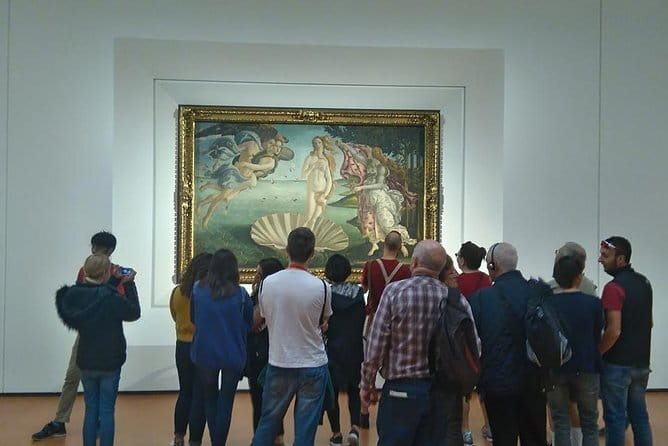
The Uffizi visit continues with Botticelli’s Birth of Venus, another 20-minute stop. Along with Primavera, it gives you two chances to see how Botticelli’s elegant figures, flowing lines, and idealized beauty shaped popular ideas about the Renaissance.
The painting is famous, but the guide can make the visit more useful by pointing out details that are easy to miss when the room is busy. Look closely at the posture of Venus, the movement of the figures around her, and the unusual balance between myth, beauty, and symbolism.
If you are traveling with older children or young teens, this part of the tour can work well. The images are immediately engaging, and the explanations give structure to what might otherwise become a quick photograph and exit. One strong feature of the experience is its educational tone, especially for people who want to learn how to look at art rather than collect famous titles.
Two Botticelli paintings in a row also create a small risk of repetition. The benefit is depth and comparison. The drawback is that anyone hoping for a broad list of artists may prefer less time on Botticelli and more time elsewhere in the Uffizi.
Leonardo’s Annunciation
Leonardo da Vinci’s Annunciation receives its own 20-minute stop. This early work lets you see Leonardo before the mature paintings that dominate his reputation.
The painting is useful for studying composition, delicate detail, and the handling of space. A guide can draw your attention to the arrangement of the figures and the care given to the surrounding setting. It also provides a bridge between the decorative elegance of Botticelli and Leonardo’s more observational approach.
This is where explanation adds real value. You may recognize Leonardo’s name, but his early work benefits from context. The point is not only to admire a famous artist, but to see how Renaissance painters built believable space, human expression, and visual balance.
The tour’s format makes this manageable. You get a clear introduction, time to look, and then move on before the museum begins to feel like an endurance test. If Leonardo is your main reason for visiting the Uffizi, you may want to continue independently after the guided portion.
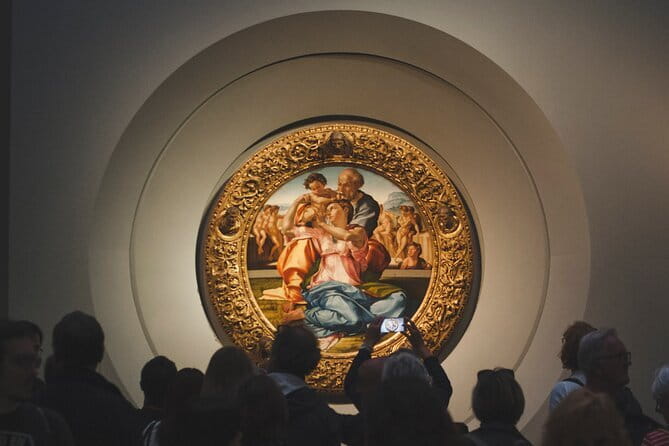
Michelangelo’s Tondo Doni
The final featured artwork is Michelangelo’s Tondo Doni, a circular panel showing the Holy Family. It offers a useful contrast with David, because you see Michelangelo working in painting rather than sculpture.
The circular format gives the composition energy. The figures are tightly connected, and the strong physical presence recalls the force of Michelangelo’s sculptures. This is an excellent closing work because it brings the afternoon back to the artist introduced at the Accademia.
The scheduled time is about 20 minutes. That is enough to explain the work’s place in the Renaissance and to point out its unusual qualities, but you will not receive a full tour of Michelangelo’s paintings or the Uffizi’s other major rooms.
Once this explanation ends, the tour finishes inside the Uffizi. You can continue exploring the collection at your own pace, which is a major practical advantage. You do not need to leave immediately just because the guided portion is over.
What the $119.30 price buys you
At $119.30 per person, this is not a cheap museum ticket. The value depends on how much you want the guide’s structure and the time saved at the two major galleries.
You are paying for admission to both the Accademia and Uffizi, a small group capped at nine, priority access intended to avoid long waits, and about three hours of guided interpretation. You also get the outdoor connection between the museums, including the Duomo and Piazza della Signoria.
For a first visit, that can be a fair trade. The two museums are easy to underestimate. Without a plan, you could spend hours moving through rooms without knowing which works deserve your attention. This tour selects eight major points and gives you a route through the city as well.
The value drops if you already know these collections well or prefer to explore alone. The schedule is fixed, and the visit concentrates on selected masterpieces rather than giving you freedom to linger. You may still want a separate visit for the rest of either museum.
The tour is often booked far ahead, with an average booking time of about 250 days in advance. That suggests you should not leave it until the last minute if the date and afternoon start are important to you.
Pace, group size, and practical details
The tour starts at 2:00 p.m. and lasts about three hours. It begins at Via Ricasoli, 113, near the Accademia, and ends at the Uffizi Galleries on Piazzale degli Uffizi, 6.
A mobile ticket is provided. The group maximum is nine people, and most people can take part. Service animals are allowed, and the meeting area is near public transportation.
Because the tour includes walking between indoor visits, wear comfortable shoes and keep your plan for the evening flexible. The tour does not include admission to the Duomo complex or Palazzo Vecchio. It also does not promise a full independent visit to every Uffizi room, although you may continue inside after the guide finishes.
The free cancellation rule allows a full refund when you cancel at least 24 hours before the start time. Changes or cancellations inside that 24-hour window are not accepted for a refund.
One important caution concerns rare museum disruptions. An unexpected Uffizi staff strike once caused a cancellation, and the provider said a refund had been issued but faced technical delay. That situation was outside the guide’s control, but it shows why you should keep your confirmation details and allow time for refund communication if a museum closure affects your booking.
Who should book Artful Eight
I would recommend this tour to a first-time Florence visitor who wants the essential Renaissance works explained in plain language. It is also a good fit for couples, families with older children or young teens, and anyone with only one afternoon for major art.
You will get the most from it if you like having a guide point out details, explain artistic styles, and keep the route moving. The small group should make the experience more personal than a large coach-style tour, and the end inside the Uffizi lets you add your own time afterward.
I would choose another plan if you want to spend half a day at one museum, sketch in front of a single work, or explore rooms that are not on the main route. The eight featured works are carefully chosen, but the schedule is built around highlights.
The strongest praise for this experience centers on the guide’s clear explanations and educational value. That is exactly where the tour earns its price. The main complaint concerns a cancellation caused by a Uffizi strike, not the art program itself, but it is still worth keeping in mind when planning a tightly scheduled trip.
Should you book it?
Book Artful Eight if you want a focused introduction to Florence’s greatest Renaissance works and prefer a guide to make the art easier to understand. The combination of David, Botticelli, Leonardo, and Michelangelo gives you a strong first look at the city’s central artistic story.
Skip it if you want a slow museum day or already have a detailed plan for both galleries. At three hours, this is a smart overview, not a complete visit. For most first-time visitors with limited time, the small group, priority access, outdoor walking route, and finish inside the Uffizi make it a practical choice.
FAQ
How long does the Artful Eight tour last?
The tour lasts approximately three hours. The schedule includes the Accademia, the walk past the Duomo and Piazza della Signoria, and the guided portion of the Uffizi.
What time does the tour begin?
The tour begins at 2:00 p.m.
Where does the tour start?
The meeting point is Via Ricasoli, 113, 50121 Florence, near the Accademia Gallery.
Where does the tour finish?
The tour ends inside the Uffizi Galleries at Piazzale degli Uffizi, 6. You may continue exploring the Uffizi collection independently afterward.
Are admissions to the Duomo and Palazzo Vecchio included?
No. The tour provides outside explanations of the Duomo complex and Piazza della Signoria, but admission tickets for those sites are not included.
What is the cancellation policy?
You can cancel for a full refund up to 24 hours before the experience begins. Cancellations or changes made less than 24 hours before the start time are not accepted for a refund.
Recently added around Florence
- Accademia and Uffizi Small-group Guided Tour★ 4.5 · 8 reviews
- The David from Michelangelo.★ 5.0 · 3 reviews
- Combo: Accademia + walking + Uffizi Galleries Guided Tour★ 3.5 · 6 reviews
- The Complete Wine Tour Brunello, Nobile, Chianti wine experience★ 4.0 · 7 reviews
- The Best of Tuscany in 3 Days★ 4.5 · 13 reviews
- The Cooking Lab – Authentic Food Experience★ 5.0 · 113 reviews
- Florence Central Market Food Tour – Private Tour★ 4.0 · 7 reviews
- Family Friendly Florence Private City Tour★ 5.0 · 47 reviews
Uffizi Gallery Tours, compared.
Skip-The-Line Uffizi Gallery Timed Entry Ticket
Read our review →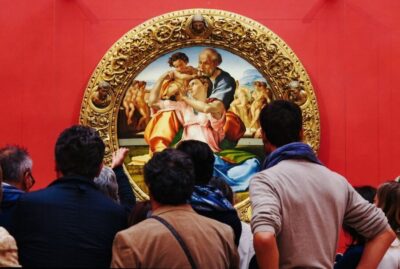
Uffizi Priority Ticket & Masterpieces Audio App
Read our review →
Skip the line: Uffizi and Accademia Small Group Walking Tour
Read our review →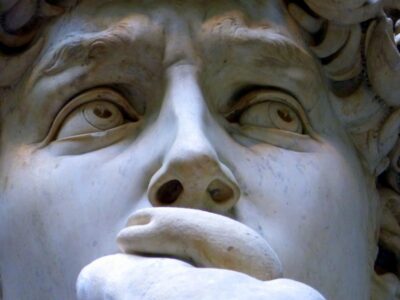
Uffizi Gallery and Accademia Gallery Guided Tour
Read our review →
Uffizi Gallery Small-Group Guided Tour with Ticket
Read our review →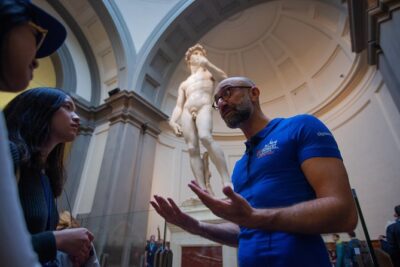
Michelangelo’s David, Accademia & Uffizi Small Group Tour
Read our review →Browse the lists this tour appears in