
Reviewed · ACCADEMIA GALLERY AND DAVID TOURS
Florence City Center w/ Accademia & David Semi-Private 8ppl Max
Michelangelo’s David is the star here, but the smart part of this tour is what comes after the museum. You move through Florence’s main streets and squares, linking the statue to the Duomo, Medici power, city politics, and the Arno in one compact walk.
I like the small-group format, which gives you a better chance to ask questions than a large city tour. I also like the route’s finish at Ponte Vecchio, after the Accademia, Piazza della Signoria, and the cathedral district have given you a strong first look at Florence. The main thing to consider is pace: two and a half hours is short for this many sights, and most landmarks are viewed from outside.
Key points at a glance
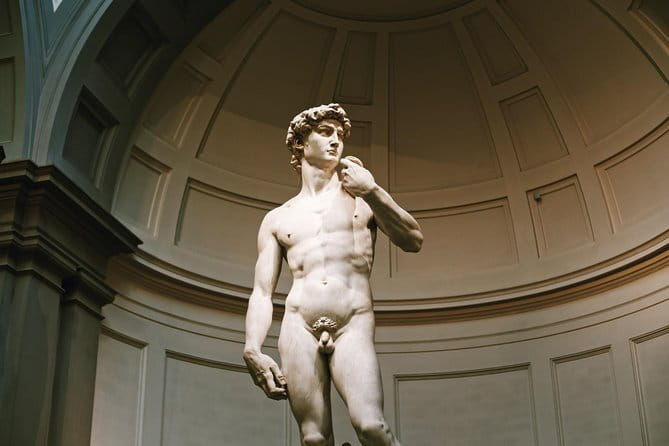
- Michelangelo’s David: Spend about an hour inside the Accademia, with entry included.
- Small group: The tour is limited to a maximum of eight people, with the included description also referring to groups of no more than seven.
- Florence’s central story: Connect the Duomo, Medici power, Renaissance art, and civic politics on foot.
- Exterior-focused route: The cathedral, Baptistery, Palazzo Vecchio, and Ponte Vecchio are seen from outside.
- Useful local guidance: Guide Jack has been praised for explaining art, architecture, and politics clearly, and for suggesting places to eat local food.
- Practical finish: The walk ends at Ponte Vecchio, not back at your hotel or the Accademia.
David first, then Florence on foot
Starting at the Galleria dell’Accademia makes good sense. You see Florence’s most famous artwork near the beginning, while your attention is fresh, then spend the rest of the tour understanding the city around it.
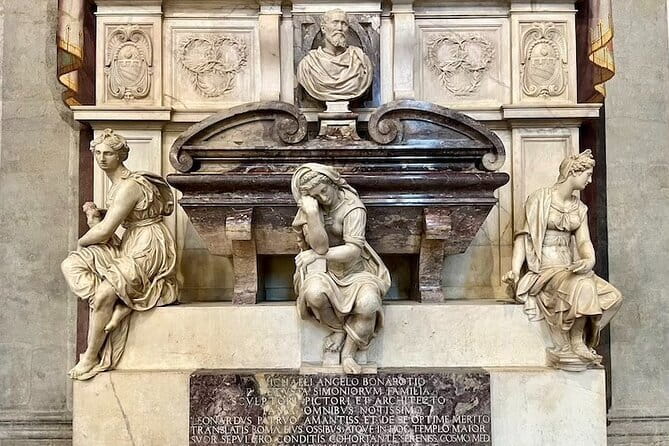
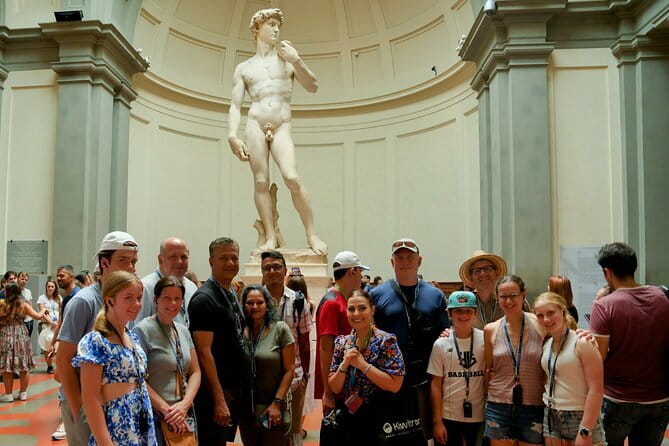
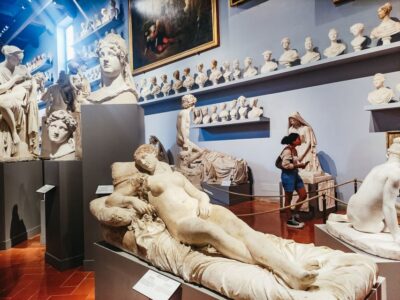
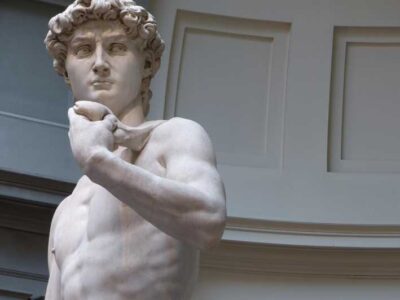
The Accademia visit lasts about one hour. Your guide focuses on Michelangelo’s David and other sixteenth-century works in the museum. David is not just a large marble nude to admire and photograph. The guide can explain Michelangelo’s artistic choices, the statue’s original public purpose, and how the work became tied to Florence’s identity.
The small group matters most inside the museum. A guide can speak to a handful of people more easily than to a crowd, and you have a better chance of asking about details you might otherwise miss. Some rooms require quiet or limit speaking, so your guide may give explanations before entering those spaces.
Entry to the Accademia is included, but museum access still comes with practical limits. Large bags and suitcases are not allowed. Bring only a handbag or small, thin backpack, and expect security checks. Temporary exhibitions are not included, and museum collections can change during the year.
More ways to see the David at the Accademia:
- Florence: Timed Entrance Ticket to Michelangelo’s David
★ 4.6 · 16,983 reviews - Florence: Michelangelo’s David Skip-the-Line Entry Ticket
★ 4.5 · 12,764 reviews - Florence Accademia Gallery Tour with Entrance Ticket Included
★ 4.5 · 6,148 reviews
Piazza del Duomo and Brunelleschi’s great roof
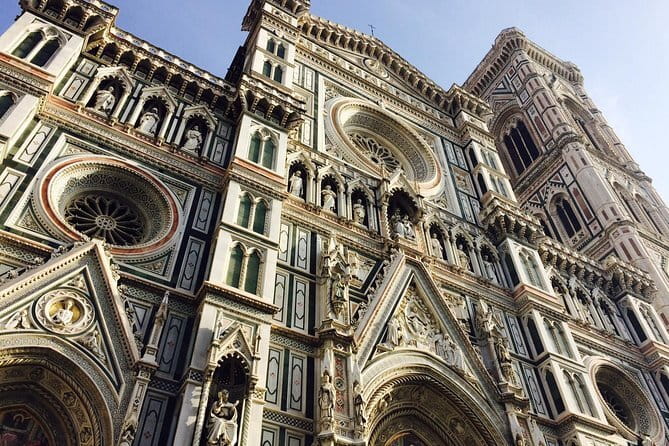
From the Accademia, the route continues toward Piazza del Duomo, one of Florence’s most famous public spaces. This is where the scale of the city’s cathedral complex hits you: the Cathedral of Santa Maria del Fiore, Brunelleschi’s huge dome, Giotto’s Campanile, and the Baptistery all crowd into one memorable view.
The tour does not take you inside the dome or cathedral. That is an important distinction. You learn how Brunelleschi’s fifteenth-century dome was created and why it mattered, but you do not climb it or enter the church as part of this experience.
For a first visit, an exterior explanation still has real value. The Duomo is difficult to understand as a whole if you simply arrive, look up, and move on. A guide can point out the dome’s place in Florence’s development and explain the role of the cathedral complex without asking you to spend another hour inside.
You have about ten minutes in Piazza del Duomo, followed by around thirty minutes focused on the cathedral and dome. That timing suggests a guided orientation rather than a slow architectural study. If the Duomo interior or dome climb is high on your list, plan those separately.
The Baptistery and its bronze doors
The Baptistery of San Giovanni is one of Florence’s oldest religious buildings and one of the most rewarding sights in the square. Its three sets of bronze doors are central to the story of Renaissance art, especially the celebrated eastern doors often linked with the phrase Gates of Paradise.
You see the Baptistery from outside on this tour. Admission is not included, and the route does not promise entry. Your guide discusses the building and its doors while also pointing out nearby structures, including the Loggia del Bigallo, the Opera del Duomo Museum, and the church authorities’ former palaces.
This is another place where the walk gives you useful orientation rather than a full museum visit. If you want to examine the original artworks connected with the cathedral, the Opera del Duomo Museum requires separate time and admission.
Via dei Calzaiuoli connects the monuments
Via dei Calzaiuoli links Piazza del Duomo with Piazza della Signoria. It is a broad pedestrian street lined with shops, restaurants, and steady foot traffic. The walk takes about ten minutes, so you are not stopping at every storefront or turning the tour into a shopping trip.
I like this section because it shows Florence as a working city rather than a collection of isolated monuments. You move from religious power at the Duomo toward civic power at Palazzo Vecchio, following a route that has long connected the city’s major centers.
The street can be busy, so stay close to the guide and watch your footing. Comfortable shoes are essential. This tour covers central Florence on foot, and the route includes streets, squares, and stops where you may spend time standing.
More private tours in Florence:
- Cinque Terre and Pisa Tower Tour from Florence Semi Private
★ 5.0 · 1,406 reviews - From Florence: Private Chianti Hills Tour with Tasting
★ 4.3 · 809 reviews - Private Self-Guided E-Bike Ride in Tuscany with Vineyard Visit
★ 5.0 · 775 reviews - Florence Private Transportation in Rickshaw
★ 5.0 · 730 reviews
Piazza della Repubblica and the changing city
Piazza della Repubblica offers a different kind of history. Unlike the medieval-looking lanes nearby, this broad square was redesigned in the nineteenth century. Its layout reflects a period when Florence was reshaped and modernized.
The stop lasts around ten minutes. You learn how the square changed and how modern Florence was placed over older layers of the city. It is not the most intimate stop on the route, but it helps explain why some parts of central Florence feel very different from the streets around the Duomo and Palazzo Vecchio.
The square is also a natural place to pause and get your bearings. You are still in the heart of the city, but the open space makes the route easier to understand on a map.
Piazza della Signoria and the statue of David
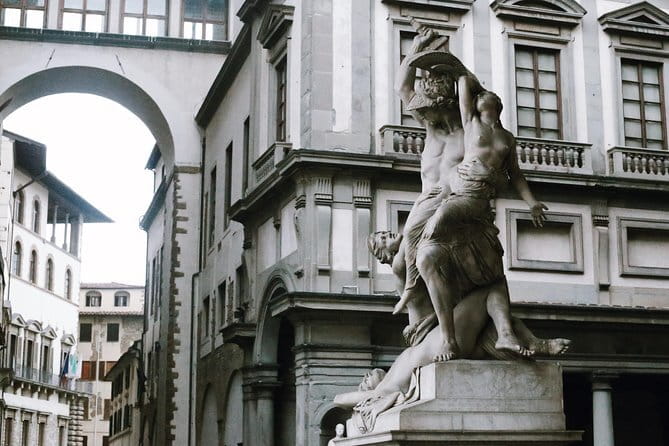
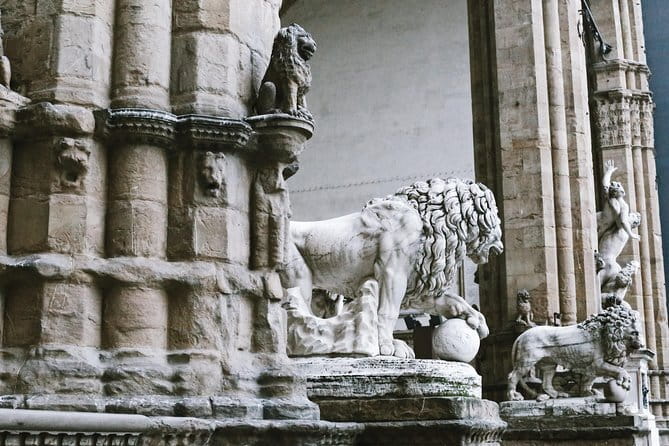
Piazza della Signoria is Florence’s political square, and it is one of the richest stops for outdoor sculpture. You see the Fountain of Neptune by Ammannati, Cellini’s Perseus, and other works displayed around the square.
A replica of David marks the location where Michelangelo’s original once stood. Seeing the copy here, after viewing the real statue at the Accademia, gives you a useful sense of how the sculpture functioned as a public symbol. Inside the museum, David is treated as an artwork. In this square, the replica shows how David also represented Florence’s strength and independence.
The stop takes about ten minutes, which is enough for a guided introduction but not enough for close study of every statue. If you want to linger, take photographs, or inspect the Loggia dei Lanzi, you will need to return later.
Palazzo Vecchio and Florence’s civic power

Palazzo Vecchio dominates Piazza della Signoria. Construction began in 1299 over the remains of destroyed towers, and the building is linked to architect Arnolfo di Cambio. It became the main symbol of Florence’s civil authority.
The tour views the palace from outside. You do not enter the building, so you will not see its grand halls, painted rooms, or tower interior as part of this walk. Still, the exterior explanation helps you read the square as a center of government rather than just a place filled with statues.
This is where the tour’s art and politics come together. Michelangelo’s David, the public fountains, the palace, and the surrounding sculptures all occupied a civic setting. A good guide can show you that Renaissance Florence was shaped by arguments over power as much as by beautiful objects.
Guide Jack has been singled out for explaining architecture, politics, and art in a clear way, with a quick sense of humor. He has also been associated with suggesting places for local food after the museum portion. You cannot count on a particular guide being assigned, but that kind of broad historical approach is exactly what suits this route.
A lucky stop at the Porcellino

Near the end of the walk, you stop at the Fontana del Porcellino, the fountain featuring a wild boar. Touching its nose is said to bring good luck, so this is your chance to take part in one of Florence’s simplest rituals.
The stop lasts about ten minutes. It is lighter in tone than the museum and political squares, and it gives the walk a small, memorable tradition before the final bridge.
The Porcellino area can be crowded. Keep personal belongings secure and do not block the fountain while taking photographs. The tour does not include a formal shopping stop, so treat the nearby market area as part of the city around you rather than a scheduled retail visit.
Ponte Vecchio and the Arno finish
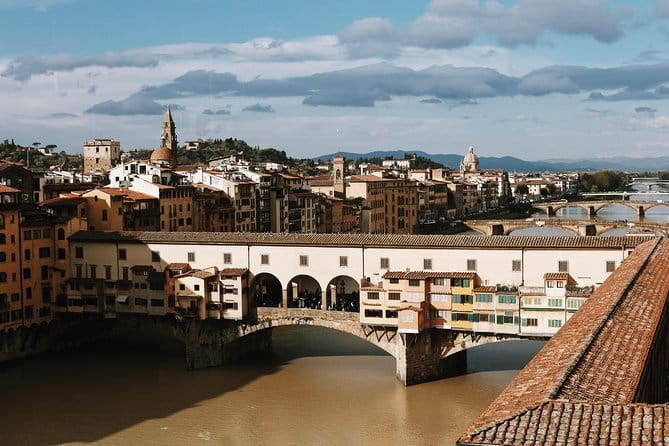
The route ends at Ponte Vecchio, Florence’s best-known bridge. It crosses the Arno and is famous for its shops and distinctive structure. The bridge is also presented as the only Florence bridge to survive the Second World War.
Finishing here is practical. Ponte Vecchio is an easy landmark from which to continue exploring, and the Arno gives you a clear sense of the city’s geography. You can walk on toward the Oltrarno district, stop for photographs, or use the bridge as a reference point for the rest of your day.
The experience ends at the bridge, not at your hotel and not back at the Accademia. Hotel pickup and drop-off are not included, so plan your arrival at Via Ricasoli and your onward route from Ponte Vecchio. Taxi or Uber is suggested for hotel connections, though the meeting point is near public transportation.
What the $159.03 price really covers
At $159.03 per person, this is not a cheap orientation walk. The value rests mainly in the included Accademia admission, the guide, and the small group.
Accademia tickets can be difficult to arrange at popular times, and having entry built into a guided visit removes one planning task. You are also paying for an organized route through several major parts of central Florence, rather than booking a museum visit and then finding your own way between the sights.
The price is easier to justify if David is a priority and you want context from a guide. It is harder to justify if you mainly want to photograph the exterior of the Duomo and Ponte Vecchio, since those sights are free to see on your own.
The description gives two group limits: a maximum of eight people overall, and a semi-private format with no more than seven guests. Since those figures do not match perfectly, confirm the exact group size when booking if that detail matters to you. Either limit is far smaller than a standard large-group city walk.
Gratuities are not included. There is also no hotel transfer, no temporary exhibition access, and no admission to the Duomo or Baptistery interiors.
Timing, clothing, and access
The tour lasts about two and a half hours, though the listed stops add up to a busy schedule. You should expect short explanations at many outdoor landmarks, not extended time at each one.
The route is not suitable for people with walking disabilities or those using a wheelchair. A moderate level of physical fitness is recommended. Wear shoes you can walk in comfortably, carry water, and bring a hat in summer or an umbrella when rain is possible.
The tour operates in all weather. National celebrations may alter the route, but the stated goal is still to cover the main highlights. Museum closures can also happen without warning. If the Accademia opening is delayed by more than an hour, an alternative is offered, but refunds or discounts are not promised in that situation.
Provide a mobile phone number with the country code when booking. You receive confirmation at booking, and free cancellation is available up to 24 hours before the start time. Changes or cancellations inside that window are not accepted for a refund.
Who should book this Florence walk?
I would choose this experience for a first visit to Florence, especially if you want to see David but also need help making sense of the city center. It suits couples, families with older children, and small groups who value a guide’s explanation more than free time inside each site.
It is also a good fit if you want a short first-day introduction. You finish near Ponte Vecchio, so you can continue on your own after the tour instead of losing a full day to a fixed schedule.
I would hesitate if you want to enter the Duomo, climb the dome, visit Palazzo Vecchio, or spend hours studying Renaissance art. Those activities are not part of this route. I would also think twice if walking for two and a half hours in changing weather will be difficult.
Should you book it?
Book it if Michelangelo’s David is essential and you want one guide to connect the Accademia with Florence’s cathedral, political square, markets, and river. The limited group size, included museum entry, and strong guide style associated with Jack make the cost easier to understand.
Skip it if you prefer to explore at your own speed or want interior visits beyond the Accademia. The tour gives you a well-planned outside view of Florence’s main sights, but it is an introduction, not a complete museum and monument program.
FAQ
How long does the Florence tour last?
The tour lasts approximately two hours and thirty minutes.
Where does the tour begin?
It begins at the Galleria dell’Accademia di Firenze, Via Ricasoli 58/60, Florence.
Where does the tour end?
It ends at Ponte Vecchio.
Is admission to the Accademia included?
Yes. Admission to the Galleria dell’Accademia is included.
Will I go inside the Duomo or climb the dome?
No. The tour explains the cathedral and Brunelleschi’s dome from outside. Entry to the dome is not included.
What is the maximum group size?
The experience allows a maximum of eight people. Its semi-private description also says the group is never more than seven guests, so confirm the exact limit when booking if needed.
Can I bring a large bag or suitcase?
No. Large bags and suitcases are not allowed. Only handbags or small, thin backpacks are permitted inside the museum.
Recently added around Florence
- Accademia and Uffizi Small-group Guided Tour★ 4.5 · 8 reviews
- The David from Michelangelo.★ 5.0 · 3 reviews
- Combo: Accademia + walking + Uffizi Galleries Guided Tour★ 3.5 · 6 reviews
- The Complete Wine Tour Brunello, Nobile, Chianti wine experience★ 4.0 · 7 reviews
- The Best of Tuscany in 3 Days★ 4.5 · 13 reviews
- The Cooking Lab – Authentic Food Experience★ 5.0 · 113 reviews
- Florence Central Market Food Tour – Private Tour★ 4.0 · 7 reviews
- Family Friendly Florence Private City Tour★ 5.0 · 47 reviews
Accademia Gallery and David Tours, compared.
Timed Entrance Ticket to Michelangelo’s David
Read our review →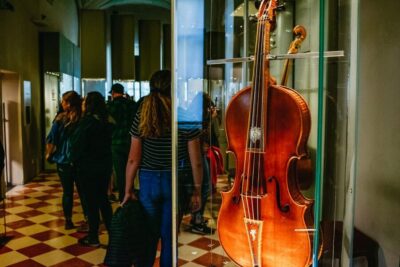
Michelangelo’s David Skip-the-Line Entry Ticket
Read our review →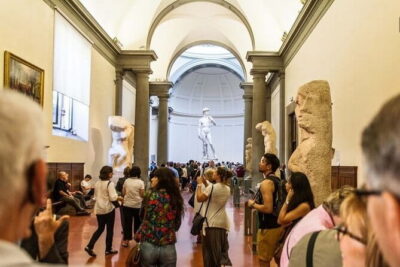
Florence Accademia Gallery Tour with Entrance Ticket Included
Read our review →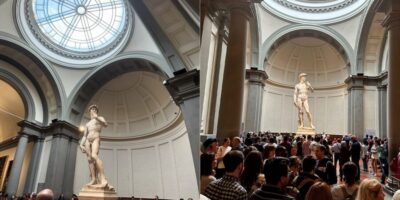
Timed Entry Ticket to Michelangelo’s David & eBook
Read our review →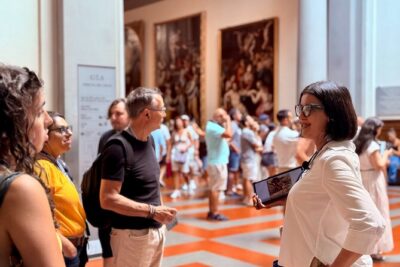
Skip the line: Uffizi and Accademia Small Group Walking Tour
Read our review →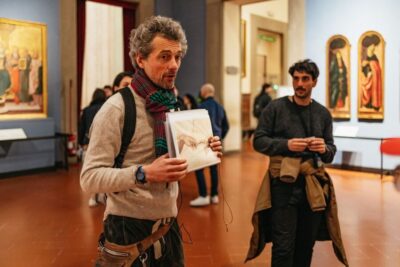
Accademia Gallery Guided Tour with Entry Ticket
Read our review →Browse the lists this tour appears in